

From Loss to Transformation: Exploring Knowledge Management Pathways for University Library Lectures Driven by SECI and Empowered by AI
Abstract
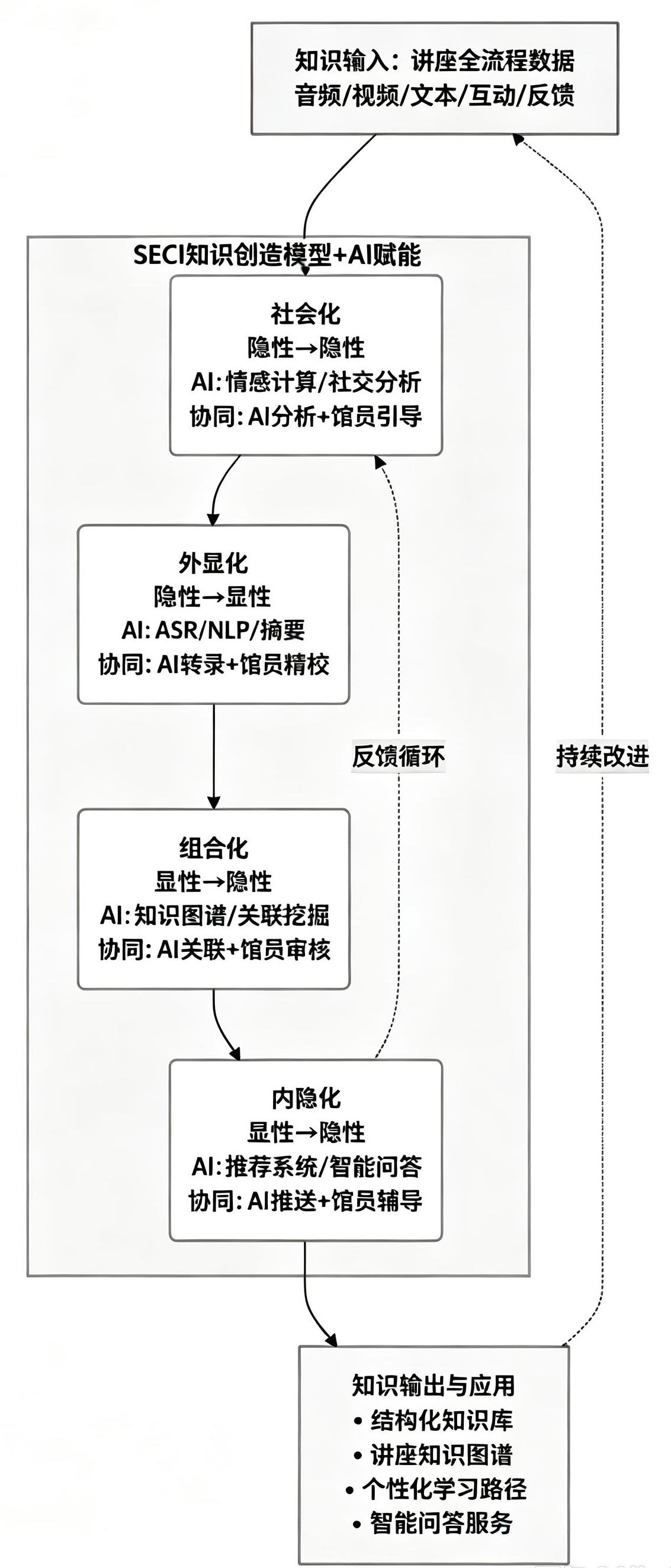
[Purpose/Significance] University library lectures generate rich knowledge resources, including oral presentations, interactive Q&A sessions, and reader feedback, which contain substantial tacit knowledge. However, due to the lack of effective capture and transformation mechanisms, this knowledge tends to dissipate upon the conclusion of each lecture, rendering these events as "one-off" occurrences rather than sustainable assets. To address this practical challenge, this paper aims to explore a knowledge management pathway for university library lectures driven by the SECI knowledge creation spiral and empowered by AI technologies, with the goal of enhancing the academic support and knowledge service capabilities of university libraries. [Method/Process] This study first reviews the current research on zero-information capture, the SECI knowledge creation model, and AI-empowered technologies, identifying research gaps and opportunities for theoretical integration in developing a comprehensive framework for lecture knowledge management. Drawing upon the SECI spiral as the core theoretical framework and AI technologies as enabling tools, the study constructs a full-lifecycle management pathway covering lecture knowledge from generation, capture, transformation, integration, to application. A simulated case study is then conducted based on a university library lecture themed "Information and Human Civilization," in which AI applications are examined stage by stage across the SECI phases to demonstrate their feasibility in facilitating tacit knowledge elicitation, knowledge externalization, cross-document knowledge fusion, and personalized knowledge internalization. [Result/Conclusion] The findings indicate that the SECI-driven and AI-empowered knowledge management pathway effectively converts lecture knowledge—which is prone to loss, difficult to associate, and lacks closed-loop management under traditional approaches—into sustainable, dynamically interconnected knowledge assets.
Key words
knowledge loss / zero-order information / academic libraries / lecture services / SECI-driven / AI empowerment
{{custom_sec.title}}
{{custom_sec.title}}
References
| [1] |
张欣毅.回眸一个科学本体论的进化史——基于公共信息资源及其认知机制的本体论观照[J].图书馆,2005(1):31-35.
|
| [2] |
野中郁次郎,竹内弘高.创造知识的企业:日美企业持续创新的动力[M].李萌,高飞,译.北京:知识产权出版社,2006.
|
| [3] |
|
| [4] |
王庆雯.基于SECI知识创新模型的图书馆信息服务[J].技术与创新管理,2008(6):613-615.
|
| [5] |
张会平,周宁.基于可视化技术的知识转化模型[J].情报理论与实践,2009(5):5-8.
|
| [6] |
朱洪瑞.基于SECI模型的图书馆知识共享研究[J].农业网络信息,2011(3):40-42.
|
| [7] |
刘青,李瑾.基于SECI知识创造螺旋的高校图书馆学科服务能力建设研究[J].图书馆,2017(4):58-64.
|
| [8] |
何慧敏.基于SECI模型的公共图书馆读者活动中知识创造螺旋研究[J].新世纪图书馆,2021(7):5-11.
|
| [9] |
|
| [10] |
周忠义.近年来我国零次情报研究的进展[J].情报学报,1989(8):317-320.
|
| [11] |
张晓林.走向知识服务:寻找新世纪图书情报工作的生长点[J].中国图书馆学报,2000(5):32-37.
|
| [12] |
洪丽.零次信息价值理论[C]//中国图书馆学会.首届全国图书馆馆藏建设报告会论文集.北京:中国图书馆学会,2005:67-82.
|
| [13] |
洪丽.零次信息价值及其价值理论探索[J].中国图书馆学报,2006(1):94-96.
|
| [14] |
黄荣东,李臻.图书馆讲座的零次信息属性与开发利用[J].现代情报,2009(29):191-194.
|
| [15] |
|
| [16] |
杨峰,张雪蕾,王懿松,等.人工智能驱动下的图书馆知识服务创新探索与实践[J].图书馆杂志,2025,44(6):63-73.
|
| [17] |
|
| [18] |
|
| [19] |
柯平. 信息管理概论[M].2版.北京:科学出版社,2011:204-205.
|
| [20] |
|
| [21] |
刘彬,米东,杜晓明,等.仿真系统概念模型验证方法的分析与选择[J].计算机仿真,2012,29(5):111-113.
|
| [22] |
饶权.全国智慧图书馆体系:开启图书馆智慧化转型新篇章[J].中国图书馆学报,2021,47(1)4-14.
|
Funding






/
| 〈 |
|
〉 |