
From “Human-Human” to “Human-AI-Human”: A Study on the Process Mechanisms and Reconstruction of Dual Roles in AI-Mediated Knowledge Transfer

Li Xuguang, Qin Xuchen, Liu Xinping, Yang Rui

Knowledge Management Forum ›› 2026, Vol. 11 ›› Issue (5) : 0.

Knowledge Management Forum ›› 2026, Vol. 11 ›› Issue (5) : 0. DOI: 10.13266/j.issn.2095-5472.2026.036  CSTR: 32306.14.j.issn.2095-5472.2026.036

From “Human-Human” to “Human-AI-Human”: A Study on the Process Mechanisms and Reconstruction of Dual Roles in AI-Mediated Knowledge Transfer

Author information +
History +

Abstract

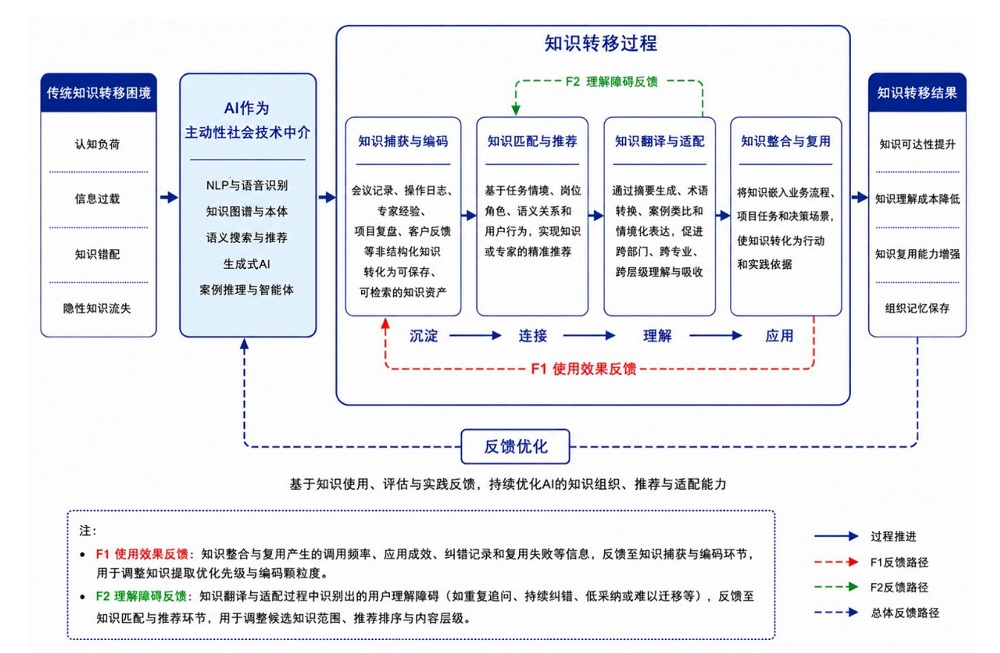
[Purpose/Significance] As artificial intelligence (AI) becomes increasingly embedded in organizational workflows, knowledge transfer is shifting from traditional human-to-human interaction toward a hybrid collaborative process of "human-AI-human." Conventional human-centric knowledge transfer models are often constrained by factors such as cognitive load, information overload, insufficient sharing motivation, and tacit knowledge loss, making it difficult to adequately support the preservation of organizational knowledge assets, the continuity of organizational memory, and process innovation. Therefore, this study constructs a theoretical framework for AI-mediated knowledge transfer from the perspective of knowledge management, explaining how AI, as a proactive sociotechnical intermediary, restructures the organizational processes of knowledge capture, sharing, comprehension, and reuse. [Method/Process] Employing a literature review and theoretical integration approach, and grounded in sociotechnical systems theory, the SECI model of knowledge creation, and the ability-motivation-opportunity (AMO) framework, this study systematically examined the process pathways, role reconfiguration, and operational boundaries of AI intervention in knowledge transfer. [Results/Conclusion] The findings indicate that AI primarily enhances knowledge accessibility, comprehensibility, and reusability through four key processes: knowledge capture and codification, matching and recommendation, translation and adaptation, and integration and reuse. Concurrently, it drives knowledge workers to assume two complementary functional roles: AI orchestration and knowledge stewardship. Building upon this, the study further proposes a dual-role reconfiguration model and, from a knowledge management perspective, reveals the sociotechnical restructuring logic underlying AI intervention in knowledge transfer, thereby offering theoretical guidance for organizations to construct human-AI collaborative knowledge management systems, preserve organizational memory, and foster continuous process innovation.
Key words

artificial intelligence / knowledge management / knowledge transfer / tacit knowledge / Human-AI collaboration / SECI model

Cite this article

Download Citations
Li Xuguang , Qin Xuchen , Liu Xinping , et al. From “Human-Human” to “Human-AI-Human”: A Study on the Process Mechanisms and Reconstruction of Dual Roles in AI-Mediated Knowledge Transfer[J]. Knowledge Management Forum. 2026, 11(5): 0 https://doi.org/10.13266/j.issn.2095-5472.2026.036

References

[1]
Standaert T, Andries P. Overcoming difficulties in knowledge transfer:harnessing the power of AI to drive process innovation[J]. Technovation,2026,149:103350.
[2]
Sundaresan S, Zhang Z. AI-enabled knowledge sharing and learning:redesigning roles and processes[J]. International journal of organizational analysis,2022,30(4):983-999.
[3]
Elfving S, Funk P. Enabling knowledge transfer in product development and production:methods and techniques from artificial intelligence[C]//Proceedings of the 1st Nordic conference on product lifecycle management,NordPLM’ 06. Gothenburg:Chalmers University of Technology,2006.
[4]
Falckenthal B, Au-Yong-Oliveira M, Figueiredo C. Intergenerational tacit knowledge transfer:leveraging AI[J]. Societies,2025,15(8):213.
[5]
Mageed I A. Entropic artificial intelligence and knowledge transfer[J]. Advances in Machine Learning & Artificial Intelligence,2024,5(2):1-8.
[6]
Jarrahi M H, Askay D, Eshraghi A,et al. Artificial intelligence and knowledge management:a partnership between human and AI[J]. Business Horizons,2023,66(1):87-99.
[7]
Nonaka I, Takeuchi H. The knowledge-creating company:how Japanese companies create the dynamics of innovation[M]. New York:Oxford University Press,1995.
[8]
Bostrom R P, Heinen J S. MIS problems and failures:a socio-technical perspective,part I:the causes[J]. MIS Quarterly,1977,1(3):17-32.
[9]
Appelbaum E, Bailey T, Berg P,et al. Manufacturing advantage:why high-performance work systems pay off[M]. Ithaca:Cornell University press,2000.
[10]
Szulanski G. Exploring internal stickiness:impediments to the transfer of best practice within the firm[J]. Strategic Management Journal,1996,17(S2):27-43.
[11]
Cohen W M, Levinthal D A. Absorptive capacity:a new perspective on learning and innovation[J]. Administrative Science Quarterly,1990,35(1):128-152.
[12]
Argote L, Ingram P. Knowledge transfer:a basis for competitive advantage in firms[J]. Organizational Behavior and Human Decision Processes,2000,82(1):150-169.
[13]
马庆国,徐青,廖振鹏,等. 知识转移的影响因素分析[J]. 北京理工大学学报(社会科学版),2006,8(1):40-43.
Ma Qingguo, Xu Qing, Liao Zhenpeng,et al. An analysis on the key factors of knowledge transfer[J]. Journal of Beijing Institute of Technology(social sciences edition),2006,8(1):40-43.
[14]
曹兴,郭然. 知识转移影响因素研究及其展望[J]. 中南大学学报(社会科学版),2008,14(2):230-236.
Cao Xing, Guo Ran. Research on the influencing factors of knowledge transfer and prospects[J]. Journal of Central South University(social science),2008,14(2):230-236.
[15]
汪长玉,左美云. 年长员工代际知识转移意愿研究:人生意义与人生发展阶段的影响[J]. 商业经济与管理,2017(9):24-33.
Wang Changyu, Zuo Meiyun. A study on senior employees’ intergenerational knowledge transfer intention:the roles of meaning in life and developmental stage in life[J]. Journal of Business Economics,2017(9):24-33.
[16]
王世泽,林春培,黄丹凤. 社会技术系统视角下人工智能应用赋能企业突破性创新的组态研究——基于机器学习方法的探索[J]. 科技进步与对策,2026,43(8):13-25.
Wang Shize, Lin Chunpei, Huang Danfeng. A configuration study on how artificial intelligence applications empower breakthrough innovation in enterprises from a Socio-Technical systems perspective:an exploration based on machine learning methods[J]. Science & Technology Progress and Policy,2026,43(8):13-25.
[17]
张宇,王玉梁. 大模型在知识管理中的应用与挑战[J]. 知识管理论坛,2024,9(3):227-236.
Zhang Yu, Wang Yuliang. Applications and challenges of large models in knowledge management[J]. Knowledge Management Forum,2024,9(3):227-236.
[18]
欧阳智,魏琴,肖旭. 人工智能环境下的知识管理:变革发展与系统框架[J]. 图书与情报,2017,37(6):104-111.
Ouyang Zhi, Wei Qin, Xiao Xu. Knowledge management under artificial intelligence in organizations:change and system framework[J]. Library & Information,2017,37(6):104-111.
[19]
Leonardi P M. When flexible routines meet flexible technologies:affordance,constraint,and the imbrication of human and material agencies[J]. MIS Quarterly,2011,35(1):147-167.
[20]
Raisch S, Krakowski S. Artificial intelligence and management:the automation-augmentation paradox[J]. Academy of Management Review,2021,46(1):192-210.
[21]
张亚莉,李辽辽,丁振斌. 组织管理中的人工智能决策:述评与展望[J]. 外国经济与管理,2024,46(10):18-38.
Zhang Yali, Li Liaoliao, Ding Zhenbin. AI decision-making in organizational management:a review and prospects[J]. Foreign Economics & Management,2024,46(10):18-38.
[22]
刘广,桑雪淼,方刚. 知识耦合与智能协同联动影响人机协同决策的组态研究[J]. 科技进步与对策,2025,42(20):32-42.
Liu Guang, Sang Xuemiao, Fang Gang. A configurational study on the linkage mechanism of knowledge coupling and intelligent collaboration affecting human-AI collaborative decision-making[J]. Science & Technology Progress and Policy,2025,42(20):32-42.
[23]
徐增林,盛泳潘,贺丽荣,等. 知识图谱技术综述[J]. 电子科技大学学报,2016,45(4):589-606.
Xu Zenglin, Sheng Yongpan, He Lirong,et al. Review on knowledge graph techniques[J]. Journal of University of Electronic Science and Technology of China,2016,45(4):589-606.
[24]
Saad I, Tounkara T. Artificial intelligence-based group decision making to improve knowledge transfer:the case of distance learning in higher education[J/OL]. Journal of Decision Systems,2023:1-16[2026-09-02]. https://doi.org/10.1080/12460125.2022.2161734.
[25]
Igbinovia M O, Ebhonu S I, Enakrire R T,et al. A scoping review of artificial intelligence application for knowledge transfer and retention in medical institutions:implications for medical librarians[J/OL]. Journal of Librarianship and Information Science,2026[2026-06-23]. https://api.semanticscholar.org/CorpusID:287062073.
[26]
张栋豪,刘振宇,郏维强,等. 知识图谱在智能制造领域的研究现状及其应用前景综述[J]. 机械工程学报,2021,57(5):90-113.
Zhang Donghao, Liu Zhenyu, Jia Weiqiang,et al. A review on knowledge graph and its application prospects to intelligent manufacturing[J]. Journal of Mechanical Engineering,2021,57(5):90-113.
[27]
Faraj S, Pachidi S, Sayegh K. Working and organizing in the age of the learning algorithm[J]. Information and Organization,2018,28(1):62-70.
[28]
Kellogg K C, Valentine M A, Christin A. Algorithms at work:the new contested terrain of control[J]. Academy of Management Annals,2020,14(1):366-410.
[29]
Parker S K, Grote G. Automation,algorithms,and beyond:why work design matters more than ever in a digital world[J]. Applied Psychology,2022,71(4):1171-1204.
[30]
Dhanaraj C, Parkhe A. Orchestrating innovation networks[J]. Academy of Management Review,2006,31(3):659-669.
[31]
Weber M, Hein A, Weking J,et al. Orchestration logics for artificial intelligence platforms:from raw data to industry-specific applications[J]. Information Systems Journal,2025,35(3):1015-1043.
[32]
Zhang Xiaowei, Tong Siliang, Luo Xueming,et al. AI orchestrator:how recommendation algorithms shape complementor strategy and market equality[J]. Strategic Management Journal,2026:1-30[2026-06-23]. https://doi.org/10.1002/smj.70073.
[33]
Patel K, Patel B, Patel P,et al. Intelligent libraries:perception and proficiency in artificial intelligence among knowledge custodians[J]. Library Progress International,2024,44(3):13144-13154.
[34]
Lazarova A, Luth E. To mine or not to mine:knowledge custodians managing access to information in the age of AI[J]. Stockholm Intellectual Property Law Review,2024,7(2):45-54.
[35]
刘细文,孙蒙鸽,王茜,等. DIKIW逻辑链下GPT大模型对文献情报工作的潜在影响分析[J]. 图书情报工作,2023,67(21):3-12.
Liu Xiwen, Sun Mengge, Wang Qian,et al. Analysis of the potential impact of GPT large model under DIKIW logic chain on documentation and information services[J]. Library and Information Service,2023,67(21):3-12.
[36]
丁遒劲,苏静. 面向生成式人工智能(AIGC)的图书馆信息资源建设优化策略研究[J]. 图书情报工作,2024,68(18):23-31.
Ding Qiujin, Su Jing. Research on the optimization strategies for library information resources construction oriented to the development of AIGC[J]. Library and Information Service,2024,68(18):23-31.
[37]
储节旺,杜秀秀,李佳轩. 人工智能生成内容对智慧图书馆服务的冲击及应用展望[J]. 情报理论与实践,2023,46(5):6-13.
Chu Jiewang, Du Xiuxiu, Li Jiaxuan. The Impact of artificial intelligence generated content on smart library services and its application prospects[J]. Information Studies:Theory & Application,2023,46(5):6-13.
[38]
马丽娜,冯梦婷. 人机协同视角下知识管理模式创新的组态研究——基于行动者网络理论的多层次分析[J]. 科技进步与对策,2026,43(8):138-149.
Ma Lina, Feng Mengting. A configurational study on the innovation of knowledge management models from the perspective of human-machine collaboration:a multilevel analysis based on actor-network theory[J]. Science & Technology Progress and Policy,2026,43(8):138-149.

Funding

General Program of the National Social Science Fund of China titled “Research on the Mechanism of Two-Way Knowledge Transfer Between Universities and Enterprises and Its Promotion Path of Overall Effect”(24BTQ034)

Accesses

Citation

Detail

Sections
Recommended

/

〈 〉