An Empirical Study of the Association Between Retracted Papers and the Retraction Risk of Citing Publications

Lou Ying, Li Menghui

Knowledge Management Forum ›› 2026, Vol. 11 ›› Issue (4) : 400-412.

PDF(5771 KB)
PDF(5771 KB)
Knowledge Management Forum ›› 2026, Vol. 11 ›› Issue (4) : 400-412. DOI: 10.13266/j.issn.2095-5472.2026.033  CSTR: 32306.14.j.issn.2095-5472.2026.033

An Empirical Study of the Association Between Retracted Papers and the Retraction Risk of Citing Publications

Author information +
History +

Abstract

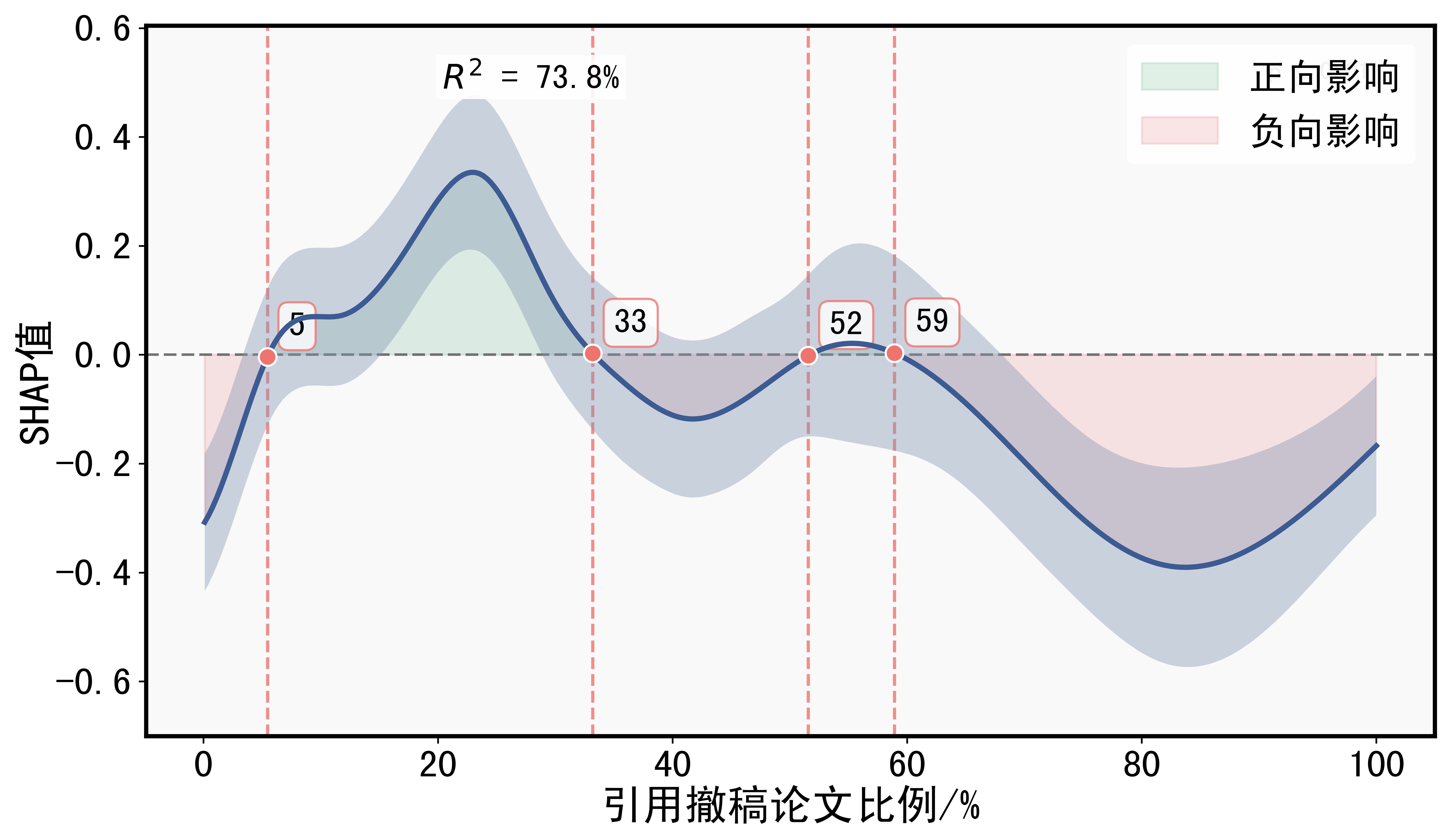
[Purpose/Significance] Retraction is an important self-correction mechanism of the scientific community. However, retraction does not necessarily mean that the affected articles immediately disappear from scientific communication, as they may continue to generate complex citation links. Existing studies have primarily focused on the impacts of retracted papers, while whether citations to retracted papers are statistically associated with the retraction risk of citing papers remains insufficiently investigated. Therefore, this study examines the statistical association between citations to retracted articles and the retraction risk of citing articles from the perspective of citation relationships, providing empirical evidence for retraction risk identification and early warning. [Method/Process] The data were primarily obtained from the Amend retraction database, combined with citing-paper information retrieved from the OpenAlex database. First, the citation characteristics of retracted articles were analyzed in terms of citation breadth, citation depth, and cascade size. Subsequently, an experimental group and a control group were constructed to examine whether papers citing retracted papers had a higher risk of retraction. Furthermore, statistical analysis and machine learning approaches were combined to identify key features associated with this statistical relationship from two dimensions: the intrinsic characteristics of retracted articles and the relational characteristics between retracted and citing articles. [Result/Conclusion] Retracted articles maintain relatively high visibility after retraction and exhibit citation cascade characteristics, including long persistence, deep citation levels, and broad citation scope within citation networks. Comparisons between the experimental and control groups demonstrate a statistical association between citing retracted articles and the retraction risk of citing articles. Further analysis reveals that citing articles of retracted papers involving clinical trials, randomized controlled trials, case studies, and paper mill-related retractions show higher retraction rates. Moreover, the proportion of retracted articles cited by a citing article exhibits a strong statistical association with the retraction rate of citing articles.
Key words

research integrity / retracted papers / citing publications / citation cascades / retraction risk

Cite this article

Download Citations
Lou Ying , Li Menghui. An Empirical Study of the Association Between Retracted Papers and the Retraction Risk of Citing Publications[J]. Knowledge Management Forum. 2026, 11(4): 400-412 https://doi.org/10.13266/j.issn.2095-5472.2026.033

References

[1]
Ajiferuke I, Adekannbi J O. Correction and retraction practices in library and information science journals[J]. Journal of librarianship and information science, 2020, 52(1): 169-183.
[2]
Van Noorden R. More than 10 000 research papers were retracted in 2023 — a new record[J]. Nature, 2023, 624(7992): 479-481.
[3]
Li Menghui, Chen Fuyou, Tong Sichao, et al. Amend: an integrated platform of retracted papers and concerned papers[J]. Journal of data and information science, 2024, 9(2): 41-55.
[4]
Richardson R A, Hong S S, Byrne J A, et al. The entities enabling scientific fraud at scale are large, resilient, and growing rapidly[J]. Proceedings of the National Academy of Sciences, 2025, 122(32): e2420092122.
[5]
Van Noorden R. Science publishing: the trouble with retractions[J]. Nature, 2011, 478(7367): 26-28.
[6]
Zheng Erte, Fu Huizhen, Thelwall M, et al. Do male leading authors retract more articles than female leading authors?[J]. Journal of informetrics, 2025, 19(3): 101682.
[7]
Budd J M, Sievert M, Schultz T R. Phenomena of retraction: reasons for retraction and citations to the publications[J]. JAMA, 1998, 280(3): 296.
[8]
Xin Shuai, Rollins J, Moulinier I, et al. A multidimensional investigation of the effects of publication retraction on scholarly impact[J]. Journal of the Association for Information Science and Technology, 2017, 68(9): 2225-2236.
[9]
van Noorden R. The trouble with retractions: a surge in withdrawn papers is highlighting weaknesses in the system for handling them[J]. Nature, 2011, 478(7367): 26-29.
[10]
Azoulay P, Furman J L, Krieger, et al. Retractions[J]. Review of economics and statistics, 2015, 97(5): 1118-1136.
[11]
Lu S F, Jin G Z, Uzzi B, et al. The retraction penalty: evidence from the Web of science[J]. Scientific reports, 2013, 3(1): 3146.
[12]
Hsiao T K, Schneider J. Continued use of retracted papers: temporal trends in citations and (lack of) awareness of retractions shown in citation contexts in biomedicine[J]. Quantitative science studies, 2021, 2(4): 1144-1169.
[13]
Suelzer E M, Deal J, Hanus K L, et al. Assessment of citations of the retracted article by Wakefield et al with fraudulent claims of an association between vaccination and autism[J]. JAMA network open, 2019, 2(11): e1915552.
[14]
Bar-Ilan J, Halevi G. Post retraction citations in context: a case study[J]. Scientometrics, 2017, 113(1): 547-565.
[15]
Candal-Pedreira C, Ruano-Ravina A, Fernández E, et al. Does retraction after misconduct have an impact on citations? a pre–post study[J]. BMJ global health, 2020, 5(11): e003719.
[16]
刘燊, 徐飞. NSC杂志撤销论文引用异常增加现象辨析与治理建议[J]. 中国科技期刊研究, 2022, 33(5): 545-553.
Liu Shen, Xu Fei. Analysis of the abnormal increase in cited frequency of retracted papers in NSC and suggestions for governance[J]. Chinese journal of scientific and technical periodicals, 2022, 33(5): 545-553.
[17]
文敏. 中文文献数据库中撤销论文的分布规律研究[J]. 中国科技期刊研究, 2016, 27(11): 1151-1155.
Wen Min. Distribution regularities of retracted articles in Chinese document databases[J]. Chinese journal of scientific and technical periodicals, 2016, 27(11): 1151-1155.
[18]
Van Der Vet P E, Nijveen H. Propagation of errors in citation networks: a study involving the entire citation network of a widely cited paper published in, and later retracted from, the journal Nature[J]. Research integrity and peer review, 2016, 1(1): 3.
[19]
Dal-Ré R, Ayuso C. For how long and with what relevance do genetics articles retracted due to research misconduct remain active in the scientific literature[J]. Accountability in research, 2021, 28(5): 280-296.
[20]
Furman J L, Jensen K, Murray F. Governing knowledge in the scientific community: exploring the role of retractions in biomedicine[J]. Research policy, 2012, 41(2): 276-290.
[21]
Budd J M. Effects of article retraction on citation and practice in medicine[J]. Bulletin of the Medical Library Association, 1999, 87(4): 437-443.
[22]
Chen Chaomei, Hu Zhigang, Milbank J, et al. A visual analytic study of retracted articles in scientific literature[J]. Journal of the American Society for Information Science and Technology, 2013, 64(2): 234-253.
[23]
Pfeifer M P, Snodgrass G L. The continued use of retracted, invalid scientific literature[J]. JAMA, 1990, 263(10): 1420-1423.
[24]
Neale A V, Dailey R K, Abrams J. Analysis of citations to biomedical articles affected by scientific misconduct[J]. Science and engineering ethics, 2010, 16(2): 251-261.
[25]
Budd J M, Coble Z, Abritis A. An investigation of retracted articles in the biomedical literature: an investigation of retracted articles in the biomedical literature[J]. Proceedings of the Association for Information Science and Technology, 2016, 53(1): 1-9.
[26]
Liu Xiaojuan, Wang Chenlin, Chen D Z, et al. Exploring perception of retraction based on mentioned status in post-retraction citations[J]. Journal of informetrics, 2022, 16(3): 101304.
[27]
Schneider J, Ye Di, Hill A M, et al. Continued post-retraction citation of a fraudulent clinical trial report, 11 years after it was retracted for falsifying data[J]. Scientometrics, 2020, 125(3): 2877-2913.
[28]
Peng Hao, Romero D M, Horvát E-Á. Dynamics of cross-platform attention to retracted papers[J]. Proceedings of the National Academy of Sciences, 2022, 119(25): e2119086119.
[29]
Sharma K, Mukherjee S. The ripple effect of retraction on an author's collaboration network[J]. Journal of computational social science, 2024, 7(2): 1519-1531.
[30]
Sharma K. Over two decades of scientific misconduct in India: retraction reasons and journal quality among inter-country and intra-country institutional collaboration[J]. Scientometrics, 2024, 129(12): 7735-7757.
[31]
Feng Sida, Feng Lingzi, Han Fang, et al. Citation network analysis of retractions in molecular biology field[J]. Scientometrics, 2024, 129(8): 4795-4817.
[32]
马梓越, 马廷灿, 岳名亮, 等. 撤稿论文及其施引论文的计量特征分析[J]. 中国科技期刊研究, 2025, 36(11): 1534-1545.
Ma Ziyue, Ma Tingcan, Yue Mingliang, et al. Bibliometric analysis of retracted papers and their citing papers[J]. Chinese journal of scientific and technical periodicals, 2025, 36(11): 1534-1545.
[33]
Feng Lingzi, Yuan Junpeng, Yang Liying. An observation framework for retracted publications in multiple dimensions[J]. Scientometrics, 2020, 125(2): 1445-1457.
[34]
冯凌子. 论文撤销风险预警研究: 框架、模型与实证[D]. 北京: 中国科学院大学(中国科学院文献情报中心), 2022.
Feng Lingzi. Research on early warning of paper retraction risk: framework, model and empirical studies[D]. Beijing: Chinese Academy of Sciences(National Science Library), 2022.
[35]
赵显嵩, 陈晓晖, 陆晔, 等. 学术撤稿风险智能预警研究: 基于大语言模型的混合增强检测框架[J]. 中国科技期刊研究, 2025, 36(11): 1478-1486.
Zhao Xiansong, Chen Xiaohui, Lu Ye, et al. Research on intelligent early warning of academic paper retraction risks: hybrid enhanced detection framework based on large language models[J]. Chinese journal of scientific and technical periodicals, 2025, 36(11): 1478-1486.
[36]
Zheng Erte, Fu Huizhen, Thelwall M, et al. Can social media provide early warning of retraction? evidence from critical tweets identified by human annotation and large language models[J]. Journal of the Association for Information Science and Technology, 2026, 77(4): 624-639.
[37]
Cohan A, Feldman S, Beltagy I, et al. SPECTER: document-level representation learning using citation-informed transformers[C]//Proceedings of the 58th annual meeting of the Association for Computational Linguistics. Stroudsburg: Association for Computational Linguistics, 2020: 2270-2282.
[38]
Council C. COPE guidelines: retraction guidelines[EB/OL].[2026-06-01].
[39]
国家卫生健康委员会办公厅. 国家卫生健康委办公厅关于印发加强医学科研诚信专项治理工作方案的通知[EB/OL].[2026-06-01].
General Office of the National Health Commission of the People's Republic of China. Circular on Issuing the Work Plan for Strengthening the Special Governance of Medical Research Integrity[EB/OL]. [2026-06-01].
[40]
International Committee of Medical Journal Editors. Recommendations for the conduct, reporting, editing, and publication of scholarly work in medical journals[EB/OL]. [2026-06-01].
[41]
International Association of Scientific, Technical and Medical Publishers. The STM Integrity Hub[EB/OL]. [2026-06-01].
[42]
Nature S. Geppetto and SnappShot playing important role in stopping fake research from being published[EB/OL]. [2026-06-01].
PDF(5771 KB)

Accesses

Citation

Detail

Sections
Recommended

/

〈 〉