An Extended SEIQR Model for Online Public Opinion Propagation: Modeling and Simulation

Xu Xinrong, Wang Ming

Knowledge Management Forum ›› 2026, Vol. 11 ›› Issue (4) : 381-399.

PDF(3647 KB)
PDF(3647 KB)
Knowledge Management Forum ›› 2026, Vol. 11 ›› Issue (4) : 381-399. DOI: 10.13266/j.issn.2095-5472.2026.032  CSTR: 32306.14.j.issn.2095-5472.2026.032

An Extended SEIQR Model for Online Public Opinion Propagation: Modeling and Simulation

Author information +
History +

Abstract

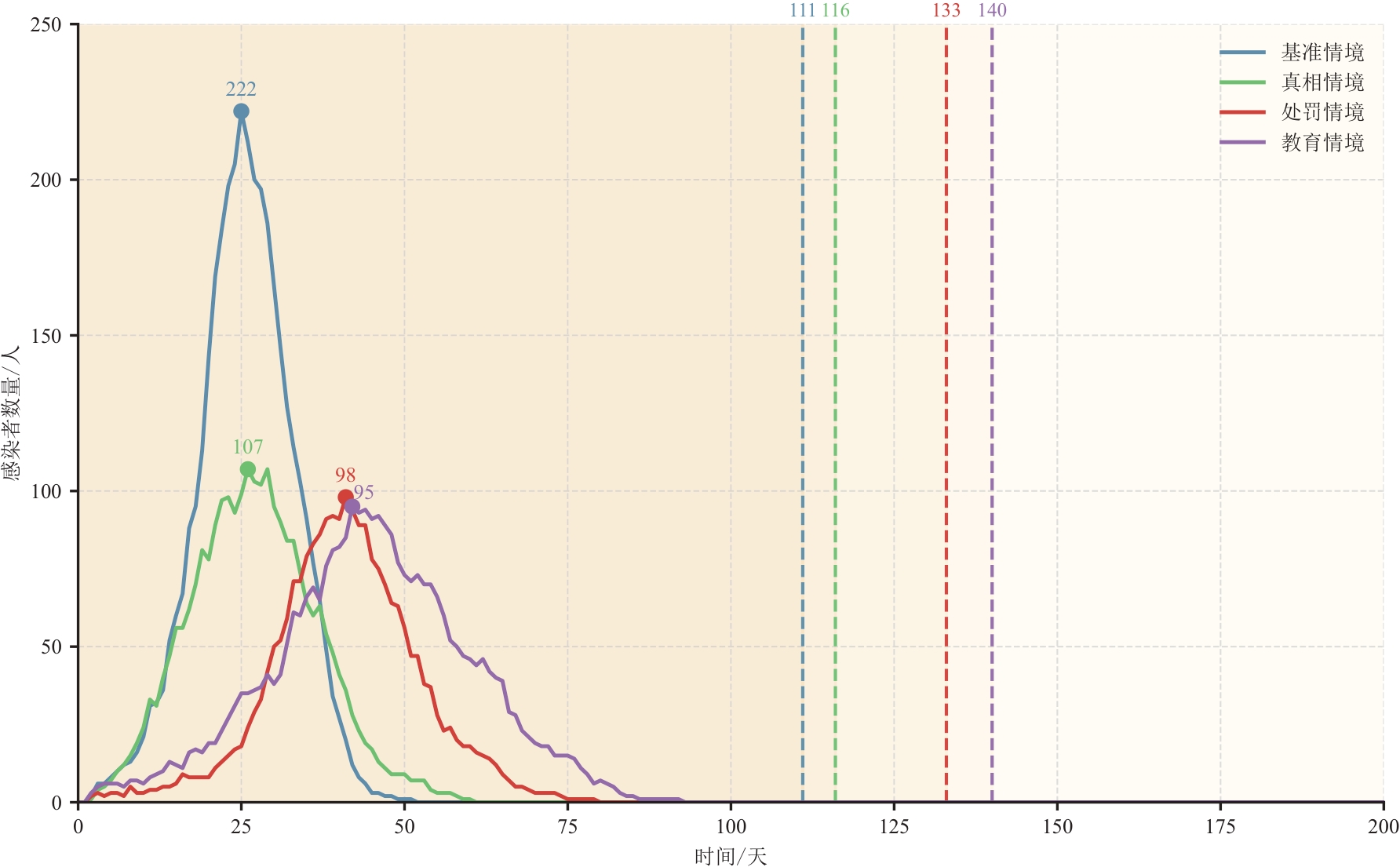
[Purpose/Significance] Online public opinion propagation poses a severe challenge to social stability and even national security. This study aims to establish an online public opinion propagation model that features both mechanistic interpretation and policy evaluation capability, thereby providing decision-making support for online public opinion governance and national security protection. [Method/Process] Based on the basic SEIQR model, this study reconfigured state transition rules and information diffusion patterns to develop an extended SEIQR model that better reflects real-world online public opinion propagation chains. An agent-based modeling (ABM) approach was then employed to reproduce the full-cycle dynamic process of online public opinion propagation at the micro-level of individual interactions. Furthermore, three categories of governance mechanisms—government disclosure of authoritative information, regulatory and platform-imposed account restrictions, and public education and guidance—were systematically simulated, and their intervention effects were comparatively analyzed using quantitative indicators. [Result/Conclusion] The results indicate that, compared with the baseline scenario, the infection peak size decreases sequentially across the “Truth”, “Penalty” and “Education” scenarios; meanwhile, the time at which the infection reaches its peak is progressively delayed, and the number of individuals who never enter the propagation chain sequentially increases. These findings indicate that the above mechanisms can reduce the infection peak, slow down the propagation speed, and narrow the scope of influence to varying degrees by affecting the state-transition process of online users. However, the propagation cycle is extended under all three scenarios, indicating that the propagation chain exhibits a certain degree of a “long-tail effect” under policy interventions. This study identifies the evolutionary patterns of online public opinion under different governance strategies, providing quantitative support for predicting public opinion development trends, optimizing the timing of policy interventions, and scientifically evaluating governance strategies. The findings offer significant theoretical contributions and practical value for fostering a clean and healthy online environment and safeguarding national security and social stability.
Key words

online public opinion propagation / SEIQR model / national security / public opinion governance / agent-based modeling / AnyLogic simulation

Cite this article

Download Citations
Xu Xinrong , Wang Ming. An Extended SEIQR Model for Online Public Opinion Propagation: Modeling and Simulation[J]. Knowledge Management Forum. 2026, 11(4): 381-399 https://doi.org/10.13266/j.issn.2095-5472.2026.032

References

[1]
中国互联网络信息中心. 第57 次中国互联网络发展状况统计报告[EB/OL]. [2026-06-10].
China Internet Network Information Center (CNNIC). The 57th statistical report on internet development in China[EB/OL]. [2026-06-10].
[2]
Kermack W O, McKendrick A G. Contributions to the mathematical theory of epidemics—I[J]. Bulletin of mathematical biology, 1991, 53(1/2): 33-55.
[3]
谭娟. 基于传染病模型的社交网络舆情话题传播[J]. 计算机工程与应用, 2015, 51(12): 118-122.
Tan Juan. Public opinion topics propagation in social network based on infectious disease model[J]. Computer engineering and applications, 2015, 51(12): 118-122.
[4]
丁学君. 基于SIR的SNS网络舆情话题传播模型研究[J]. 计算机仿真, 2015, 32(1): 241-247.
Ding Xuejun. Research on propagation model of public opinion topics in SNS based on SIR[J]. Computer simulation, 2015, 32(1): 241-247.
[5]
赵剑华, 万克文. 基于信息传播模型-SIR传染病模型的社交网络舆情传播动力学模型研究[J]. 情报科学, 2017, 35(12): 34-38.
Zhao Jianhua, Wan Kewen. Research on the communication dynamics model of social network public opinion based on the SIR model[J]. Information science, 2017, 35(12): 34-38.
[6]
Hethcote H W, van den Driessche P. An SIS epidemic model with variable population size and a delay[J]. Journal of mathematical biology, 1995, 34(2): 177-194.
[7]
Escalante R, Odehnal M. A deterministic mathematical model for the spread of two rumors[J]. Afrika matematika, 2020, 31(2): 315-331.
[8]
Li M Y, Muldowney J S. Global stability for the SEIR model in epidemiology[J]. Mathematical biosciences, 1995, 125(2): 155-164.
[9]
Guo Hao Ming, Yan Xue Feng, Cui Peng. Modeling and simulation of rumor propagation based on multiple contact mechanism and incentive effect[J]. Journal of applied mathematics and computing, 2023, 69(5): 3625-3644.
[10]
Chen Xue Long, Wang Nan. Rumor spreading model considering rumor credibility, correlation and crowd classification based on personality[J]. Scientific reports, 2020, 10(1): 5887.
[11]
Zhang Qian, Li Xian Yong, Du Ya Jun, et al. Dynamical analysis of an SE2IR information propagation model in social networks[J]. Discrete dynamics in nature and society, 2021(1): 5615096.
[12]
陈帅, 司光亚, 王艳正. 基于SEI3R的微信舆情演化模型[J]. 信息工程大学学报, 2021, 22(2): 222-227, 240.
Chen Shuai, Si Guangya, Wang Yanzheng. WeChat public opinion evolution model based on SEI3R[J]. Journal of Information Engineering University, 2021, 22(2): 222-227, 240.
[13]
畅雅雯, 杨波, 高玥琳, 等. 基于SEIR的微信公众号信息传播建模与分析[J]. 计算机科学, 2022, 49(4): 56-66.
Chang Yawen, Yang Bo, Gao Yuelin, et al. Modeling and analysis of WeChat official account information dissemination based on SEIR[J]. Computer science, 2022, 49(4): 56-66.
[14]
魏静, 黄阳江豪, 林萍, 等. 基于改进SIR模型的微博网络舆情传播研究[J]. 情报科学, 2019, 37(6): 16-22.
Wei Jing, Huang Yangjianghao, Lin Ping, et al. Public opinion transmission of micro-blog network based on improved SIR model[J]. Information science, 2019, 37(6): 16-22.
[15]
王筱莉, 张静, 赵来军, 等. 基于改进SEIR模型的微博舆情衍生话题传播研究[J]. 信息资源管理学报, 2022, 12(4): 95-104, 120.
Wang Xiaoli, Zhang Jing, Zhao Laijun, et al. Research on microblog public opinion derived topic communication based on improved SEIR model[J]. Journal of information resources management, 2022, 12(4): 95-104, 120.
[16]
Zhao Lai Jun, Wang Jia Jia, Chen Yu Cheng, et al. SIHR rumor spreading model in social networks[J]. Physica A: statistical mechanics and its applications, 2012, 391(7): 2444-2453.
[17]
Zan Yong Li, Wu Jian Liang, Li Ping, et al. SICR rumor spreading model in complex networks: Counterattack and self-resistance[J]. Physica A: statistical mechanics and its applications, 2014, 405: 159-170.
[18]
Xia Ling Ling, Jiang Guo Ping, Song Bo, et al. Rumor spreading model considering hesitating mechanism in complex social networks[J]. Physica A: statistical mechanics and its applications, 2015, 437: 295-303.
[19]
Lv Rong Jian, Li Hua, Sun Qiu Bai, et al. Research on panic spread and decision behaviour in a delayed SEIR evolutionary game model under an emergency[J]. Scientific reports, 2023, 13(1): 17360.
[20]
Wang Ya Qi, Yang Xiao Yuan, Han Yi Liang, et al. Rumor spreading model with trust mechanism in complex social networks[J]. Communications in theoretical physics, 2013, 59(4): 510-516.
[21]
Sun Rui, Luo Wan Bo. Rumor propagation model for complex network with non-uniform propagation rates[J]. Applied mechanics and materials, 2014, 596: 868-872.
[22]
Yang An Zhi, Huang Xian Ying, Cai Xiu Mei, et al. ILSR rumor spreading model with degree in complex network[J]. Physica A: statistical mechanics and its applications, 2019, 531: 121807.
[23]
Qiu Li Qing, Jia Wei, Niu Wei Nan, et al. SIR-IM: SIR rumor spreading model with influence mechanism in social networks[J]. Soft computing, 2021, 25(22): 13949-13958.
[24]
胡凯茜, 李欣, 刘明帅. 演化视角下的网络暴力治理研究——基于SEIQR模型[J]. 情报杂志, 2025, 44(1): 146-154.
Hu Kaixi, Li Xin, Liu Mingshuai. Research on governance of cyber violence from the evolutionary perspective: based on SEIQR model[J]. Journal of intelligence, 2025, 44(1): 146-154.
[25]
Bonabeau E. Agent-based modeling: methods and techniques for simulating human systems[J]. Proceedings of the National Academy of Sciences, 2002, 99(S3): 7280-7287.
[26]
Macal C M, North M J. Tutorial on agent-based modelling and simulation[J]. Journal of simulation, 2010, 4(3): 151-162.
[27]
Tran M H. A Markov multiple state model for epidemic and insurance modelling[J]. ASTIN bulletin: the journal of the IAA, 2024, 54(2): 360-384.
[28]
Fink S. Crisis management: planning for the inevitable[M]. New York: American Management Association, 1986.
[29]
彭榕. 网络谣言与公共秩序——基于“长尾理论”的观察视角[J]. 学术交流, 2018(6): 120-125.
Peng Rong. Internet rumors and public order: an observation based on the “long tail theory”[J]. Academic exchange, 2018(6): 120-125.
[30]
中华人民共和国公安部. 2025年“净网”“护网”专项工作部署会召开[EB/OL]. [2026-06-12].
Ministry of Public Security of the People's Republic of China. Meeting on “Clean Net” and “Protect Net” special campaign in 2025[EB/OL]. [2026-06-12].
[31]
中国互联网联合辟谣平台. 面对谣言: 勿听!勿言!多思![EB/OL]. [2026-06-12].
China Internet Joint Platform for Refuting Rumors. Facing rumors: do not listen, do not spread, think more![EB/OL]. [2026-06-12].
[32]
澎湃新闻. 造谣会封号!中央网信办通报首发谣言典型案例, 5400余个账号被处置[EB/OL]. [2026-06-15].
The Paper. Accounts spreading rumors will be banned: Cyberspace Administration of China reported typical rumor cases, over 5400 accounts penalized[EB/OL]. [2026-06-15].
[33]
Min B, Goh K I, Vazquez A. Spreading dynamics following bursty human activity patterns[J]. Physical review E: statistical, nonlinear, and soft matter physics, 2011, 83(3): 036102.
[34]
Karsai M, Kivelä M, Pan R K, et al. Small but slow world: how network topology and burstiness slow down spreading[J]. Physical review E: statistical, nonlinear, and soft matter physics, 2011, 83(2): 025102.
[35]
Yan Qiang, Wu Lian Ren, Liu Chao, et al. Information propagation in online social network based on human dynamics[J]. Abstract and applied analysis, 2013(1): 953406.
[36]
国务院国有资产监督管理委员会. 中盐集团关于保障食盐市场供应的声明[EB/OL]. [2026-06-18].
State-owned Assets Supervision and Administration Commission of the State Council. Statement by China Salt Group on ensuring the supply of the salt market[EB/OL]. [2026-06-18].
[37]
央视网. 中国消费者协会消费提示: 谨慎对待 无需抢购[EB/OL]. [2026-06-18].
CCTV News. Consumer advisory from the China Consumers Association: exercise caution and avoid panic buying[EB/OL]. [2026-06-18].
[38]
腾讯网. 辟谣工作室 | 日本核污染水排海后, 第一波谣言已被辟谣[EB/OL]. [2026-06-18].
Tencent News. Rumor Debunking Studio | After Japan's discharge of nuclear-contaminated water into the sea, the first wave of rumors has been debunked[EB/OL]. [2026-06-18].
PDF(3647 KB)

Accesses

Citation

Detail

Sections
Recommended

/

〈 〉