
A Study on the Differences in the Impact of Large Language Model-Assisted Verification on the Authenticity Discrimination of User Information

Li Wangxu, Xia Zhijie

Knowledge Management Forum ›› 2026, Vol. 11 ›› Issue (3) : 0.

Knowledge Management Forum ›› 2026, Vol. 11 ›› Issue (3) : 0. DOI: 10.13266/j.issn.2095-5472.2026.020  CSTR: 32306.14.j.issn.2095-5472.2026.020

A Study on the Differences in the Impact of Large Language Model-Assisted Verification on the Authenticity Discrimination of User Information

Author information +
History +

Abstract

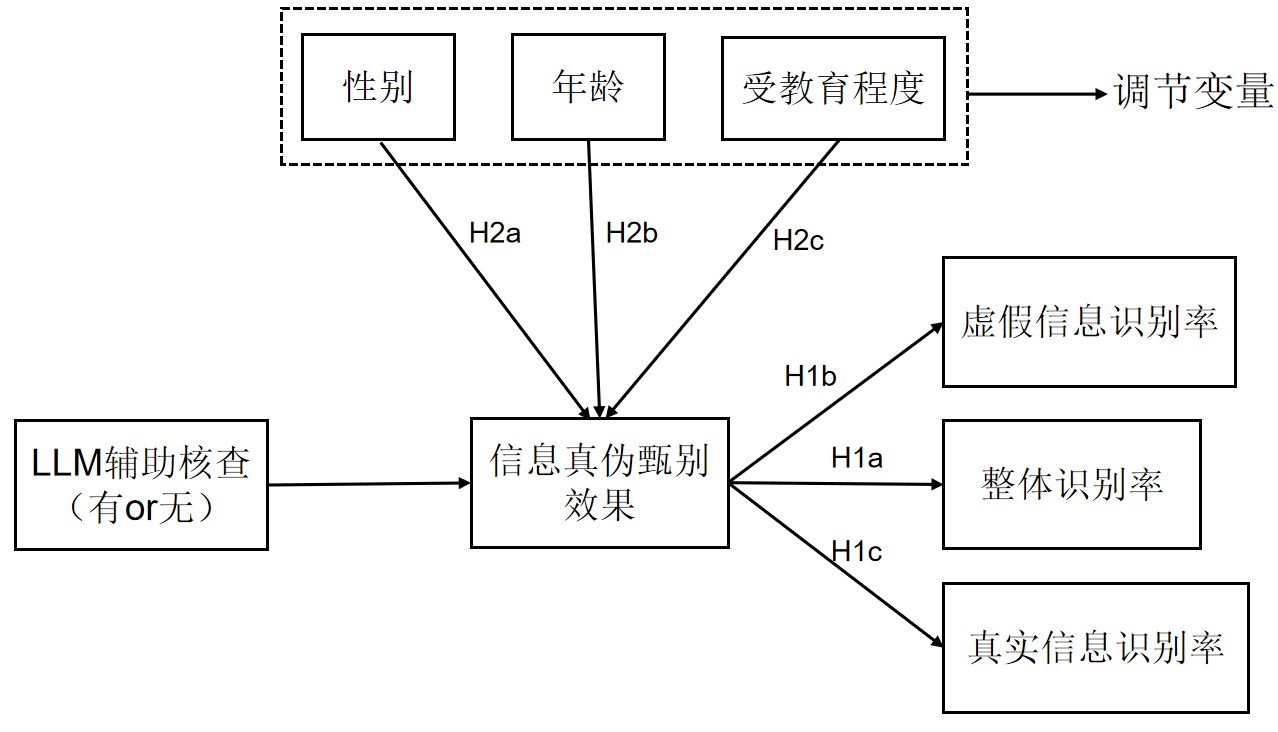
[Purpose/Significance] This study focuses on the application effect of large language models in the field of fact-checking, aiming to systematically explore their impact on users' ability to distinguish the authenticity of information and examine the moderating effect of demographic variables, providing empirical support for social platforms to combat false information. [Method/Process] This study used health-related information as the specific context and experimental material, adopting an inter-group control experiment design based on the dual-process theory. A total of 142 participants were recruited, and an experimental group using LLM for fact-checking and a control group relying on their own knowledge for judgment were established. Through one-way ANOVA and moderation effect analysis, the impact of LLM on users' ability to distinguish the authenticity of information and the moderating effects of gender, age, and education level were explored. [Result/Conclusion] LLM-assisted fact-checking significantly improves users' ability to distinguish the authenticity of information, with a significant increase in the accuracy of identifying false information, but the improvement in the accuracy of identifying true information does not reach a significant level. Further analysis indicates that users with lower educational attainment show a more pronounced improvement in their ability to distinguish the authenticity of information when assisted by LLMs in fact-checking, while gender and age variables do not exhibit significant moderating effects.
Key words

large language models / fact-checking / effect of information authenticity discrimination / demographic differences / moderating effect

Cite this article

Download Citations
Li Wangxu , Xia Zhijie. A Study on the Differences in the Impact of Large Language Model-Assisted Verification on the Authenticity Discrimination of User Information[J]. Knowledge Management Forum. 2026, 11(3): 0 https://doi.org/10.13266/j.issn.2095-5472.2026.020

References

[1]
PORTER E, WOOD T J. The global effectiveness of fact-checking: evidence from simultaneous experiments in Argentina, Nigeria, South Africa, and the United Kingdom[J]. Proceedings of the National Academy of Sciences, 2021, 118(37): e2104235118.
[2]
ROOZENBEEK J, VAN DER LINDEN S, GOLDBERG B, et al. Psychological inoculation improves resilience against misinformation on social media[J]. Science advances, 2022, 8(34): eabo6254.
[3]
DAS A, LIU H, KOVATCHEV V, et al. The state of human-centered NLP technology for fact-checking[J]. Information processing management, 2023, 60(2): 103219.
[4]
QIN C, ZHANG A, ZHANG Z, et al. Is ChatGPT a general-purpose natural language processing task solver?[J]. arXiv preprint arXiv:2302.06476, 2023.
[5]
孟健, 方媛.在线新闻核查“众包”模式的应用、困境及对策[J]. 传媒, 2024(14): 90-92.
MENG J, FANG Y. Application, dilemmas and countermeasures of the "crowdsourcing" model in online news verification [J]. Media, 2024 (14): 90-92.
[6]
李瑾颉, 聂凯伦, 吴联仁, 等.众包事实核查对信息参与行为的影响:基于来源可信度的调节[J]. 知识管理论坛, 2024, 9(4): 367-379.
LI J J, NIE K L, WU L R, et al. The impact of crowdsourced Fact-checking on user information engagement behavior: the moderating of source credibility [J]. Knowledge management forum, 2024, 9(4): 367-379.
[7]
王智超, 许祯臻, 俞怡帆, 等.社交媒体上错误信息的分享:影响因素、理论解释和干预[J]. 心理学探新, 2024, 44(6): 507-515.
WANG Z C, XU Z Z, YU Y F, et al. Sharing of misinformation on social media: influencing factors, theoretical explanations, and interventions [J]. Psychological exploration, 2024, 44(6): 507-515.
[8]
CLAYTON K, BLAIR S, BUSAM J A, et al. Real solutions for fake news? measuring the effectiveness of general warnings and fact-check tags in reducing belief in false stories on social media[J]. Political behavior, 2020, 42(4): 1073-1095.
[9]
王孝盼, 张淼, 吴懿, 等.社交媒体中健康信息可信度的影响因素研究:先验知识的调节作用[J]. 信息资源管理学报, 2024, 14(1): 55-67.
WANG X P, ZHANG M, WU Y, et al. Exploring the antecedents of health information credibility at social media platforms: the moderating role of prior knowledge [J]. Journal of information resources management, 2024, 14(1): 55-67.
[10]
张翔然, 李璐旸.PromptWE:一种融合解释的提示学习事实核查模型[J]. 清华大学学报(自然科学版), 2024, 64(5): 760-769.
ZHANG X R, LI L Y. PromptWE: a fact-checking method based on prompt learning with explanations [J]. Journal of Tsinghua University (science and technology), 2024, 64(5): 760-769.
[11]
张欣, 孙靖超.基于大语言模型的虚假信息检测框架综述[J]. 计算机科学与探索, 2025, 19(6): 1414-1436.
ZHANG X, SUN J C. Review of false information detection frameworks based on large language models [J]. Journal of frontiers of computer science and technology, 2025, 19(6): 1414-1436.
[12]
ROUMELIOTIS K I, TSELIKAS N D, NASIOPOULOS D K. Fake news detection and classification: a comparative study of convolutional neural networks, large language models, and natural language processing models[J]. Future internet, 2025, 17(1): 28.
[13]
TRAN T, VALECHA R, RAO H R. Machine and human roles for mitigation of misinformation harms during crises: an activity theory conceptualization and validation[J]. International journal of information management, 2023, 70: 102627.
[14]
何宇华, 李霞.生成式人工智能虚假信息治理的新挑战及应对策略——基于敏捷治理的视角[J]. 治理研究, 2024, 40(4): 142-156, 160.
HE Y H, LI X. New challenges and countermeasures of false information governance in generative artificial intelligence——based on the agile governance perspective [J]. Governance studies, 2024, 40(4): 142-156, 160.
[151]
祁凯, 周燕生.基于大语言模型生成内容的负面舆情态势恶化牵引作用研究[J]. 情报杂志, 2025, 44(8): 153-161, 171.
QI K, ZHOU Y S. Research on the traction effect of the deterioration of negative public opinion situation based on content generated by large language models [J/OL]. Journal of intelligence, 2025, 44(8): 153-161, 171.
[16]
SHAH S B, THAPA S, ACHARYA A, et al. Navigating the Web of disinformation and misinformation: large language models as double-edged swords[J]. IEEE access, 2024.
[17]
ALI K, LI C, ZAIN-UL-ABDIN K, et al. Fake news on Facebook: examining the impact of heuristic cues on perceived credibility and sharing intention[J]. Internet research, 2022, 32(1): 379-397.
[18]
DEVERNA M R, YAN H Y, YANG K C, et al. Fact-checking information from large language models can decrease headline discernment[J]. Proceedings of the National Academy of Sciences, 2024, 121(50): e2322823121.
[19]
TRUICA C O, APOSTOL E S. It’s all in the embedding! fake news detection using document embeddings[J]. Mathematics, 2023, 11(3): 508.
[20]
付少雄, 孙岚, 邓胜利, 等.应对理论视角下短视频用户虚假健康信息采纳的动因研究[J]. 情报资料工作, 2023, 44(6): 100-110.
FU S X, SUN L, DENG S L, et al. A study on the motivation of short video users' false health information adoption from the perspective of coping theory [J]. Information and documentation services, 2023, 44(6): 100-110.
[21]
姜雨杉, 张仰森.大语言模型驱动的立场感知事实核查[J]. 计算机应用, 2024, 44(10): 3067-3073.
JIANG Y S, ZHANG Y S. Large language model-driven stance-aware fact-checking[J]. Journal of computer applications, 2024, 44(10): 3067-3073.
[22]
RIJO A, WALDZUS S. That's interesting! the role of epistemic emotions and perceived credibility in the relation between prior beliefs and susceptibility to fake-news[J]. Computers in human behavior, 2023, 141: 107619.
[23]
郑铭, 李婕, 成佩霞, 等.新型冠状病毒肺炎流行期间公众对典型谣言正确甄别率的调查[J]. 中南大学学报(医学版), 2022, 47(12): 1704-1710.
ZHENG M, LI J, CHENG P X, et al. A survey on the public’s discrimination rate of typical rumors during the coronavirus disease 2019 epidemic [J]. Journal of Central South University (medical sciences), 2022, 47(12): 1704-1710.
[24]
虞鑫, 王金鹏.“真实”的鸿沟:人类认知与大语言模型判定新闻真实的比较研究[J]. 当代传播, 2024(5): 17-23.
YU X, WANG J P. "The gap of 'truth': a comparative study of human cognition and large language models in judging the truth of news [J]. Journalism communication, 2024(5): 17-23.
[25]
周国韬, 邓胜利.突发公共卫生事件下老年人信息感知与保护性行动决策研究[J]. 情报资料工作, 2021, 42(2): 31-42.
ZHOU G T, DENG S L. Research on the elderly's information perception and protective action decision under the sudden public health event [J]. Information and documentation services, 2021, 42(2): 31-42.
[26]
张秀, 李月琳.年龄梯度视角下网络用户健康信息甄别能力研究[J]. 情报学报, 2019, 38(8): 838-848.
ZHANG X, LI Y L. Ability of users in different age groups to screen health information in social media[J]. Journal of the China Society for Scientific and Technical Information, 2019, 38(8): 838-848.
[27]
BRASHIER N M, SCHACTER D L. Aging in an era of fake news[J]. Current directions in psychological science, 2020, 29(3): 316-323.
[28]
刘鸣筝, 孔泽鸣.媒介素养视阈下公众谣言辨别能力及其影响因素的实证研究[J]. 新闻大学, 2017(4): 102-109, 151.
LIU M Z, KONG Z M. An Empirical study on the nature and determinants of rumor discrimination ability from the perspective of media literacy[J]. Journalism bimonthly, 2017(4): 102-109, 151.
[29]
邓胜利, 顾一飞.网络虚假健康信息研究综述:认知、行为与治理[J]. 图书馆杂志, 2022, 41(5): 14-22.
DENG S L, GU Y F. A review of online health misinformation: recognition, action and governance[J]. Library journal, 2022, 41(5): 14-22.

李汪煦:撰写论文初稿,修改论文。

夏志杰:进行选题的把握与指导,对论文初稿提出修改意见以及最终定稿。

Funding

National Social Science Fund of China titled "Research on the Mechanism and Operation Strategy of Smart Governance of Online Rumors Supported by Big Data"(21BGL243)

Accesses

Citation

Detail

Sections
Recommended

/