Research on the Influencing Factors of High-Quality Participation of Library Knowledge Service Users Based on the DEMATEL-ISM-MICMAC Method

Li Yongming Li Shuangshuang Wang Jinxia Dong Panpan

Knowledge Management Forum ›› 2026, Vol. 11 ›› Issue (2) : 173-184.

PDF(2967 KB)
PDF(2967 KB)
Knowledge Management Forum ›› 2026, Vol. 11 ›› Issue (2) : 173-184. DOI: 10.13266/j.issn.2095-5472.2026.015  CSTR: 32306.14.j.issn.2095-5472.2026.015

Research on the Influencing Factors of High-Quality Participation of Library Knowledge Service Users Based on the DEMATEL-ISM-MICMAC Method

Author information +
History +

Abstract

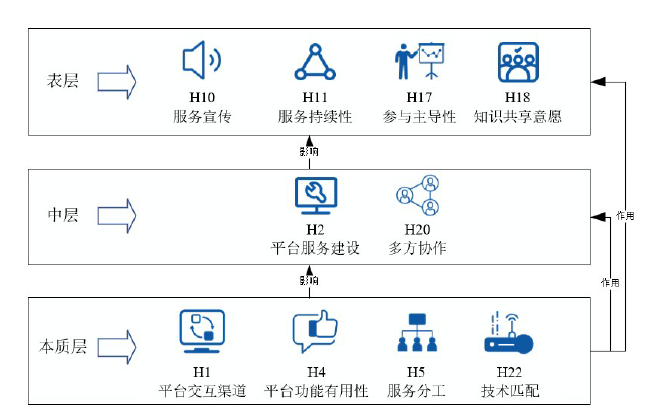
[Purpose/Significance] To seek the entry point for optimizing knowledge services from the perspective of user wisdom, and to provide references for improving the supply mode of knowledge services and promoting the high-quality development of knowledge services. [Method/Process] Firstly, qualitative analysis methods were utilized to identify the factors influencing users' high-quality participation in library knowledge services from the interview data. Secondly, the DEMATEL-ISM-MICMAC method was used to analyze the key influencing factors as well as the hierarchical structure and interaction relationship among these influencing factors. [Result/Conclusion] The results show that the factors influencing users' high-quality participation in library knowledge services include four superficial influencing factors: participation dominance, service continuity, service promotion, and willingness to share knowledge; two middle-level factors: platform service construction and multi-party collaboration; and four essential factors: technical matching, platform interaction channels, platform function usefulness, and service division of labor. Based on the analysis results, suggestions are put forward for libraries to integrate user wisdom, optimize the supply of knowledge services, and meet user demands from the perspectives of surface factors, middle factors, and essential factors.
Key words

user participation / knowledge services / DEMATEL-ISM-MICMAC method / user wisdom

Cite this article

Download Citations
Li Yongming Li Shuangshuang Wang Jinxia Dong Panpan. Research on the Influencing Factors of High-Quality Participation of Library Knowledge Service Users Based on the DEMATEL-ISM-MICMAC Method[J]. Knowledge Management Forum. 2026, 11(2): 173-184 https://doi.org/10.13266/j.issn.2095-5472.2026.015

References

[1]
张进澳, 卢新元, 郭一若, 等. 图书馆多源跨模态知识服务:内涵、模式及发展路径[J/OL]. 图书馆杂志[2026-01-03].
ZHANG J A, LU X Y, GUO Y R, et al. Library multi-source cross-modal knowledge service: connotation, mode and development path[J/OL]. Library journal[2026-01-03].
[2]
张晓林. 走向知识服务:寻找新世纪图书情报工作的生长点[J]. 中国图书馆学报, 2000(5): 30-35.
ZHANG X L. Towards knowledge services: seeking development opportunities for library and information services in the 21st century[J]. Journal of library science in China, 2000(5): 30-35.
[3]
初景利, 张冬荣. 第二代学科馆员与学科化服务[J]. 图书情报工作, 2008(2): 6-10, 68.
CHU J L, ZHANG D R. Subject librarian 2.0 and subject services[J]. Library and information service, 2008(2): 6-10, 68.
[4]
初景利, 段美珍. 从智能图书馆到智慧图书馆[J]. 国家图书馆学刊, 2019, 28(1): 3-9.
CHU J L, DUAN M Z. From intelligent libraries to smart libraries[J]. Journal of the National Library of China, 2019, 28(1): 3-9.
[5]
刘佳, 李佳忆, 宋芳漪. 基于系统动力学的图书馆知识服务价值共创机理研究[J]. 图书情报工作, 2024, 68(24): 38-54.
LIU J, LI J Y, SONG F Y. Research on the mechanisms of value co-creation in library knowledge services based on system dynamics[J]. Library and information service, 2024, 68(24): 38-54.
[6]
张晓林.颠覆性变革与后图书馆时代——推动知识服务的供给侧结构性改革[J]. 中国图书馆学报, 2018, 44(1): 4-16.
ZHANG X L. Disruptive changes and the post-library era: toward supply-side structure reform of knowledge services[J]. Journal of library science in China, 2018, 44(1): 4-16.
[7]
邹桂芬.基于用户导向的知识服务创新研究[J]. 情报资料工作, 2010(4): 73-75.
ZOU G F. On user-oriented knowledge service innovation[J]. Information and documentation services, 2010(4): 73-75.
[8]
李永明, 郑德俊.用户参与对图书馆知识服务绩效的影响模型[J]. 图书情报工作, 2020, 64(3): 42-52.
LI Y M, ZHENG D J. Influence mechanism of user participation on library knowledge service performance[J]. Library and information service, 2020, 64(3): 42-52.
[9]
李杨, 郑德俊.与用户共创图书馆的知识服务价值——云舟知识空间的用户智慧融入案例及其启示[J]. 图书情报工作, 2020, 64(4): 34-42.
LI Y, ZHENG D J. Creating the knowledge service value of library with users——analysis and enlightenment of user wisdom integrated in Yunzhou Knowledge Space[J]. Library and information service, 2020, 64(4): 34-42.
[10]
李广平, 王婧怡, 袁润.用户参与图书馆知识服务研究[J]. 图书馆学研究, 2017(10): 40-45.
LI G P, WANG J Y, YUAN R. Research on user participation in library knowledge service[J]. Researches in library science, 2017(10): 40-45.
[11]
李永明, 李双双, 董盼盼.图书馆知识服务用户高质量参与构成要素及其作用机制[J]. 图书馆理论与实践, 2024(4): 89-96.
LI Y M, LI S S, DONG P P. The components and mechanism of high-quality participation of library knowledge service users[J]. Library theory and practice, 2024(4): 89-96.
[12]
SILPAKIT P, FISK R P. Participating the service encounter: a theoretical service[C]//THOMAS M B, GERGORY S U, VALARIE A Z. Services Marketing in a Changing Environment. Chicago: American Marketing Association, 1985:117-121.
[13]
KLEM A M, CONNELL J P. Relationships matter: linking teacher support to student engagement and achievement[J]. Journal of school health, 2004, 74(7): 262-273.
[14]
李永明.图书馆知识服务中用户参与行为分析[J]. 图书馆学研究, 2021(17): 82-89.
LI Y M. Analysis of user participation behavior in library knowledge service[J]. Researches in library science, 2021(17): 82-89.
[15]
PATTERSON P, YU T, DERUYTE K. Understanding customer engagement in services[J]. European journal of marketing, 2015, 49(3/4): 491—511.
[16]
郑德俊, 黄鹏, 李杨.高校图书馆学科服务用户参与水平测评模型——以用户高质量参与为视角[J]. 图书情报工作, 2022, 66(12): 17-25.
ZHENG D J, HUANG P, LI Y. The evaluation model of user participation level of subject services in university libraries: taking high quality user participation as a perspective[J]. Library and information service, 2022, 66(12): 17-25.
[17]
肖珑.支持“双一流”建设的高校图书馆服务创新趋势研究[J]. 大学图书馆学报, 2018, 36(5): 43-51.
XIAO L. Research on the service innovation trends of academic libraries supporting “double world-class” construction[J]. Journal of academic libraries, 2018, 36(5): 43-51.
[18]
范并思, 胡小菁.图书馆2.0:构建新的图书馆服务[J]. 大学图书馆学报, 2006(1): 2-7.
FAN B S, HU X J. Library2∙0: building the new library services[J]. Journal of academic libraries, 2006(1): 2-7.
[19]
齐向华.用户与图书馆的关系利益探析[J]. 国家图书馆学刊, 2018, 27(4): 55-63.
QI X H. Analysis of the relational benefit between users and libraries[J]. Journal of the national library of China, 2018, 27(4): 55-63.
[20]
张建伟, 李月琳, 张泰瑞.知识服务平台用户检索与推荐交互行为关系研究[J]. 情报理论与实践, 2024, 47(11): 186-193.
ZHANG J W, LI Y L, ZHANG T R. Relationships between user searching and interaction with recommendation on knowledge service platforms[J]. Information studies: theory & application, 2024, 47(11): 186-193.
[21]
程秀峰, 肖兵, 夏立新.知识融合视角下用户行为数据采集与共享机制研究[J]. 情报科学, 2020, 38(1): 30-35.
CHENG X F, XIAO B, XIA L X. The mechanism of user behavior data collection and sharing from the perspective of knowledge fusion[J]. Information science, 2020, 38(1): 30-35.
[22]
何胜, 冯新翎, 武群辉, 等.基于用户行为建模和大数据挖掘的图书馆个性化服务研究[J]. 图书情报工作, 2017, 61(1): 40-46.
HE S, FENG X L, WU Q H, et al. Research on personalized services of library based on user behavior modeling and big data mining[J]. Library and information service, 2017, 61(1): 40-46.
[23]
王雪峰.智慧图书馆知识服务场景构建研究——以吉林艺术学院图书馆为例[J]. 情报科学, 2019, 37(12): 98-104.
WANG X F. The construction of knowledge service scene of smart library——taking Jilin University of Arts Library as an example[J]. Information science, 2019, 37(12): 98-104.
[24]
钟欢, 王天一, 马秀峰.用户需求驱动下高校图书馆智能化学科服务平台构建研究[J]. 情报理论与实践, 2022, 45(2): 182-190.
ZHONG H, WANG T Y, MA X F. Research on the construction of intelligent subject service platform of university library driven by user demand[J]. Information studies: theory & application, 2022, 45(2): 182-190.
[25]
DUPERRIN J C, GODET M. SMIC 74—a method for constructing and ranking scenarios[J]. Futures, 1975, 7(4): 302-312.
[26]
向宇然, 夏瑶徽, 张国权.基于模糊DEMATEL-ISM-MICMAC的脚手架事故致因机理分析[J]. 工程管理学报, 2022, 36(5): 142-147.
XIANG Y R, XIA Y H, ZHANG G Q. Analysis on the causal mechanism of scaffolding accidents based on fuzzy DEAMATEL-ISM -MICMAC[J]. Journal of engineering management, 2022, 36(5): 142-147.
[27]
宋娜, 周旭瑶, 唐亦博, 等.基于DEMATEL-ISM-MICMAC法的康养旅游资源评价指标体系研究[J]. 生态经济, 2020, 36(5): 128-134.
SONG N, ZHOU X Y, TANG Y B, et al. An approach to the health and wellness tourism resources assessment based on DEMATEL-ISM-MICMAC[J]. Ecological economy, 2020, 36(5): 128-134.
[28]
邱均平, 胡博, 徐中阳.学者学术话语权的关键影响因素识别与作用机理分析[J]. 情报科学, 2024, 42(2): 1-11, 23.
QIU J P, HU B, XU Z Y. Key influencing factors identification and action mechanism analysis of the scholars’ academic discourse power[J]. Information science, 2024, 42(2): 1-11, 23.
[29]
冯缨, 唐慧, 孙晓阳.基于DEMATEL的企业社交媒体信息效用的关键影响因素研究[J]. 情报理论与实践, 2022, 45(4): 137-145, 153.
FENG Y, TANG H, SUN X Y. Research on key factors of the information utility of corporate social media based on dematel[J]. Library theory and practice, 2022, 45(4): 137-145, 153.
[30]
胡南燕, 李雪雪, 李玉飞, 等.基于ISM与N-K模型的高校火灾多因素耦合风险分析与解耦管控[J]. 实验室研究与探索, 2023, 42(10): 284-291.
HU N Y, LI X X, LI Y F, et al. Analysis and control of risk mechanism of multiple-factors coupling in campuses fire based on ISM and N-K model[J]. Research and exploration in laboratory, 2023, 42(10): 284-291.
[31]
周德群, 章玲.集成DEMATEL/ISM的复杂系统层次划分研究[J]. 管理科学学报, 2008, 11(2): 20-26.
ZHOU D Q, ZHANG L. Establishing hierarchy structure in complex systems based on the integration of DEMATEL and ISM[J]. Journal of management sciences in China, 2008, 11(2): 20-26.
[32]
WANG W, LIU X, QIN Y, et al. Assessing contributory factors in potential systemic accidents using AcciMap and integrated fuzzy ISM-MICMAC approach[J]. International journal of industrial ergonomics, 2018, 68:311–326.
[33]
XING Y D, MENG W J, ZHOU J L, et al. DEMATEL, AISM, and MICMAC-based research on causative factors of self-build housing fire accidents in rural areas of China[J]. Fire, 2023, 6(5): 179.
[34]
许苗苗, 邵波.高校图书馆知识服务发展新契机、新问题及新思考[J]. 新世纪图书馆, 2022(3): 5-10.
XU M M, SHAO B. New opportunities, new problems and new thoughts on the development of knowledge service in university library [J]. New century library, 2008(2): 6-10, 68.
[35]
陈一, 向妮, 鲍秀爽.智慧图书馆知识服务:关键要素、典型场景与未来展望[J]. 图书馆论坛, 2025, 45(10): 40-50.
CHEN Y, XIANG N, BAO X S. Smart library knowledge services: key elements, typical scenarios and development prospects [J]. Library tribune, 2025, 45(10): 40-50.
[36]
丁莉, 王雪燕, 张容.生成式人工智能工具驱动的图书馆知识服务研究[J]. 图书与情报, 2025(5): 95-103.
DING L, WANG X Y, ZHANG R. Research on library knowledge services driven by generative artificial intelligence tools [J]. Library and information, 2025(5): 95-103.
[37]
范炜, 李桂华.图书馆知识服务流程再造及其制度优化对策[J]. 情报资料工作, 2011(5): 76-79, 87.
FAN W, LI G H. Remaking the process of library knowledge service and the strategy of optimizing system[J]. Information and documentation services, 2011(5): 76-79, 87.
PDF(2967 KB)

Accesses

Citation

Detail

Sections
Recommended

/