PDF(4016 KB)

Practices and Advances in Assessing AI Literacy: A Synthesized Review of 69 Empirical Studies
Ma Yunzhe, Tang Qiong
Knowledge Management Forum ›› 2026, Vol. 11 ›› Issue (1) : 50-60.
PDF(4016 KB)
 PDF(4016 KB)
Practices and Advances in Assessing AI Literacy: A Synthesized Review of 69 Empirical Studies
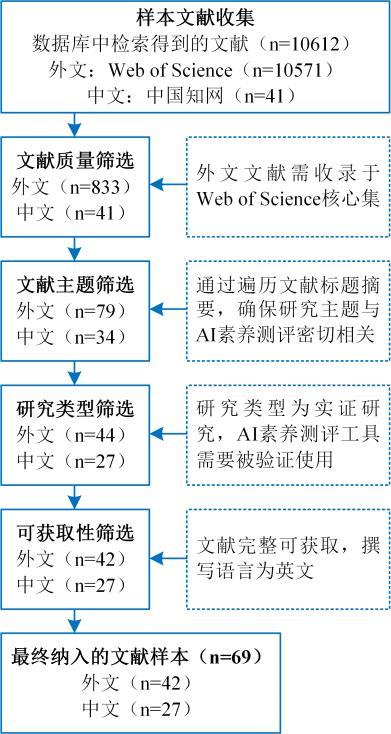
[Purpose/Significance] As AI technologies become deeply embedded in social life, AI literacy has emerged as a fundamental competency for the public in the intelligent era. This study aims to systematically review the progress of empirical research on AI literacy assessment worldwide, providing reference and insights for future studies. [Method/Process] Following the principles of systematic review, this study selected 69 empirical studies on AI literacy assessment as the analytical sample. Through a comprehensive examination of the included literature, descriptive characteristics were summarized, and key elements of AI literacy assessment—including assessment targets, assessment dimensions, development and validation of assessment tools, influencing factors, and research limitations—were systematically analyzed. [Result/Conclusion] Existing research shows that AI literacy assessments primarily target the general public, students, and educators. Core assessment dimensions commonly include cognition, application, evaluation, and ethics. The assessment process generally involves sample selection and the development and validation of assessment tools. Empirical findings indicate that AI literacy levels are influenced by variables such as gender, age, nationality, and educational background. Current studies still exhibit limitations regarding assessment tools, sample characteristics, and assessment methods, suggesting the need for further refinement in future research.
AI literacy / literacy assessment / assessment tools / systematic review
| [1] |
赵益民, 彭雪琴, 寸国美. 人工智能素养的内涵、结构和评价体系[J]. 图书情报工作, 2025, 69(13): 83-93.
|
| [2] |
OECD,
|
| [3] |
UNESCO. Artificial intelligence and digital transformation: competencies for civil servants[EB/OL]. [2026-01-04].
|
| [4] |
|
| [5] |
|
| [6] |
|
| [7] |
|
| [8] |
|
| [9] |
|
| [10] |
|
| [11] |
|
| [12] |
|
| [13] |
|
| [14] |
|
| [15] |
|
| [16] |
|
| [17] |
林燕, 孙海霞, 蒲思樾, 等.国内外人工智能素养测评工具综述[J]. 医学信息学杂志, 2025, 46(10): 25-36.
|
| [18] |
|
| [19] |
|
| [20] |
|
| [21] |
|
| [22] |
|
| [23] |
|
| [24] |
|
| [25] |
|
| [26] |
|
| [27] |
|
| [28] |
|
| [29] |
|
| [30] |
|
| [31] |
|
| [32] |
|
| [33] |
|
| [34] |
郭亚军, 寇旭颍, 冯思倩, 等.人工智能素养:内涵剖析与评估标准构建[J]. 图书馆论坛, 2025, 45(2): 42-50.
|
| [35] |
|
| [36] |
|
| [37] |
|
| [38] |
|
| [39] |
|
| [40] |
|
| [41] |
|
| [42] |
|
| [43] |
|
| [44] |
|
| [45] |
|
| [46] |
|
| [47] |
ITC. ITC guidelines for the large-scale assessment of linguistically and culturally diverse populations[J]. International journal of testing, 2019, 19(4): 301-336.
|
| [48] |
|
| [49] |
刘明, 郭烁, 苏逸飞, 等.大学生生成式人工智能素养测评工具开发与应用[J]. 现代远程教育研究, 2025, 37(6): 24-33, 70.
|
| [50] |
|
| [51] |
|
| [52] |
|
| [53] |
|
| [54] |
|
| [55] |
|
| [56] |
|
| [57] |
|
| [58] |
|
| [59] |
|
| [60] |
|
/
| 〈 |
|
〉 |