Uncover the Hidden Social Relationships between Researchers and Understand the Overlap between Social Relationships and Collaboration by using the Dissertation Acknowledgment

Yang Xiao, Ding Liangping, Feng Lingzi, Yuan Junpeng

Knowledge Management Forum ›› 2025, Vol. 10 ›› Issue (6) : 535-552.

PDF(3507 KB)
PDF(3507 KB)
Knowledge Management Forum ›› 2025, Vol. 10 ›› Issue (6) : 535-552. DOI: 10.13266/j.issn.2095-5472.2025.036  CSTR: 32306.14.CN11-6036.2025.036

Uncover the Hidden Social Relationships between Researchers and Understand the Overlap between Social Relationships and Collaboration by using the Dissertation Acknowledgment

Author information +
History +

Abstract

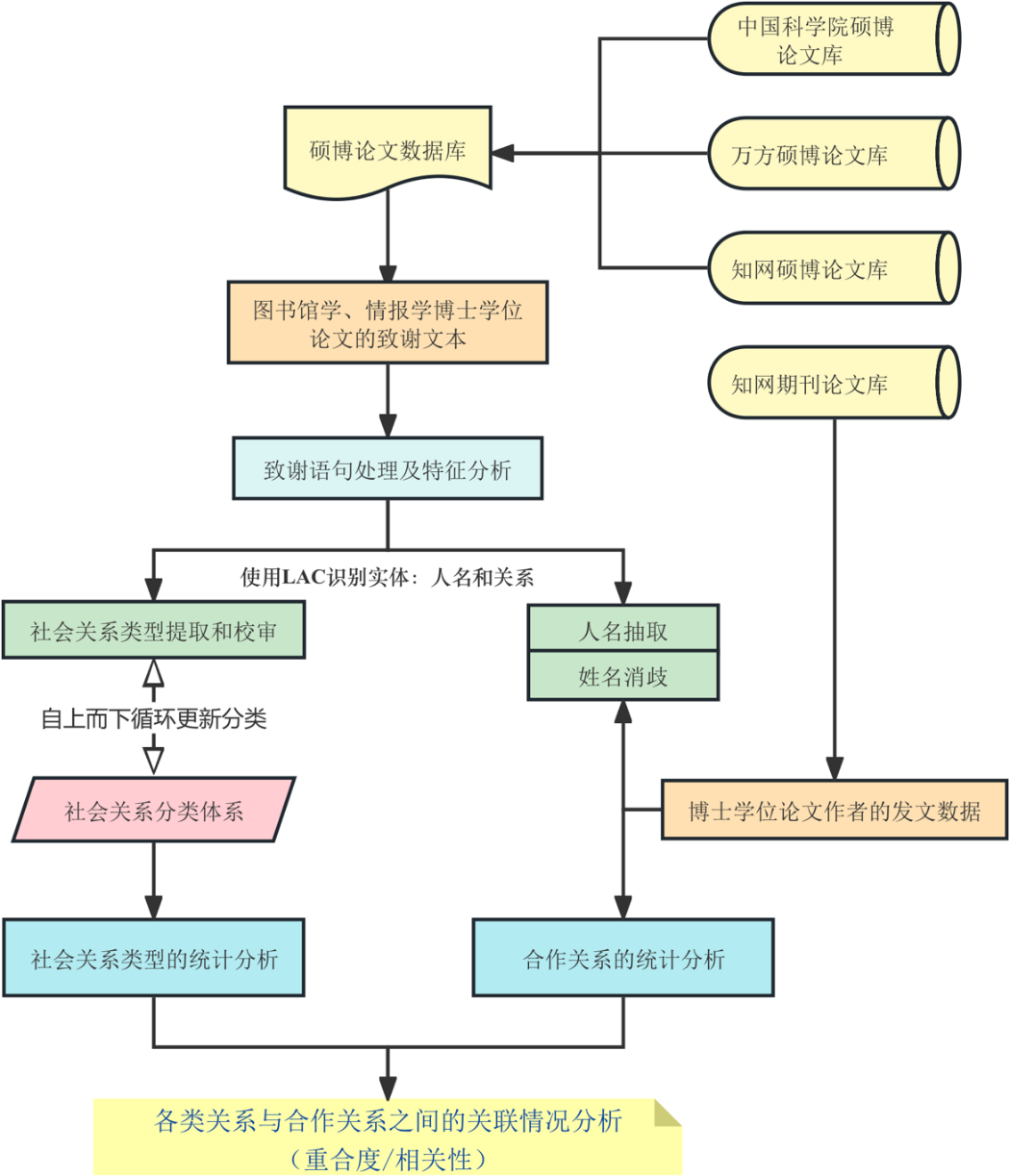
[Purpose/Significance] The paper aims to reveal richer social relationships beyond formal collaboration networks from the acknowledgment text of the doctoral dissertation, deepen our perception of academic social networks, and provide new evidence for understanding academic social capital and the cultivation of young researchers. [Method/Process] This paper had used the LAC model to extract and identify the people being acknowledged and their social relationships mentioned in the acknowledgment sentences of the acknowledgment text of doctoral dissertations, and had then analyzed the correlation between the social relations between the persons acknowledged and the authors of doctoral dissertations (hereinafter referred to as "dissertation authors") and their cooperation relations in academic publications. [Result/Conclusion] Most of the social relationships mentioned in the acknowledgments did not translate into formal research collaborations. This indicates that acknowledgments can effectively capture implicit social relationships that are often overlooked in traditional collaboration datasets, such as mentorship, peer review, peer networks, academic friendships, and family support. The study shows that nearly half of research collaborations can be traced back to the doctoral stage, demonstrating that social relationships highlighted in acknowledgments have a substantial impact on research output and publication. Among these, mentorship and peer relationships represent the closest types of collaboration, indirectly revealing the patterns of research collaboration among early-career researchers. Moreover, a significant correlation was observed between the order of mention in acknowledgments, the type of relationship, and the intensity of research collaboration, indicating that social networks play a critical and tangible role in the academic growth of early-career researchers.
Key words

social relationships / relation extraction / researchers / doctoral dissertation acknowledgments / research paper

Cite this article

Download Citations
Yang Xiao , Ding Liangping , Feng Lingzi , et al. Uncover the Hidden Social Relationships between Researchers and Understand the Overlap between Social Relationships and Collaboration by using the Dissertation Acknowledgment[J]. Knowledge Management Forum. 2025, 10(6): 535-552 https://doi.org/10.13266/j.issn.2095-5472.2025.036

References

[1]
TRIPODI G, CHIAROMONTE F, LILLO F. Knowledge and social relatedness shape research portfolio diversification[J]. Scientific reports, 2020, 10(1): 14232.
[2]
沈金波. 基于社会网络的竞争情报系统研究[D]. 武汉: 华中师范大学, 2007.
SHEN J B. A study on the social network-based competitive intelligence system[D]. Wuhan: Central China Normal University, 2007.
[3]
Conflict resolution[J]. Nature Plants, 2021, 7(11): 1435-1435.
[4]
胥伟岚. 基于人际网络的学术社交网络知识交流模式研究[J]. 图书馆学研究, 2018(13): 13-18.
XU W L. Research on the knowledge exchange mode of academic social networks based on interpersonal network[J]. Research on library science, 2018(13): 13-18.
[5]
陈定权, 朱维凤, 莫秀娟. 图书情报学论文合著(1999-2002)现象研究[J]. 情报科学, 2009, 1(27): 70-73.
CHEN D Q, ZHU W F, MO X J. Study of the periodical paper co-authorship of library and information science: 1999-2002[J]. Information science, 2009, 1(27): 70-73.
[6]
田利云. 面向学位论文的致谢分析和生成研究[D]. 大连:大连理工大学, 2017.
TIAN L Y. Research on analysis and generation of acknowledgements for academic dissertations[D]. Dalian: Dalian University of Technology, 2017.
[7]
DÍAZ-FAES A A, BORDONS M. Making visible the invisible through the analysis of acknowledgements in the humanities[J]. Aslib journal of information management, 2017, 69(5): 576-590.
[8]
LIU J, GUO X, XU S, et al. Understanding super‐partnerships in scientific collaboration: Evidence from the field of economics[J]. Journal of the Association for Information Science and Technology, 2024, 75(6): 717-733.
[9]
WU L, YI F, BU Y, et al. Toward scientific collaboration: a cost-benefit perspective[J]. Research policy, 2024, 53(2): 104943.
[10]
XIE Q, ZHANG X, KIM G, et al. Exploring the influence of coauthorship with top scientists on researchers' affiliation, research topic, productivity, and impact[J]. Journal of informetrics, 2022, 16(3): 101314.
[11]
ZHU Y, KIM D, JIANG T, et al. Dependency, reciprocity, and informal mentorship in predicting long-term research collaboration: a co-authorship matrix-based multivariate time series analysis[J]. Journal of informetrics, 2024, 18(1): 101486.
[12]
LI W, ZHANG S, ZHENG Z, et al. Untangling the network effects of productivity and prominence among scientists[J]. Nature communications, 2022, 13(1): 4907.
[13]
ZINGG C, NANUMYAN V, SCHWEITZER F. Citations driven by social connections? a multi-layer representation of coauthorship networks[J]. Quantitative science studies, 2020, 1(4): 1493-1509.
[14]
CHUNG Y, JACKSON S E. Co-worker trust and knowledge creation: a multilevel analysis[J]. Journal of trust research, 2011, 1(1): 65-83.
[15]
XU S, AN M, AN X. Do scientific publications by editorial board members have shorter publication delays and then higher influence?[J]. Scientometrics, 2021, 126(8): 6697-6713.
[16]
WUESTMAN M, WANZENBÖCK I, FRENKEN K. Local peer communities and future academic success of Ph.D. candidates[J]. Research policy, 2023, 52(8): 104844.
[17]
COLLEGE D. How friendship networks at college impact students' academic and social success[EB/OL]. [2025-11-25]. https://phys.org/news/2016-10-friendship-networks-college-impact-students.html
[18]
SCHWEITZER F, GARAS A, TOMASELLO M V, et al. The role of network embeddedness on the selection of collaboration partners: an agent-based model with empirical validation[J]. Advances in complex systems, 2022, 25(02n03): 2250003.
[19]
XING Z, WANG L, FANG D. Unraveling the dynamics and identifying the "superstars" of R&D alliances in IUR collaboration: a two-mode network analysis in China[J]. Humanities & social sciences communications, 2023, 10(1): 951.
[20]
XU Y, ZHOU D, MA J. Scholar-friend recommendation in online academic communities: an approach based on heterogeneous network[J]. Decision support systems, 2019, 119: 1-13.
[21]
刘晶. 基于相关性特征权重选择决策树算法的学术关系分类规则提取[D]. 长沙: 中南大学, 2012.
LIU J. Extraction of academic relationship classification rules based on correlation feature weight selection decision tree algorithm[D]. Changsha: Central South University, 2012.
[22]
孙晓玲, 林鸿飞.人际网络关系抽取和结构挖掘[J]. 微电子学与计算机, 2008(9): 233-236.
SUN X L, LIN H F. Relations extraction and structure mining of personal network[J]. Microelectronics & computer, 2008(9): 233-236.
[23]
张福增, 杨洪勇, 李阿丽. 科学家影响关系网络与科学家的影响力[J]. 复杂系统与复杂性科学, 2007(2): 45-49.
ZHANG Z F, YANG H Y, LI A L. Scientists relation networks and scientists influences[J]. Complex systems and complexity science, 2007(2): 45-49.
[24]
康文杰. 基于知识图谱的Web of Scholars系统设计与实现[D]. 大连: 大连理工大学, 2018.
KANG W J. Design and implementation of Web of scholars system based on knowledge graph[D]. Dalian: Dalian University of Technology, 2018.
[25]
MATSUO Y, MORI J, HAMASAKI M, et al. POLYPHONET: an advanced social network extraction system from the Web[J]. Journal of Web semantics, 2007, 5(4): 262-278.
[26]
刘玉琴, 彭茂祥. 国内外学术关系分析方法与工具研究综述[J]. 情报科学, 2013, 31(11): 137-142.
LIU Y Q, PENG M X. A summary of studies on analysis methods and tools about academic relationship at home and abroad[J]. Information science, 2013, 31(11): 137-142.
[27]
吕康娟, 陆玓, 王娟.上海高校引进人才的社会网络特征分析[C]// Proceedings of 2010 third international conference on education technology and training. Wuhan: Hubei University of Technology, 2010:227-232.
LV K J, LU D, WANG J. Study on the social network characteristics of the introduced talents in Shanghai's universities[C]// Proceedings of 2010 third international conference on education technology and training. Wuhan: Hubei University of Technology, 2010:227-232.
[28]
王炎. 基于多数据源的专家学术网络构建及其应用[D]. 合肥: 安徽财经大学, 2016.
WANG Y. Construction and application of expert academic network based on multiple data sources[D]. Hefei: Anhui University of Finance and Economics, 2016.
[29]
LONG F, NING N, ZHANG Y, et al. Mining latent academic social relationships by network fusion of multi-type data[J]. Social network analysis and mining, 2020, 10(1): 52.
[30]
EDGE D. Quantitative measures of communication in science: a critical review[J]. History of science, 1979, 17(2): 102-134.
[31]
NACEY S. Systematic metaphors in Norwegian doctoral dissertation acknowledgements[J]. Scandinavian journal of educational research, 2023, 67(5): 679-694.
[32]
刘正妙. 国内毛泽东研究博士论文致谢内容统计分析——以中国知网103篇学位论文为样本[J]. 聊城大学学报(社会科学版), 2016(4): 122-128.
LIU Z M. Statistical analysis of acknowledgement of doctoral dissertations on Mao Zedong studies in China——taking 103 dissertations on CNKI as samples[J]. Journal of Liaocheng University(social science edition), 2016(4): 122-128.
[33]
徐今, 阮玉芳. 汉语文/理科学位论文致谢语比较研究[J]. 湖北广播电视大学学报, 2017, 37(4): 34-38.
XU J, RUAN Y F. A comparative study on Chinese acknowledgements in arts/science dissertations[J]. Journal of Hubei Open University, 2017, 37(4): 34-38.
[34]
梁晗, 胡志刚, 罗雯, 等. 致谢越诚挚,未来越成功?——基于fsQCA的博士学位论文致谢内容与学术成果关系研究[J]. 图书馆论坛, 2022, 42(11): 50-59.
LIANG H, HU Z G, LUO W, et al. Researches on the relationship between the acknowledgements in doctoral dissertations and the authors' future academic outcomes based on FSQCA[J]. Library tribune, 2022, 42(11): 50-59.
[35]
杨奕虹, 万小影, 武夷山. 2012年中国百篇优秀博士论文致谢内容分析[J]. 情报杂志, 2014, 33(1): 62-66, 119.
YANG Y H, WAN X Y, WU Y S. The content analysis of the acknowledgements in national outstanding doctoral dissertations 2012[J]. Journal of intelligence, 2014, 33(1): 62-66, 119.
[36]
俞兆达. 拔尖文科博士成长的社会支持系统分析——以73篇全国优秀博士学位论文致谢为轴[J]. 重庆高教研究, 2023, 11(5): 25-39.
YU Z D. An analysis of social support system for the growth of top PhDs in humanities and social sciences: based on 73 acknowledgements of national excellent doctoral dissertation[J]. Chongqing higher education research, 2023, 11(5): 25-39.
[37]
陈观玉. 博士生视角下的导师角色定位研究——基于977篇优博论文致谢的文本分析[J]. 高等理科教育, 2023(4): 69-79.
CHEN G Y. A study on the role orientation of supervisors from the perspective of doctoral students——based on the text analysis of 977 excellent doctoral dissertation acknowledgments[J]. Higher education of sciences, 2023(4): 69-79.
[38]
JIAO Z, SUN S, SUN K. Chinese lexical analysis with deep Bi-GRU-CRF network[J]. arXiv preprint, 2018, arXiv:1807.01882.

杨 晓:研究思路设计,实验执行与数据收集,数据分析与结果解读,论文撰写;

丁良萍:研究思路完善,数据抓取与分析,论文撰写与修改;

冯凌子:研究问题提出与设计,数据收集,论文撰写与修改;

袁军鹏:研究问题提出与设计,论文修改与审核。

PDF(3507 KB)

Accesses

Citation

Detail

Sections
Recommended

/