The Impact of Negative Opinion Recovery Strategies for Scenic Area Short Videos on Public Satisfaction in the Context of Varying Public Involvement

Chen Jinghao, Li Wensi, Gu Lian

Knowledge Management Forum ›› 2025, Vol. 10 ›› Issue (5) : 441-452.

PDF(1690 KB)
PDF(1690 KB)
Knowledge Management Forum ›› 2025, Vol. 10 ›› Issue (5) : 441-452. DOI: 10.13266/j.issn.2095-5472.2025.029  CSTR: 32306.14.CN11-6036.2025.029

The Impact of Negative Opinion Recovery Strategies for Scenic Area Short Videos on Public Satisfaction in the Context of Varying Public Involvement

Author information +
History +

Abstract

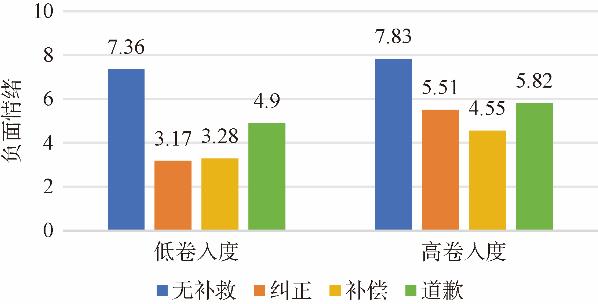
[Purpose/Significance] Focusing on sudden incidents at tourist attractions within the short-video public opinion environment, this study aims to explore the most effective recovery strategies (apology, rectification, compensation) to restore public trust and enhance post-recovery satisfaction. [Method/Process] Using an online experiment, a 4 (recovery strategy: apology, rectification, compensation, no remedy) × 2 (involvement: high, low) between-subjects design was implemented. Short videos of service failures at tourist attractions served as stimulus materials to examine the effects of different strategies on public negative emotions and satisfaction under varying levels of involvement. [Result/Conclusion] The results indicate that among the recovery strategies, compensation is the most effective, followed by rectification, and then apology. Effective recovery enhances satisfaction by mitigating the public’s negative emotions. Public involvement plays a key moderating role: under high involvement, compensation is the optimal strategy for emotional remediation; under low involvement, rectification and compensation are equally effective in alleviating negative emotions.
Key words

short videos / negative public opinion / public opinion recovery / tourist attractions / involvement

Cite this article

Download Citations
Chen Jinghao , Li Wensi , Gu Lian. The Impact of Negative Opinion Recovery Strategies for Scenic Area Short Videos on Public Satisfaction in the Context of Varying Public Involvement[J]. Knowledge Management Forum. 2025, 10(5): 441-452 https://doi.org/10.13266/j.issn.2095-5472.2025.029

References

[1]
杜学美, 刘桃, 吴念烔, 等. 主题乐园服务补救满意度模型——基于上海迪士尼乐园的实证研究[J]. 上海管理科学, 2022, 44(4): 70-80.
DU X M, LIU T, WU N T, et al. Satisfaction model of theme park service remediation: an empirical study based on Shanghai Disneyland[J]. Shanghai management science, 2022, 44(4): 70-80.
[2]
格罗鲁斯. 服务管理与营销[M]. 韩经纶, 韦福祥, 译. 北京: 电子工业出版社, 2002.
GRÖNROOS C. Service management and marketing[M]. HAN J L, WEI F X, trans. Beijing: Publishing House of Electronics Industry, 2002.
[3]
SPRENG R A, HARRELL G D, MACKOY R D. Service recovery: impact on satisfaction and intentions[J]. Journal of services marketing, 1995, 9(1): 15-23.
[4]
SMITH A K, BOLTON R N. The effect of customers’ emotional responses to service failures on their recovery effort evaluations and satisfaction judgments[J]. Journal of the Academy of Marketing Science, 2002, 30(1): 5-23.
[5]
齐晶晶.基于感知公平的景区服务补救对游客行为意向的影响研究[D]. 北京: 北京交通大学, 2017.
QI J J. Study on the effect of scenic spot service recovery on tourist behavior intention based on perceived fairness[D]. Beijing: Beijing Jiaotong University, 2017.
[6]
CARDOZO R N. An experimental study of customer effort, expectation, and satisfaction[J]. Journal of marketing research, 1965, 2(3): 244–249.
[7]
WESTBROOK R A, REILLY M D. Value-percept disparity: an alternative to the disconfirmation of expectations theory of consumer satisfaction[J]. Advances in consumer research, 1983, 10(1): 256-261.
[8]
ENGEL J F, BLACKWELL R D. Consumer behavior[M]. Chicago: Dryden Press, 1986.
[9]
BITNER M J, BOOMS B H, MOHR L A. Critical service encounters: the employee's viewpoint[J]. Journal of marketing, 1994, 58(4): 95-106.
[10]
SMITH A K, BOLTON R N, WAGNER J A. A model of customer satisfaction with service encounters involving failure and recovery[J]. Journal of marketing research, 1999, 36(3): 356-372.
[11]
GOODWIN R, IVAN R. Consumer responses to service failures: influence of procedural and interactional fairness perceptions[J]. Journal of business research, 1992, 25(2): 149-163.
[12]
LIN H H, WANG Y S, CHANG L K. Consumer responses to online retailer’s service recovery after a service failure[J]. Managing service quality: an international journal, 2012, 21(5): 511-534.
[13]
李春华. 基于情绪感染理论的航空公司社交媒体印象管理策略研究[D]. 天津: 中国民航大学, 2022.
LI C H. Research on airline social media impression management strategy based on emotional contagion theory[D]. Tianjin: Civil Aviation University of China, 2022.
[14]
PUGH S D. Service with a smile: emotional contagion in the service encounter[J]. Academy of management journal, 2001, 44(5): 1018-1027.
[15]
杜建刚, 范秀成. 服务补救中情绪对补救后顾客满意和行为的影响——基于情绪感染视角的研究[J]. 管理世界, 2007, 23(8): 85-94.
DU J G, FAN X C. The effect of emotion on customers' satisfaction and behavior in service recovery: a study from the perspective of emotional contagion[J]. Journal of management world, 2007, 23(8): 85-94.
[16]
方淑杰, 黎耀奇, 傅云新. 赔礼还是赔钱?——基于情绪感染理论的旅游景区服务补救策略研究[J]. 旅游学刊, 2019, 34(1): 44-57.
FANG S J, LI Y Q, FU Y X. Symbolic or utilitarian? research on recovery strategies of scenicareas based on emotional contagion theory[J]. Tourism tribune, 2019, 34(1): 44-57.
[17]
SCHOEFER K, ENNEW C. The impact of perceived justice on consumers' emotional responses to service complaint experiences[J]. Journal of services marketing, 2005, 19(5): 261-270.
[18]
赵云泽, 薛婷予. 危机事件中恐慌情绪传播及群体认知研究[J]. 当代传播, 2021, 217(2): 31-35, 40.
ZHAO Y Z, XUE T Y. Research on the spread of panic emotions and group cognition in crisis events[J]. Contemporary communications, 2021, 217(2): 31-35, 40.
[19]
PETTY R E, CACIOPPO J T. The elaboration likelihood model of persuasion[J]. Advances in experimental social psychology, 1986, 19(1): 123-205.
[20]
赵文军, 孙丽, 易明. 在线健康谣言辟谣效果的影响机制研究:信息框架、信息来源及话题卷入度的作用[J]. 图书情报工作, 2023, 67(4): 80-90.
ZHAO W J, SUN L, YI M. Research on the influence mechanism of online health rumor refutation effect: the roles of information framing, information source, and topic involvement[J]. Library and information service, 2023, 67(4): 80-90.
[21]
王巍. 网络用户对虚假社会新闻的态度及行为:基于ELM模型的实证分析[J]. 情报科学, 2021, 39(12): 126-132, 145.
WANG W. Attitudes and behaviors of internet users towards fake social news: an empirical analysis based on ELM model[J]. Information science, 2021, 39(12): 126-132, 145.
[22]
张帅, 阿比旦·艾尼瓦尔, 刘运梅. 社交媒体虚假疫情信息纠正效果评估的元分析[J]. 现代情报, 2021, 41(8): 16-26.
ZHANG S, ABIDAN A N, LIU Y M. Meta-analysis of the evaluation of the effect of correcting epidemic misinformation on social media[J]. Journal of modern information, 2021, 41(8): 16-26.
[23]
关新华, 谢礼珊, 皮平凡. 负面报道对旅游目的地的影响及信任修复研究[J]. 经济管理, 2017, 39(8): 146-158.
GUAN X H, XIE L S, PI P F. The effect of negative publicity on tourism destination image and how to repair the tourists' trustworthiness of destination[J]. Business and management journal, 2017, 39(8): 146-158.

陈璟浩:研究构思与方案设计,论文撰写、修改与定稿;

李文思:数据收集、整理与分析,论文撰写与修改;

顾 连:数据收集,组织协调。

Funding

Fund project(s): This work is supported by the National Social Science Fund of China(NSSFC) project titled "Research on the Principle and Intervention Strategy of Emotional Polarization in Short-video Public Opinion"(22BTQ046)
PDF(1690 KB)

Accesses

Citation

Detail

Sections
Recommended

/