
数字内容生态高质量可持续发展的影响因素研究——基于“平台—创作者”演化博弈分析
作者贡献声明 /Author contributions:
刘齐平:博弈模型构建,论文撰写;
何国卿:数学公式推导,论文修改。
|
刘齐平,讲师,博士。 |
收稿日期: 2025-11-25
网络出版日期: 2026-06-25
基金资助
湖北省社会科学基金前期资助项目“面向共识构建的用户‘信息茧房’破解路径与协同治理研究”(23ZD195)
Research on the Influencing Factors of High-Quality and Sustainable Development of Digital Content Ecology: Analysis of Evolutionary Game Between Platform and Creator
|
Liu Qiping, Assistant Professor, PhD. |
Received date: 2025-11-25
Online published: 2026-06-25
Supported by
Hubei Provincial Social Science Fund Project titled "Research on the Cracking Path and Collaborative Governance of User 'Information Cocoon' towards Consensus Building"(23ZD195)
[目的/意义] 研究平台激励政策与创作者内容生产之间的博弈关系有助于破解平台内容生产同质化问题。[方法/过程] 通过演化博弈分析推导得出Lotka-Volterra-Logistic动力学模型,描述平台在“流量激励”和“质量激励”之间、创作者在“高质量”和“低质量”之间混合策略组合的演化规律,并通过仿真模拟探讨创作者生产成本、平台质量激励成本、内容领域同质化程度等因素对平台内容生态演化模式的影响。[结果/结论] 平台内容生态演化普遍具有周期性振荡更替规律,“投资驱动”“热点驱动”和“创新驱动”是平台内容生态可持续发展的3种模式。研究为平台内容生态战略提供了参考框架,指出数字内容平台应选择合适的发展模式,根据周期性规律因势利导促进内容生态新陈代谢,并努力降低创作者的生产成本和平台的激励成本以消除发展瓶颈。
关键词: 数字内容平台治理; 演化博弈论; Lotka-Volterra模型; 仿真模拟
刘齐平 , 何国卿 . 数字内容生态高质量可持续发展的影响因素研究——基于“平台—创作者”演化博弈分析[J]. 知识管理论坛, 2026 , 11(3) : 254 -268 . DOI: 10.13266/j.issn.2095-5472.2026.022
[Purpose/Significance] With the growing maturity and proliferation of AIGC, the production and dissemination of a large amount of homogenized content will threaten the quality and diversity of the Internet digital content ecosystem, leaving users trapped in an information cocoon that may cause social disruption. Studying the game relationship between platform incentive policies and creator content production can help solve the problem of homogenization in platform content production. [Method/Process] This article derived the Lotka Volterra Logistic dynamic model through evolutionary game analysis, describing the evolution law of the platform's mixed strategy combination between "traffic incentive" and "quality incentive", and the creator's mixed strategy combination between "high quality" and "low quality". Through simulation, it explored the impact of factors such as creator production cost, platform incentive cost, and content domain homogenization on the platform's content ecology evolution mode. [Result/Conclusion] The evolution of platform content ecology generally follows a periodic oscillation and replacement pattern, and the three modes of sustainable development of platform content ecology are "investment driven", "hotspot driven", and "innovation driven". This article provides a reference framework for the platform's content ecology strategy, pointing out that digital content platforms should choose appropriate development models, promote content ecology metabolism according to cyclical laws, and strive to reduce the production costs of creators and the incentive costs of the platform to eliminate development bottlenecks.
表1 流量激励与质量激励的比较Table 1 Comparison between traffic incentives and quality incentives |
| 比较维度 | 流量激励(T) | 质量激励(Q) |
|---|---|---|
| 内容定位 | 舆论热点 | “冷门黑马” |
| 同/异质性 | 同类主题/同质内容 | 多元主题/异质内容 |
| 选题依据 | 主题热度 | 国家导向,自身定位 |
| 激励标准 | 主题热度,内容流量 (不区分质量) | 选题价值,内容质量 |
| 激励目标 | 在窗口期内收割用户流量 | 制造差异化竞争优势 |
表2 平台和创作者的收益和成本Table 2 Benefits and costs for platform and creator |
| 模型参数 | 创作者 | 平台 |
|---|---|---|
| 收益 | u:用户端收益 cT :流量激励收入 cQ :质量激励收入 | u:用户端收益 d:数据收益 |
| 成本 | cHI :高质量下的生产成本 cLO :低质量下的生产成本 s:低质量下的声誉损失成本 | cT :流量激励费用 cQ :质量激励费用 s:低质量下的声誉损失成本 |
| 其他 | n:同质内容的用户流量回报倍率 n':异质内容的用户流量回报倍率 | |
| 合成参数* |
| |
| 前提假设* | u 0,d 0,s 0,n 1,n' 1,cHI cLO 0
| |
| 非平凡解* | 当A 1 A 2 0,B 1 B 2 0时有非平凡的局部稳定解: | |
|
表3 平台—创作者内容生产博弈的支付矩阵Table 3 Payment matrix of platform-creator content production game |
| 创作者策略 | 平台策略 | |
|---|---|---|
| 流量激励T(q) | 质量激励Q(1-q) | |
| 高质量HI (p) |
|
|
| 低质量LO (1-p) |
|
|
|
表4 原模型局部均衡点的稳定性判定Table 4 Stability determination of local equilibrium points in the original model |
| (p, q)取值 | 雅各比矩阵J 1 | Det(J 1) | Tr(J 1) | 稳定性 |
|---|---|---|---|---|
| (0, 0) | -A 2 B 2 0 | A 2 - B 2 (符号不确定) | 鞍点 | |
| (0, 1) | - (A 1 – A 2) B 2 0 | A 2 – A 1 + B 2 (符号不确定) | 鞍点 | |
| (1, 0) | - A 2 (B 1 - B 2) 0 | - A 2 + B 1 – B 2 (符号不确定) | 鞍点 | |
| (1, 1) | - (A 1 – A 2) (B 1 - B 2) 0 | (A 1 – A 2) – (B 1 – B 2) (符号不确定) | 鞍点 | |
| (p *, q *) | 0 | 中心点 |
表5 仿真模型参数设定及相关变量Table 5 Simulation model parameter setting and related variables |
| 仿真 内容 | 编号 | 模型参数设定 | 合成参数计算 | 非平凡解 | 步长 | 初始点 | |||||||||||||||
|---|---|---|---|---|---|---|---|---|---|---|---|---|---|---|---|---|---|---|---|---|---|
| u | s | d | cHI | cLO | cT | cQ | n | n' | kHI | kT | A 1 | A 2 | B 1 | B 2 | p* | q* | dt | p 0 | q 0 | ||
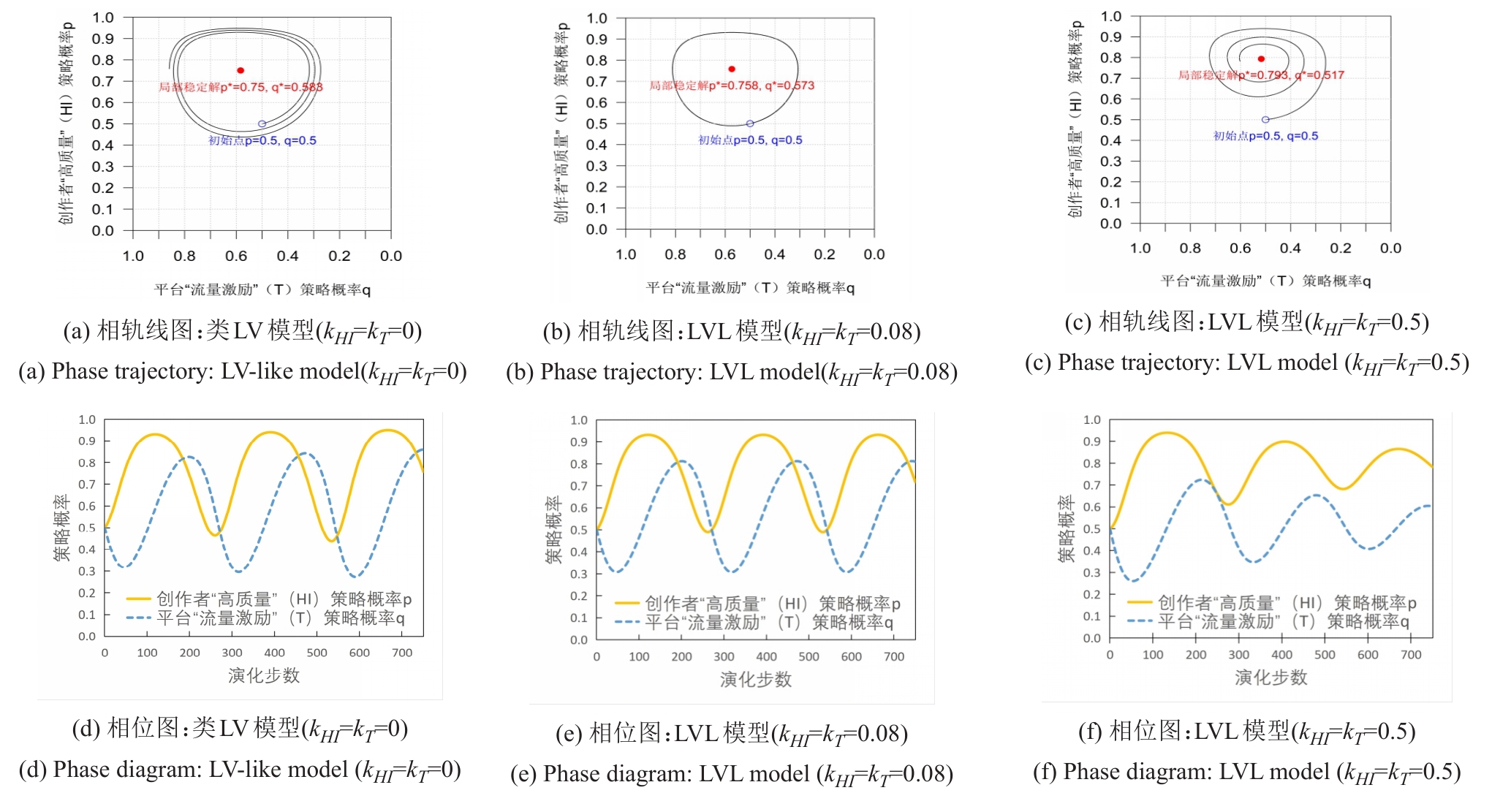
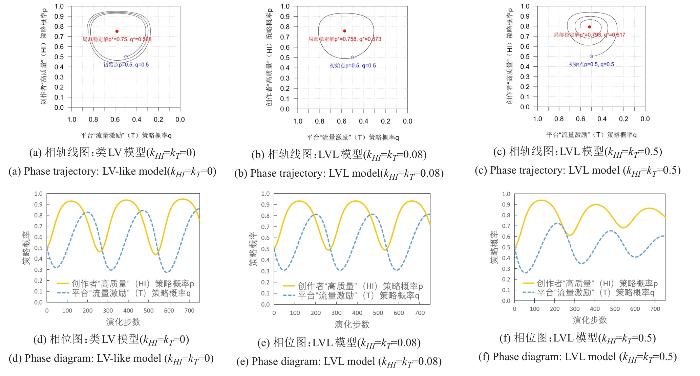
| 类LV模型 | 1 | 0.5 | 4 | 7.5 | 0.5 | 1.5 | 6 | 3 | 3 | 0 | 0 | 6 | 3.5 | 6 | 4.5 | 0.750 | 0.583 | 0.02 | 0.5 | 0.5 | |
| LVL 模型 | 1 | 0.5 | 4 | 7.5 | 0.5 | 1.5 | 6 | 3 | 3 | 1.2 | 1.2 | 6 | 3.5 | 6 | 4.5 | 0.833 | 0.417 | 0.02 | 0.5 | 0.5 | |
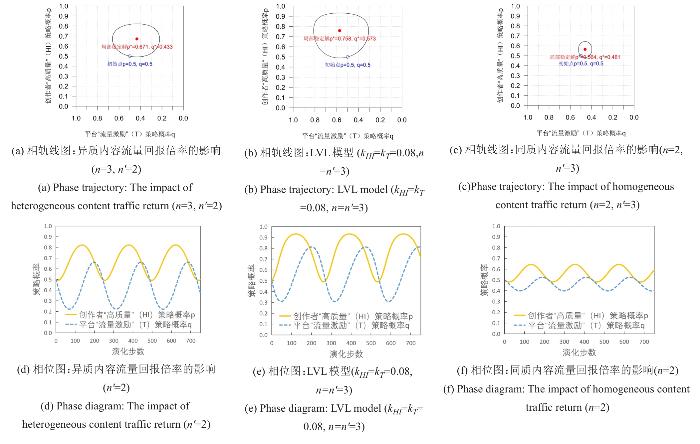
| 1 | 0.5 | 4 | 7.5 | 0.5 | 1.5 | 6 | 3 | 3 | 0.08 | 0.08 | 6 | 3.5 | 6 | 4.5 | 0.758 | 0.573 | 0.02 | 0.5 | 0.5 | ||
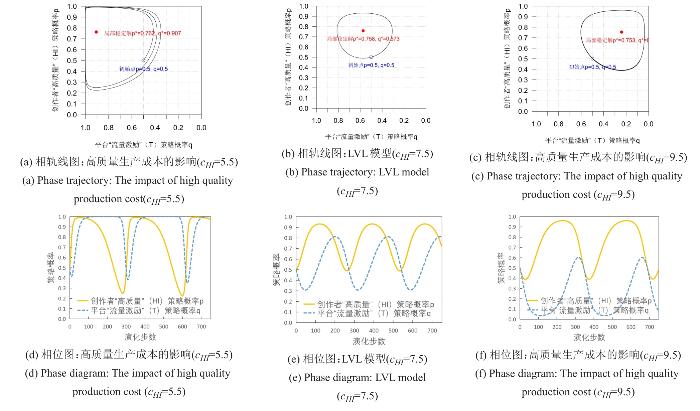
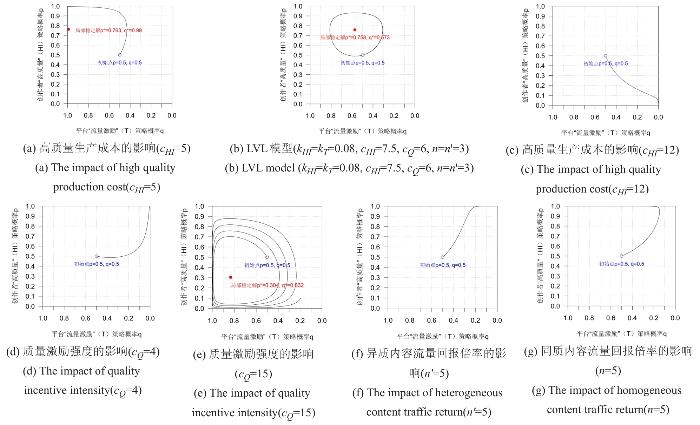
| 改变 cHI | 1 | 1 | 0.5 | 4 | 5.5 | 0.5 | 1.5 | 6 | 3 | 3 | 0.08 | 0.08 | 6 | 5.5 | 6 | 4.5 | 0.750 | 0.917 | 0.05 | 0.5 | 0.5 |
| 2 | 1 | 0.5 | 4 | 9.5 | 0.5 | 1.5 | 6 | 3 | 3 | 0.08 | 0.08 | 6 | 1.5 | 6 | 4.5 | 0.750 | 0.250 | 0.02 | 0.5 | 0.5 | |
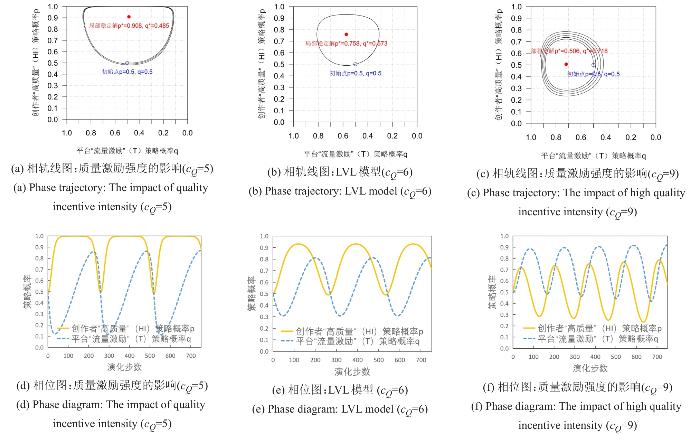
| 改变 cQ | 3 | 1 | 0.5 | 4 | 7.5 | 0.5 | 1.5 | 5 | 3 | 3 | 0.08 | 0.08 | 5 | 2.5 | 5 | 4.5 | 0.900 | 0.500 | 0.05 | 0.5 | 0.5 |
| 4 | 1 | 0.5 | 4 | 7.5 | 0.5 | 1.5 | 9 | 3 | 3 | 0.08 | 0.08 | 9 | 6.5 | 9 | 4.5 | 0.500 | 0.722 | 0.02 | 0.5 | 0.5 | |
| 改变 n/n' | 5 | 1 | 0.5 | 4 | 7.5 | 0.5 | 1.5 | 6 | 3 | 2 | 0.08 | 0.08 | 4.5 | 2 | 7.5 | 5 | 0.667 | 0.444 | 0.02 | 0.5 | 0.5 |
| 6 | 1 | 0.5 | 4 | 7.5 | 0.5 | 1.5 | 6 | 2 | 3 | 0.08 | 0.08 | 7.5 | 3.5 | 4.5 | 2.5 | 0.556 | 0.467 | 0.02 | 0.5 | 0.5 | |
| cHI 越界 | 7 | 1 | 0.5 | 4 | 5 | 0.5 | 1.5 | 6 | 3 | 3 | 0.08 | 0.08 | 6 | 6 | 6 | 4.5 | -- | -- | 0.02 | 0.5 | 0.5 |
| 8 | 1 | 0.5 | 4 | 12 | 0.5 | 1.5 | 6 | 3 | 3 | 0.08 | 0.08 | 6 | -1 | 6 | 4.5 | -- | -- | 0.02 | 0.5 | 0.5 | |
| cQ 越界 | 9 | 1 | 0.5 | 4 | 7.5 | 0.5 | 1.5 | 4 | 3 | 3 | 0.08 | 0.08 | 4 | 1.5 | 4 | 4.5 | -- | -- | 0.02 | 0.5 | 0.5 |
| 10 | 1 | 0.5 | 4 | 7.5 | 0.5 | 1.5 | 15 | 3 | 3 | 0.08 | 0.08 | 15 | 12.5 | 15 | 4.5 | 0.300 | 0.833 | 0.02 | 0.5 | 0.5 | |
| n/n' 越界 | 11 | 1 | 0.5 | 4 | 7.5 | 0.5 | 1.5 | 6 | 3 | 5 | 0.08 | 0.08 | 9 | 6.5 | 3 | 3.5 | -- | -- | 0.02 | 0.5 | 0.5 |
| 12 | 1 | 0.5 | 4 | 7.5 | 0.5 | 1.5 | 6 | 5 | 3 | 0.08 | 0.08 | 3 | 3.5 | 9 | 8.5 | -- | -- | 0.02 | 0.5 | 0.5 | |
表6 平台—创作者内容生产博弈演化路径模式Table 6 Analysis of the evolutionary path of the game between platforms and creators in content production |
| 创作者策略 | 平台策略 | ||
|---|---|---|---|
| 流量激励T(q) | 质量激励Q(1-q) | ||
| 高质量HI (p) | “流量密码”阶段开始 ΠC(HI, T) ΠC(LO, T) EC(HI) EC(LO) | q增大 EC(HI)减小 EC(LO)增大 | “一夜爆红”阶段开始 ΠP(HI, T) ΠP(HI, Q) EP(T) EP(Q) |
| p减小 EP(T)减小 | EP(T)增大 EP(Q)减小 | ||
| 低质量LO (1-p) | “信息倦怠”阶段开始 ΠP(LO, T) ΠP(LO, Q) EP(T) EP(Q) | EC(HI)增大 EC(LO)减小 q减小 | “内容培育”阶段开始 ΠC(HI, Q) ΠC(LO, Q) EC(HI) EC(LO) |
|
表7 不同内容领域的发展模式Table 7 Development models in different content domains |
| [1] |
张省, 蔡永涛. 算法时代“信息茧房”生成机制研究[J]. 情报理论与实践, 2023, 46(4): 67-73.
|
| [2] |
孙晋, 冯涛. 数字时代平台内容治理的挑战与应对——从平台分类分级和主体责任展开[J]. 学术界, 2026(1): 145-155.
|
| [3] |
年度网络内容治理研究课题组. 边界挑战与生态治理:2025年中国网络内容治理报告[J]. 新闻记者, 2026(1): 72-85.
Research Group on Annual Internet Content Governance. Boundary challenges and ecological governance: report on internet content governance in China 2025[J]. Shanghai journalism review, 2026(1): 72-85.
|
| [4] |
赵燕珊. 平台激励计划重塑内容创业的路径研究——以快手、B站等网络平台为例[J]. 科技创业月刊, 2026, 39(1): 165-172.
|
| [5] |
侯经川, 张晨旭. 博弈论在竞争情报中的应用[J]. 情报学报, 2022, 41(12): 1305-1313.
|
| [6] |
赵晓敏, 翟礼滢, 蒋茵. 基于数字化赋能的平台供应链演化博弈决策[J]. 管理学报, 2023, 20(6): 925- 935.
|
| [7] |
张耀坤, 吴瑞, 宗金星. 基于SD的学术社交网络科研协同行为演化博弈分析[J]. 现代情报, 2022, 42(7): 68-80.
|
| [8] |
盛志云, 邵记友, 徐榕桦. 平台所有者和参与企业数据共享行为的微分博弈研究[J]. 现代情报, 2023, 43(3): 83-95.
|
| [9] |
王勇, 刘乐易, 迟熙, 等. 流量博弈与流量数据的最优定价——基于电子商务平台的视角[J]. 管理世界, 2022, 38(8): 116-132.
|
| [10] |
|
| [11] |
宋美慧, 王维才. 能源安全背景下企业与政府间双方演化博弈行为研究[J]. 中国软科学, 2022(9): 152-160.
|
| [12] |
卢方元. 环境污染问题的演化博弈分析[J]. 系统工程理论与实践, 2007(9): 148-152.
|
| [13] |
杨广青. Bertrand竞争下融资策略与产品差异化策略的博弈分析[J]. 中国管理科学, 2006(4): 88-94.
|
| [14] |
胡明礼. 企业集群演进的进化博弈链模型研究[J]. 科技进步与对策, 2006(11): 34-37.
|
| [15] |
徐松鹤, 胡少龙, 韩传峰. 基于改进复制动态方程的邻避事件随机演化博弈模型[J]. 数学的实践与认识, 2021, 51(15): 1-12.
|
| [16] |
商淑秀, 张再生. 虚拟企业知识共享演化博弈分析[J]. 中国软科学, 2015(3): 150-157.
|
| [17] |
王先甲, 何奇龙, 全吉. 基于复制动态的消费者众筹策略演化动态[J]. 系统工程理论与实践, 2017, 37(11): 2812-2820.
|
| [18] |
刘雅姝, 张海涛, 任亮, 等. 商务网络信息生态链价值协同创造的演化博弈研究[J]. 情报学报, 2019, 38(9): 932-942.
|
| [19] |
常永华, 李春玲. 基于演化博弈的电子政务信息服务模型分析研究[J]. 情报学报, 2013, 32(7): 733-741.
|
| [20] |
杨奇光. 平台方与出版商:数字视听产业的平台化实践与生态治理[J]. 编辑之友, 2023(1): 45-51.
|
| [21] |
欧阳耀福. 互联网平台化组织模式对企业创新的影响研究[J]. 经济研究, 2023, 58(4): 190-208.
|
| [22] |
赵连霞, 刘佳, 张小峰, 等.三方博弈视角下供应商社会责任审查策略研究[J]. 管理学报, 2023, 20(9): 1380-1388.
|
| [23] |
卢超, 王璇璇, 周迪, 等.平台企业数据滥用行为的治理机制研究——基于多主体演化博弈视角[J]. 工程管理科技前沿, 2023, 42(2): 16-24.
|
| [24] |
赵璐. 算法实践的社会建构——以某信息分发平台为例[J]. 社会学研究, 2022, 37(4): 23-44. 226-227.
|
| [25] |
刘建刚, 吴倩, 张美娟.直播带货平台生态体系价值共毁的演化博弈[J]. 中国管理科学, 2023, 31(3): 143-154.
|
| [26] |
王克, 秦江涛.考虑合谋行为下的短视频平台监管策略演化博弈研究[J]. 经济研究导刊, 2021(36): 90-94, 116.
|
| [27] |
|
| [28] |
|
| [29] |
|
| [30] |
|
| [31] |
教育行业黑板报.B站1w播放量能赚多少钱?揭秘UP主真实收入内幕[EB/OL]. [2026-03-08].
|
| [32] |
瓴麟科技, 浦软学院.何同学与科技叙事:从“5G 测评”到“人文科技博主”, 技术内容的情感化破圈[EB/OL]. [2026-03-08].
|
| [33] |
罗茂林.动画短剧月流水破千万元 B站推出扶持政策“觉醒计划”[EB/OL]. [2026-03-08].
|
| [34] |
韦英姿.十亿流量激励, B站切入视频播客市场[EB/OL]. [2026-03-08].
|
| [35] |
廖尔摩斯|设计大侦探.1.4 万字产品拆解!3.15亿Z时代用户为何热爱哔哩哔哩?[EB/OL]. [2026-03-08].
|
| [36] |
|
| [37] |
|
/
| 〈 |
|
〉 |

 EP(Q)增大
 p增大
p增大