

面向动态谣言识别的领域自适应大语言模型微调框架研究
Research on a Domain-Adaptive Large Language Model Fine-Tuning Framework for Dynamic Rumor Detection
摘要
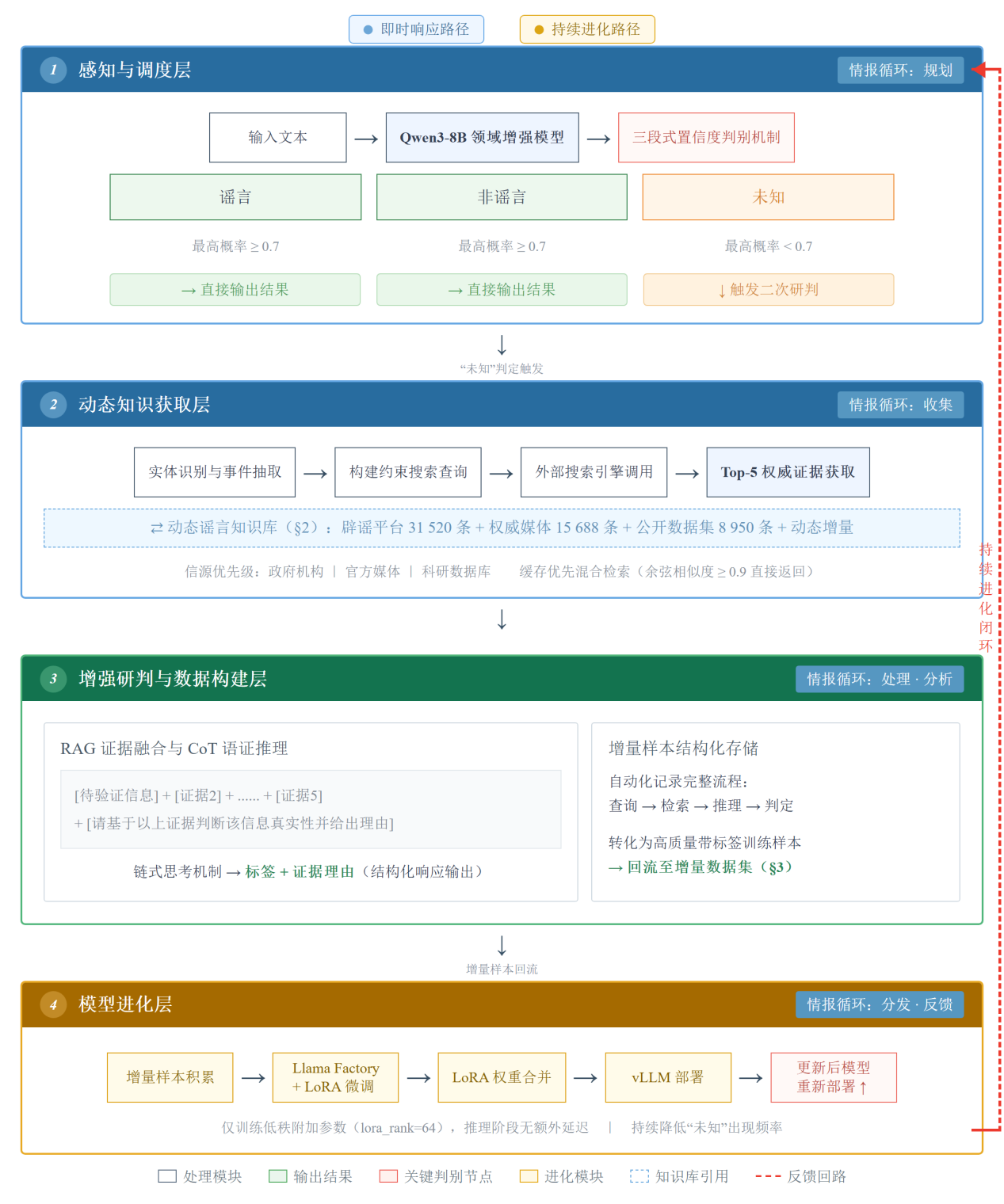
[目的/意义] 针对大语言模型在面对突发性网络谣言时受限于静态知识边界而无法准确判断的未知难题,传统静态识别方案缺少实时事实核查能力,难以适应不断涌现、形式多变的新型谣言,本研究设计并实现了一种检索—学习一体化的动态谣言识别新范式,提升模型对新发谣言的识别准确率,助力网络舆情自动化治理。[方法/过程] 本研究以Qwen3-8B微调模型为基础模型,设计谣言—非谣言—未知的三段式判断机制。当模型对输入信息判定为未知时,系统将自动触发网络搜索引擎,抓取权威信源证据,并将检索结果作为即时上下文,供模型进行二次精准研判。系统同时对每一次成功的查询、佐证与判别过程进行结构化存储,构建增量样本集,并采用轻量化低秩自适应微调技术,对基础模型进行周期性更新,从而实现检索增强与持续学习的一体化协同,形成实时查证、样本积累和模型迭代的闭环工作流程。[结果/结论] 实验结果表明,该方法在谣言识别任务中表现突出,F1值达到0.96,FTCA指标达到94.8,显著优于多种主流基线模型,且在应对突发与新型谣言场景中,能有效降低未知判定比例,表现出良好的稳定性与实用性,可为动态网络虚假信息智能研判提供技术参考,也为检索增强类谣言检测模型的优化提供新思路。
Abstract
[Purpose/Significance] Faced with emergent online rumors, large language models are restricted by static knowledge boundaries and fail to produce accurate judgments. Traditional static recognition schemes lack real-time fact-checking capability and cannot adapt to emerging and diversely expressed new rumors. This study designs and implements an integrated retrieval-learning dynamic rumor recognition paradigm to improve the model’s recognition accuracy for newly emerging rumors and facilitate automatic governance of online public opinions. [Method/Process] Taking the fine-tuned Qwen3-8B as the base model, this study constructed a three-category discrimination mechanism including rumor, non-rumor and unknown. If the input information is judged as unknown by the model, the system automatically activated the Web search engine to capture evidence from authoritative sources, and took the retrieved results as real-time context for the model to conduct secondary accurate evaluation. The system structurally stored every successful query, supporting evidence and discrimination record to build an incremental sample set. Lightweight low-rank adaptive fine-tuning technology was adopted to periodically update the base model, so as to realize the integrated coordination of retrieval augmentation and continual learning, and form a complete closed loop of real-time verification, sample accumulation and model iteration. [Result/Conclusion] Experimental results show that the proposed method achieves excellent performance in the rumor recognition task, with an F1-score of 0.96 and an FTCA index of 94.8, which is significantly better than many mainstream baseline models. When dealing with sudden and novel rumors, it can effectively reduce the proportion of unknown judgments and presents favorable stability and practicability. It can provide technical references for the intelligent identification of dynamic online disinformation, and also offer new ideas for optimizing retrieval-augmented rumor detection models.
关键词
谣言识别 / 大语言模型 / 监督式微调 / 检索增强生成 / 低秩自适应 / 链式思考推理
Key words
rumor detection / large language model / supervised fine-tuning / retrieval-augmented generation / low-rank adaptation / chain-of-thought reasoning
{{custom_sec.title}}
{{custom_sec.title}}
| [1] |
|
| [2] |
|
| [3] |
郭长青, 侯勇光. 情报感知视角下社交媒体信息迷雾线索识别研究[J]. 情报杂志, 2023, 42(7): 140-146.
|
| [4] |
朱鹏, 陈晓天, 王有建, 等. 融合超图的演化博弈网络谣言传播模型研究[J]. 情报理论与实践, 2025, 48(8): 11-20.
|
| [5] |
王根生, 朱奕, 李胜. 一种融合知识图谱的图注意力神经网络谣言实时检测方法[J]. 数据分析与知识发现, 2024, 8(6): 95-106.
|
| [6] |
曾子明, 张瑜. 基于数据增强和多任务学习的突发公共卫生事件谣言识别研究[J]. 数据分析与知识发现, 2023, 7(11): 56-67.
|
| [7] |
潘杰, 王娟, 王楠. 大语言模型与谣言: 生成与检测的综述[J]. 计算机科学, 2025, 52(11): 1-12.
|
| [8] |
司赟, 苏依拉, 仁庆道尔吉, 等. 基于多模态融合和知识感知的谣言检测方法[J].计算机应用与软件, 2025, 42(10): 177-182, 221.
|
| [9] |
吴诗苑, 董庆兴, 宋志君, 等. 社交媒体中错误信息的检测方法研究述评[J].情报学报, 2022, 41(6): 651-661.
|
| [10] |
黄涛, 肖玉芝, 向洁萍, 等. 融合多层级特征表示的多领域谣言早期检测方法[J]. 情报杂志, 2025, 44(4): 127-135.
|
| [11] |
|
| [12] |
阳长征. 算法推荐语境下突发事件网络谣言信息时空泛化与共变影响研究[J]. 情报杂志, 2025, 44(5): 104-111.
|
| [13] |
石锴文, 刘勘. 突发公共卫生事件中微博谣言的识别[J].图书情报工作, 2021, 65(13): 87-95.
|
| [14] |
丁浩, 刘清, 齐江蕾, 等. 基于网络突发公共卫生事件早期谣言识别研究——以新冠疫情谣言为例[J].情报科学, 2023, 41(4): 156-163.
|
| [15] |
中国互联网联合辟谣平台. 中国互联网联合辟谣平台[EB/OL].[2026-06-23].
China Internet Joint Rumor-Busting Platform. China Internet Joint Rumor-Busting Platform[EB/OL].[2026-06-23].
|
| [16] |
陈燕方, 周晓英. 基于文本特征融合的衍生性网络健康谣言识别模型研究[J]. 图书情报工作, 2023, 67(14): 73-84.
|
| [17] |
Weibo 21 中文谣言检测数据集. Weibo21中文谣言检测数据集[DS/OL].
Weibo 21 Chinese rumor detection dataset[DS/OL].
|
| [18] |
李贺, 杨心苗, 沈旺, 等. 启发式图结构增强的社交媒体短文本谣言检测研究[J]. 情报理论与实践, 2025, 48(3): 151-159.
|
| [19] |
|
| [20] |
|
| [21] |
杨洋洋, 谢雪梅. 三元主体交互视角下网络谣言监管的博弈演化研究[J].现代情报, 2021, 41(5): 167-177.
|
| [22] |
蒋超, 朱学芳. 基于模态融合增强的谣言检测研究[J]. 数据分析与知识发现, 2025, 9(7): 26-37.
|






/
| 〈 |
|
〉 |