

生成式人工智能背景下网络信息内容生态机制研究
Research on the Ecological Mechanism of Online Information Content in the Context of Generative Artificial Intelligence
- Liu Ting ,
- Zhou Jia ,
- Xu Xiaofang ,
- Hu Yuan
摘要
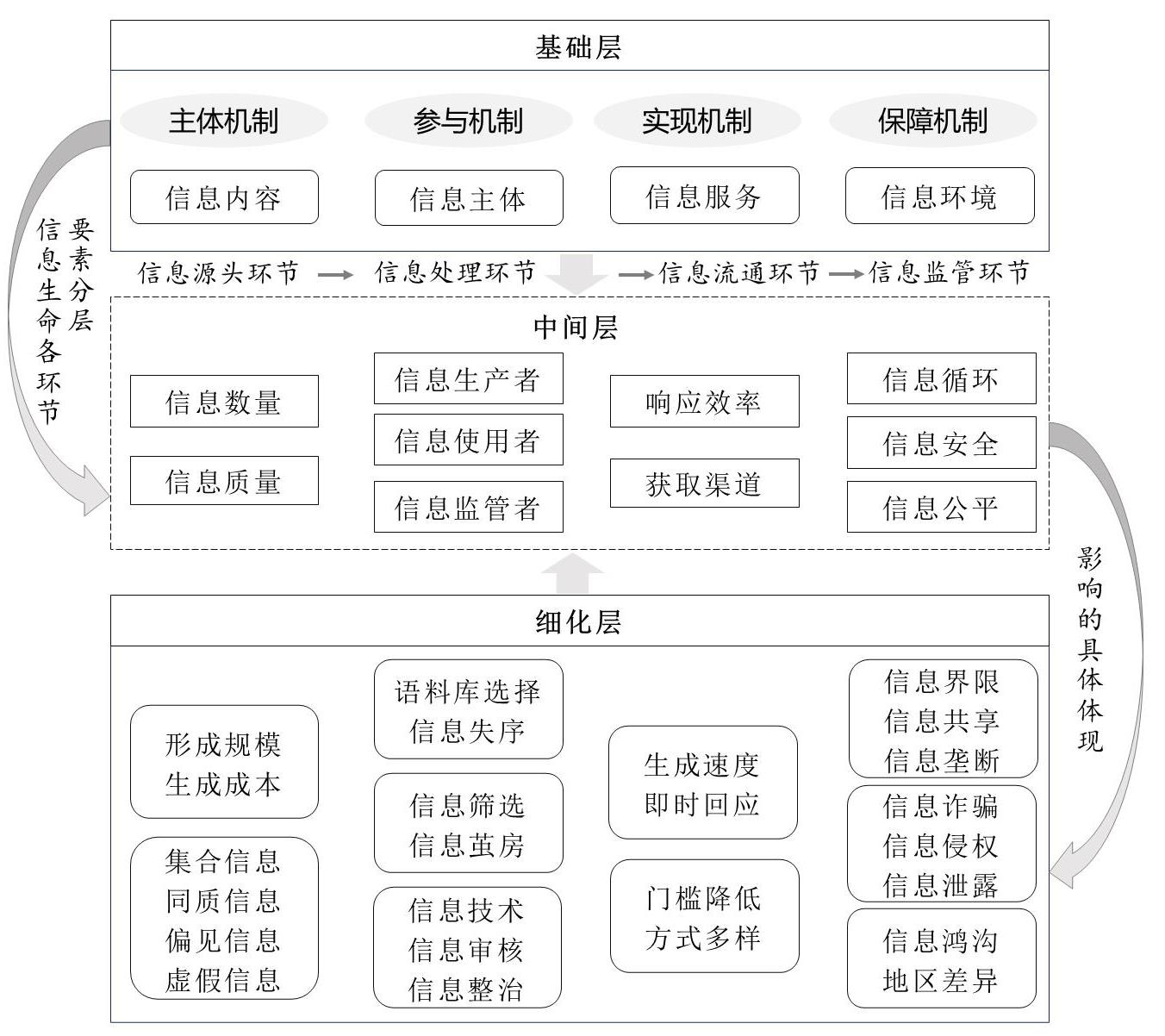
[目的/意义] 探究生成式人工智能的发展给网络信息内容生态机制带来的影响,为优化网络信息内容生态、提升信息利用效能提供作用。[方法/过程] 采用扎根理论研究方法,对生成式人工智能和网络信息内容生态机制相关的文献及政策文件进行开放式编码、主轴编码及选择性编码,构建包含主体机制、参与机制、实现机制和保障机制的生成式人工智能背景下的网络信息内容生态机制。然后,对网络信息内容生态机制内部的相互影响关系进行分析,并解析生成式人工智能对网络信息内容机制的影响路径,在此基础上选择自媒体平台AI应用情况作为案例,验证4条影响路径的合理性。[结果/结论] 研究发现,生成式人工智能对主体机制、参与机制、实现机制、保障机制存在4条影响路径,整体分析逻辑为生成式人工智能—信息内容—信息主体—信息服务—信息环境,在自媒体平台的案例中都能得到有效验证,印证了各路径的合理性与可行性,也充分体现了生成式人工智能对信息内容影响的系统性与动态性。最后,为优化生成式人工智能背景下的网络信息内容生态机制提出一些建议:需规范生成合成内容的传播、严格审查生成模型语料库的选择、强化用户信息判断和信息筛选的能力、明确生成内容涉及的版权问题。
Abstract
[Purpose/Significance] This paper explores the impact of the development of generative artificial intelligence on the ecological mechanism of network information content, and provides a role in optimizing the ecological mechanism of network information content and improving the efficiency of information utilization. [Method/Process] This paper adopted the grounded theory research method to carry out open coding, axial coding and selective coding on the literature and policy documents related to the ecological mechanism of generative artificial intelligence and network information content, and construct the ecological mechanism of network information content under the background of generative artificial intelligence including subject mechanism, participation mechanism, realization mechanism and guarantee mechanism. Then, the mutual influence relationship within the ecological mechanism of network information content was analyzed, and the influence path of generative artificial intelligence on the mechanism of network information content was analyzed. On this basis, the application of self-media platform AI was selected as a case to verify the rationality of the four influence paths. [Result/Conclusion] The study finds that the overall analytical logic of generative artificial intelligence with respect to the subject mechanism, participation mechanism, realization mechanism, and guarantee mechanism follows the chain: generative artificial intelligence-information content-information subjects-information services-information environment. Moreover, all four influence pathways have been effectively validated through case studies on self-media platforms. This not only confirms the rationality and feasibility of each pathway, but also fully demonstrates the systematic and dynamic nature of generative artificial intelligence's impact on information content. Finally, some suggestions are put forward to optimize the ecological mechanism of network information content under the background of generative artificial intelligence: it is necessary to standardize the dissemination of generated synthetic content, strictly review the selection of generated model corpus, strengthen the ability of user information judgment and information screening, and clarify the copyright issues involved in generated content.
关键词
网络信息内容生态 / 生成式人工智能 / 扎根理论 / 影响机制
Key words
network information content ecology / generative artificial intelligence / grounded theory / influence mechanism
{{custom_sec.title}}
{{custom_sec.title}}
| [1] |
张力, 何振, 毛太田. 生成式人工智能信息获取对信息茧房的双刃剑效应[J]. 情报资料工作, 2026, 47(3): 104-112.
|
| [2] |
张庆锋. 网络生态论[J]. 情报资料工作, 2000(4): 2-4.
|
| [3] |
魏傲希, 马捷, 韩朝. 网络信息生态系统自我调整能力及实现机制研究[J]. 图书情报工作, 2014, 58(15): 14-21.
|
| [4] |
|
| [5] |
娄策群, 李青维, 娄冬. 网络信息生态环境中的信息制度环境优化研究[J]. 图书馆学研究, 2016(23): 2-6.
|
| [6] |
|
| [7] |
张新新, 黄如花. 生成式智能出版的应用场景、风险挑战与调治路径[J]. 图书情报知识, 2023, 40(5): 77-86, 27.
|
| [8] |
李荣, 吴晨生, 董洁, 等. ChatGPT对开源情报工作的影响及对策[J]. 情报理论与实践, 2023, 46(5): 1-5.
|
| [9] |
漆晨航. 生成式人工智能的虚假信息风险特征及其治理路径[J]. 情报理论与实践, 2024, 47(3): 112-120.
|
| [10] |
侯东德, 张丽萍. 生成式人工智能背景下网络信息生态风险的法律规制[J]. 社会科学研究, 2023(6): 93-104.
|
| [11] |
薛志华. 生成式人工智能对网络信息内容治理的挑战及应对[J]. 中国广播电视学刊, 2023(10): 13-16.
|
| [12] |
赵梓羽. 生成式人工智能数据安全风险及其应对[J]. 情报资料工作, 2024, 45(2): 30-37.
|
| [13] |
|
| [14] |
储节旺, 罗怡帆, 李佳轩. AIGC对信息生成方式及用户信息行为的影响[J]. 图书情报工作, 2023, 67(24): 13-23.
|
| [15] |
|
| [16] |
苏君华, 宋雯琪. 人工智能生成内容技术赋能下的集群式信息攻防研究综述[J]. 情报理论与实践, 2024, 47(9): 9-21.
|
| [17] |
王贇芝, 王欣昱, 陈洁. 面向网络信息内容生态治理的旁观者用户干预意愿触发机理研究[J]. 情报资料工作, 2024, 45(6): 66-74.
|
| [18] |
严炜炜, 宋佳慧, 王妍妍. 基于制度文本分析的网络信息内容生态协同治理研究[J]. 图书情报知识, 2024, 41(5): 115-127.
|
| [19] |
|
| [20] |
聂冰, 王婷,
|
| [21] |
喻国明, 金丽萍. 生成式媒介的极致优化: DeepSeek对传播生态的系统性影响[J]. 新疆师范大学学报(哲学社会科学版), 2025(4): 1-9.
|
| [22] |
|
| [23] |
张瑞娟. 生成式人工智能驱动信息资源组织与服务研究向度质性分析与反思[J]. 档案管理, 2024(3): 19-21.
|
| [24] |
曾森. 生成式人工智能与国家治理信息机制变革: 以ChatGPT为例[J]. 理论月刊, 2024(8): 82-94.
|
| [25] |
梁怀新, 宋诚. AIGC时代的网络信息内容生态安全风险及其治理——兼以ChatGPT为对象的实验访谈案例分析[J]. 图书情报工作, 2023, 67(20): 58-69.
|
| [26] |
李孟瑶. 生成式人工智能浪潮下的内容生产革新[J]. 全媒体探索, 2024(6): 136-138.
|
| [27] |
支振锋. 生成式人工智能大模型的信息内容治理[J]. 政法论坛, 2023, 41(4): 34-48.
|
| [28] |
张涛甫. 人工智能推动舆论生态转型及其治理进路[J]. 学术月刊, 2024, 56(2): 149-157.
|
| [29] |
徐腾飞. 生成式人工智能阅读推广与读者思维的信息茧房[J]. 图书情报导刊, 2024, 9(1): 25-31.
|
| [30] |
李瑾颉, 吴联仁, 齐佳音. 对抗AIGC虚假信息的行为助推与认知干预研究[J]. 青年记者, 2025, (5): 53-57.
|
| [31] |
蒙新梦. 生成式人工智能对话式搜索对个人用户信息搜寻行为的影响研究[J]. 社会科学前沿, 2024, 13(7): 591-598.
|
| [32] |
宋行健. 生成式人工智能处理信息的法律风险应对[J]. 黑龙江省政法管理干部学院学报, 2024(5): 129-135.
|
| [33] |
吴进, 王立杰, 昝栋. DeepSeek赋能高校图书馆信息服务提升研究——以中国海洋大学图书馆为例[J].高校图书馆工作, 2025, 45(2): 22-29.
|
| [34] |
张欣. 面向产业链的治理: 人工智能生成内容的技术机理与治理逻辑[J]. 行政法学研究, 2023(6): 43-60.
|
| [35] |
丁亚南. 人工智能生成内容的传播风险及其法律规制研究[J]. 四川轻化工大学学报(社会科学版), 2025(4): 1-12.
|
| [36] |
|
| [37] |
|
基金






/
| 〈 |
|
〉 |