
人工智能与风险治理研究:主题分野与走向展望

李睿绎

知识管理论坛 ›› 2026, Vol. 11 ›› Issue (3) : 0.

知识管理论坛 ›› 2026, Vol. 11 ›› Issue (3) : 0. DOI: 10.13266/j.issn.2095-5472.2026.019  CSTR: 32306.14.j.issn.2095-5472.2026.019
研究论文

人工智能与风险治理研究:主题分野与走向展望

作者信息 +

Artificial Intelligence and Risk Governance: Thematic Division and Future Outlook

Author information +
文章历史 +

摘要

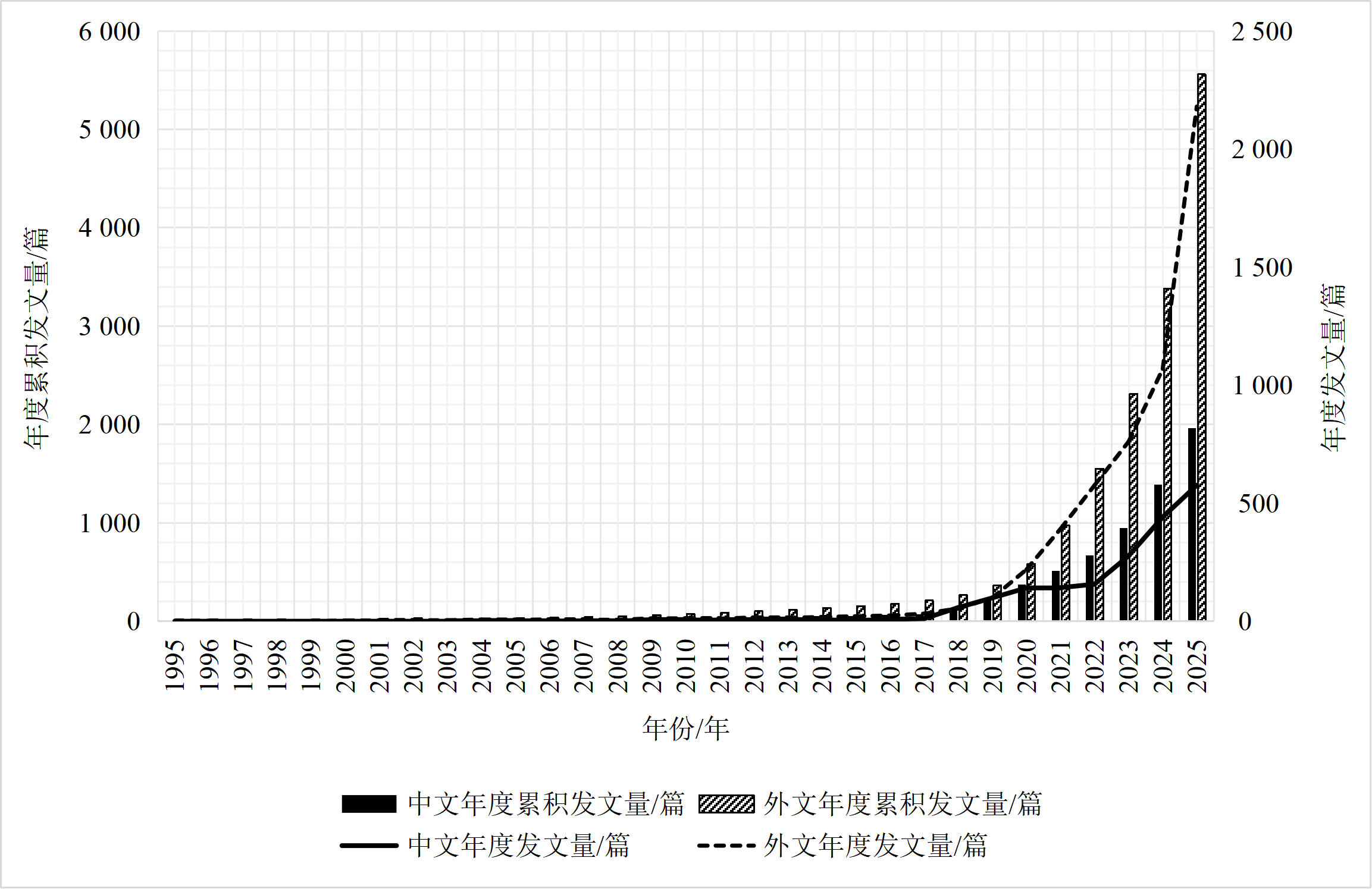
【目的/意义】归纳并梳理中外人工智能与风险治理研究领域的主题分野与演进趋势,明确未来研究走向,为推动该领域理论深化与研究体系完善提供参考。【方法/过程】基于Web of Science核心合集与CNKI数据库,以人工智能与风险治理领域的5 560篇外文文献(1995—2025年)与1 964篇中文文献(2003—2025年)为数据样本,利用VOSviewer 1.6.20与Cytoscape 3.10.4软件进行科学知识图谱分析,明确总体发文趋势、核心研究领域、主题演化时序、研究特征差异、未来发展进路。【结果/结论】结果表明,外文文献的研究主题可划分为人工智能驱动下的不确定性系统风险治理、数字化转型风险治理、人身风险治理三大领域,在主题演进时序上遵循从分散到整合、从技术导向到治理导向的清晰路径;中文文献研究主题包括人工智能算法风险治理、人工智能战略风险治理、生成式人工智能应用风险治理,遵循“技术本体治理—技术规范治理—技术应用治理”的演化趋势。中外研究在研究导向、研究学科、研究对象、研究范式上存在显著差异。未来应强化可信AI应用、细化理性思维培育、深化学科交叉耦合、量化理论落地实证、优化国际合作共识等方面的研究。

Abstract

[Purpose/Significance] To summarize and sort out the thematic division and evolutionary trends in the field of artificial intelligence and risk governance research at home and abroad, clarify future research directions, and provide reference for promoting theoretical deepening and research system improvement in this field. [Method/Process] Based on the Web of Science core collection and CNKI database, 5560 foreign literature (1995-2025) and 1964 Chinese literature (2003-2025) in the field of artificial intelligence and risk governance were used as data samples. VOSviewer 1.6.20 and Cytoscape 3.10.4 software was used for scientific knowledge map analysis to clarify the overall publication trend, core research areas, thematic evolution time sequence, research feature differences, and future development path. [Result/Conclusion] The results indicate that the research topics of foreign literature can be divided into three major areas: uncertainty system risk governance driven by artificial intelligence, digital transformation risk governance driven by artificial intelligence, and personal risk governance driven by artificial intelligence. In terms of theme evolution, it follows a clear path from decentralization to integration, and from technology orientation to governance orientation. The research topics of Chinese literature include artificial intelligence algorithm risk governance, artificial intelligence strategic risk governance, and generative artificial intelligence application risk governance, following the evolutionary trend of "technology ontology governance - technology specification governance - technology application governance". There are significant differences in research orientation, research disciplines, research objects, and research paradigms between Chinese and foreign research. Future research should strengthen trustworthy AI applications, refine rational thinking cultivation, deepen interdisciplinary coupling, quantify theoretical implementation and empirical evidence, and optimize international cooperation consensus.
关键词

人工智能 / 风险治理 / 主题分野 / 知识图谱

Key words

artificial intelligence / risk governance / thematic division / knowledge map

引用本文

导出引用
李睿绎. 人工智能与风险治理研究:主题分野与走向展望[J]. 知识管理论坛. 2026, 11(3): 0 https://doi.org/10.13266/j.issn.2095-5472.2026.019
Li Ruiyi. Artificial Intelligence and Risk Governance: Thematic Division and Future Outlook[J]. Knowledge Management Forum. 2026, 11(3): 0 https://doi.org/10.13266/j.issn.2095-5472.2026.019
中图分类号: G301   

参考文献

[1]
郎平.全球人工智能治理的进展、挑战与中国角色[J]. 当代世界, 2025, (5): 16-22.
LANG P. Progress and challenges of global Al governance and China's role[J]. Contemporary world, 2025(5): 16-22.
[2]
CAI B P, SHENG C Y, GAO C T, et al. Artificial intelligence enhanced reliability assessment methodology with small samples[J]. IEEE transactions on neural networks and learning systems, 2023, 34(9): 6578-6590.
[3]
AZIM A BIN, ALI A, ALI S, et al. Q-Spherical fuzzy rough frank aggregation operators in AI neural networks: applications in military transport systems[J]. IEEE access, 2024, 12: 104215-104241.
[4]
DHANUSHKODI K, THEJAS S. AI enabled threat detection: leveraging artificial intelligence for advanced security and cyber threat mitigation[J]. IEEE access, 2024, 12: 173127-173136.
[5]
HUANG F, CAO M, WANG L. Approximate policy iteration for robust stochastic control of multiagent markov decision processes[J]. IEEE transactions on automatic control, 2025, 70(6): 3587-3602.
[6]
WANG Z Q, WANG H P, SADDIK A EL. FedITD: a federated parameter-efficient tuning with pre-trained large language models and transfer learning framework for insider threat detection[J]. IEEE access, 2024, 12: 160396-160417.
[7]
YANG C Y, LIU J, SUN H, et al. WTDP-Shapley: efficient and effective incentive mechanism in federated learning for intelligent safety inspection[J]. IEEE transactions on big data, 2024, 10(6): 1028-1037.
[8]
WANG T, HE Y, HAO M Y. Real-Time cyber threat detection in smart cities using artificial intelligence[J]. IEEE transactions on consumer electronics, 2025, 71(2): 4744-4750.
[9]
FARHAN M, NAEEM M R, ALMADHOR A, et al. Explainable AI-Driven security framework for cyber-physical production systems in industry 4.0: leveraging immersive embedded CIoT[J]. IEEE transactions on consumer electronics, 2025, 71(4): 10446-10453.
[10]
BARYANNIS G, VALIDI S, DANI S, et al. Supply chain risk management and artificial intelligence: state of the art and future research directions[J]. International journal of production research, 2019, 57(7): 2179-2202.
[11]
WANG H, SHAO W B, SUN C, et al. A survey on an emerging safety challenge for autonomous vehicles: safety of the intended functionality[J]. Engineering, 2024, 33: 17-34.
[12]
OTTUN A R, AKINTOLA A, LIYANAGE M, et al. AI robustness against attacks in city-scale autonomous drone deployments[J]. Computer, 2024, 57(12): 47-57.
[13]
ULNICANE I. Governance fix? power and politics in controversies about governing generative AI[J]. Policy and society, 2025, 44(1): 70-84.
[14]
ROFF H M. The frame problem: the AI arms race isn't one[J]. Bulletin of the atomic scientists, 2019, 75(3): 95-98.
[15]
NAZIR M, RASHEED M Q, YU X H, et al. Can computer technology, semiconductors, and artificial intelligence shape a sustainable future? evidence from leading semiconductor-producing countries[J]. Sustainable development, 2025, 33(4): 5214-5233.
[16]
NUJUMUDEEN F, ANUJA V, DEVI R, et al. AI in financial services: fraud detection and risk management[J]. Metallurgical materials engineering, 2025, 31(3): 119-127.
[17]
PRISZNYÁK A. Bankrobotics: artificial intelligence and machine learning powered banking risk management prevention of money laundering and terrorist financing[J]. Public finance quarterly-Hungary, 2022, 67(2): 288-303.
[18]
HSU M F, HSIN Y S, SHIUE F J. Business analytics for corporate risk management and performance improvement[J]. Annals of operations research, 2022, 315(2): 629-669.
[19]
BUSSMANN N, GIUDICI P, MARINELLI D, et al. Explainable machine learning in credit risk management[J]. Computational economics, 2021, 57(1): 203-216.
[20]
RATKU A, NEUMANN D. Derivatives of feed-forward neural networks and their application in real-time market risk management[J]. OR spectrum, 2022, 44(3): 947-965.
[21]
YOON J, ALKHUDARY R, TALLURI S, et al. Risk management and macroeconomic disruptions in supply chains: the role of blockchain, digital twins, generative AI, and quantum computing[J]. IEEE transactions on engineering management, 2025, 72: 2995-3009.
[22]
HE Y X, TAO W J, DAI A Y, et al. Risk comprehensive evaluation of urban network planning based on fuzzy Bayesian LS_SVM[J]. Kybernetes, 2010, 39(5), 707-722.
[23]
SARI O F, AMER E, BADER-EL-DEN M, et al. AI-driven risk assessment in food safety using EU RASFF Database[J]. Food and bioprocess technology, 2025, 18(7): 6282-6303.
[24]
SHARMA A, SHARMA A, RAJU K N, et al. Synergistic integration of 5G-enabled cloud native infrastructures with advanced technologies for urban safety enhancement[J]. IEEE transactions on consumer electronics, 2025, 71(2): 5321-5334.
[25]
NAINIVA S P, JAJARM S S, MOHAMMADREZAEI M, et al. Soil erosion risk prediction: an assessment of qualitative and quantitative modeling approaches[J]. Journal of sedimentary environments, 2025, 10(2): 261-280.
[26]
JIANG S, LI J Y, ZHANG S, et al. Landslide risk prediction by using GBRT algorithm: application of artificial intelligence in disaster prevention of energy mining[J]. Process safety and environmental protection, 2022, 166: 384-392.
[27]
ZONNO G, GARCÍA-FERNÁNDEZ M, JIMÉNEZ M J, et al. The SERGISAI procedure for seismic risk assessment[J]. Journal of seismology, 2003, 7(2): 259-277.
[28]
CHEN K, BLONG R. Towards an integrated approach to natural hazards risk assessment using GIS: with reference to bushfires[J]. Environmental management, 2003, 31(4): 546-560.
[29]
THEKDI S, TATAR U, SANTOS J, et al. On the compatibility of established methods with emerging artificial intelligence and machine learning methods for disaster risk analysis[J]. Risk analysis, 2025, 45(4): 863-877.
[30]
KOUROUTZAS C, PALAMARI V. Opening the black boxes of the black carpet in the era of risk society: a sociological analysis of AI, algorithms and big data at work through the case study of the Greek postal services[J]. AI society, 2025, 40(2): 825-838.
[31]
DELGADO J, DE MANUEL A, PARRA I, et al. Bias in algorithms of AI systems developed for COVID-19: a scoping review[J]. Journal of bioethical inquiry, 2022, 19(3): 407-419.
[32]
ANDRADE R O, YOO S G, TELLO-OQUENDO L, et al. A comprehensive study of the IoT cybersecurity in smart cities[J]. IEEE access, 2020, 8: 228922-228941.
[33]
DUNG L. Is superintelligence necessarily moral?[J]. Analysis, 2024, 84(4): 730-738.
[34]
MOORADIAN N, FRANKS P C, SRIVASTAV A. The impact of artificial intelligence on data privacy: a risk management perspective[J]. Records management journal, 2025, 35(2): 147-159.
[35]
DANAHER J. Why AI doomsayers are like sceptical theists and why it matters[J]. Minds and machines, 2015, 25(3): 231 246.
[36]
MIKALSEN S G, SKJOTSKIFT T, FLOTE V G, et al. Extensive clinical testing of deep learning segmentation models for thorax and breast cancer radiotherapy planning[J]. Acta oncologica, 2023, 62(10): 1184-1193.
[37]
CHEN M, WU S, ZHAO W, et al. Application of deep learning to auto - delineation of target volumes and organs at risk in radiotherapy[J]. Cancer radiotherapie, 2022, 26(3): 494-501.
[38]
BAEK J W, CHUNG K. Context deep neural network model for predicting depression risk using multiple regression[J]. IEEE access, 2020, 8: 18171-18181.
[39]
MAYOURIAN J, EL-BOKL A, LUKYANENKO P, et al. Electrocardiogram-based deep learning to predict mortality in paediatric and adult congenital heart disease[J]. European heart journal, 2024, 46(9): 856-868.
[40]
CAYIRTEPE Z, SENEL A C. Risk management in intensive care units with artificial intelligence technologies: systematic review of prediction models using electronic health records[J]. Journal of basic and clinical health sciences, 2022, 6(3): 958-976.
[41]
朴毅, 叶斌, 徐飞.从算法分析看人工智能的价值非中立性及其应对[J]. 科技管理研究, 2020, 40(24): 245-251.
PIAO Y, YE B, XU F. The value non-neutrality of artificial intelligence and countermeasure from the perspective of algorithm analysis[J]. Science and technology management research, 2020, 40(24): 245-251.
[42]
岳平, 苗越.社会治理:人工智能时代算法偏见的问题与规制[J]. 上海大学学报(社会科学版), 2021, 38(6): 1-11.
YUE P, MIAO Y. Social governance: problems and regulation of algorithm bias in the age of AI[J]. Journal of Shanghai University(social sciences edition), 2021, 38(6): 1-11.
[43]
王晰巍, 吴彦婷, 李玥琪.社交机器人驱动的信息迷雾:传播机理、社会风险与治理路径[J]. 情报理论与实践, 2025, 48(3): 41-51.
WANG X W, WU Y T, LI Y Q. Disinformation driven by social bots: dissemination mechanisms, social risks, and governance paths[J]. Information studies: theory application, 2025, 48(3): 41-51.
[44]
程雪军.金融科技公司算法黑箱风险的生成机制与多维治理[J]. 金融论坛, 2023, 28(8): 25-34, 46.
CHENG X J. The generation mechanism and multi-dimensional governance of algorithm black box risk in financial technology companies[J]. Journal of modern finance, 2023, 28(8): 25-34, 46.
[45]
张轩语, 杨柳新.数字经济促进共同富裕的机制、困境与出路[J]. 理论探讨, 2023(6): 149-154.
ZHANG X Y, YANG L X. The mechanism, dilemmas, and solutions of the digital economy in promoting common prosperity[J]. Theoretical investigation, 2023(6): 149-154.
[46]
侯东德, 周莉欣.人工智能发展中的经济风险及制度应对[J]. 安徽大学学报(哲学社会科学版), 2022, 46(2): 69-76.
HOU D D, ZHOU L X. Economic risks and institutional responses in the development of artificial intelligence[J]. Journal of Anhui University(philosophy and social sciences edition), 2022, 46(2): 69-76.
[47]
徐智华, 解彩霞.人工智能时代失业劳动者权利保护:问题与路径[J]. 经济体制改革, 2022(1): 180-187.
XU Z H, XIE C X. The protection of the rights of unemployed workers in the era of artificial intelligence: problem and path[J]. Reform of economic system, 2022(1): 180-187.
[48]
董青岭.人工智能“武器化”与数智时代的国家安全[J]. 人民论坛·学术前沿, 2025(9): 88-94.
DONG Q L. "Weaponization" of artificial intelligence and national security in the age of digital intelligence[J]. Frontiers, 2025(9): 88-94.
[49]
王旭, 谢方, 邱均平.全球人工智能治理研究:进展、挑战与策略[J]. 图书馆论坛, 2025, 45(8): 86-96.
WANG X, XIE F, QIU J P. A study on global artificial intelligence governance: progress,challenges,and strategies[J]. Library tribune, 2025, 45(8): 86-96.
[50]
林曦.人工智能“幻觉”的存在主义阐释[J]. 社会科学辑刊, 2025(2): 81-91.
LIN X. Existential interpretation of artificial intelligence "Hallucinations"[J]. Social science journal, 2025(2): 81-91.
[51]
杜艳.新时代人工智能赋能网络意识形态治理的理论基础、现实样态与实践要略[J]. 重庆社会科学, 2023(12): 115-127.
DU Y. The theoretical basis, realistic pattern and practical outline of network ideological governance enabled by artificial intelligence in the new era[J]. Chongqing social sciences, 2023(12): 115-127.
[52]
张宁, 高鹏程.生成式人工智能情感模拟的伦理风险与治理路径:基于技术—社会互构理论框架的分析[J]. 科学决策, 2025(2): 123-134.
ZHANG N, GAO P C. Ethical risks and governance pathways of generative AI emotional simulation: an analysis based on the Socio-Technical Co-Evolution Framework[J]. Scientific decision making, 2025(2): 123-134.
[53]
郑煌杰.生成式人工智能的伦理风险与可信治理路径研究[J]. 科技进步与对策, 2025, 42(12): 38-48.
ZHENG H J. Ethical risks and trusted governance pathways of generative artificial intelligence[J]. Science technology progress and policy, 2025, 42(12): 38-48.
[54]
刘云开.人工智能生成内容的著作权侵权风险与侵权责任分配[J]. 西安交通大学学报(社会科学版), 2024, 44(6): 166-177.
LIU Y K. Risk of copyright infringement and distribution of tort liability for the artificial intelligence generated content[J]. Journal of Xi'an Jiaotong University(social sciences), 2024, 44(6): 166-177.
[55]
韩雨潇.人工智能大模型训练数据的版权风险与化解路径[J]. 中国出版, 2025(2): 54-59.
HAN Y X. Copyright risks and mitigation paths of training data for AI large models[J]. China publishing journal, 2025(2): 54-59.
[56]
李琳.元宇宙赋能在线信息素养教育高质量发展的现实挑战与纾解路径[J]. 知识管理论坛, 2024, 9(4): 394-403.
LI L. The practical challenges and mitigation ways of the high quality development of meta-universe enabling online information literacy education[J]. Knowledge management forum, 2024, 9(4): 394-403.

Accesses

Citation

Detail

段落导航
相关文章

/