图书馆智慧知识服务赋能边疆高校教师AI素养发展的作用机制

蒋继平, 吴睿瑶, 韦佳秀

知识管理论坛 ›› 2025, Vol. 10 ›› Issue (6) : 579-593.

PDF(2775 KB)
PDF(2775 KB)
知识管理论坛 ›› 2025, Vol. 10 ›› Issue (6) : 579-593. DOI: 10.13266/j.issn.2095-5472.2025.039  CSTR: 32306.14.CN11-6036.2025.039
研究论文

图书馆智慧知识服务赋能边疆高校教师AI素养发展的作用机制

作者信息 +

The Mechanism of Intelligent Knowledge Services in Libraries Empowering AI Literacy Development of Faculty in Border-region Universities

Author information +
文章历史 +

摘要

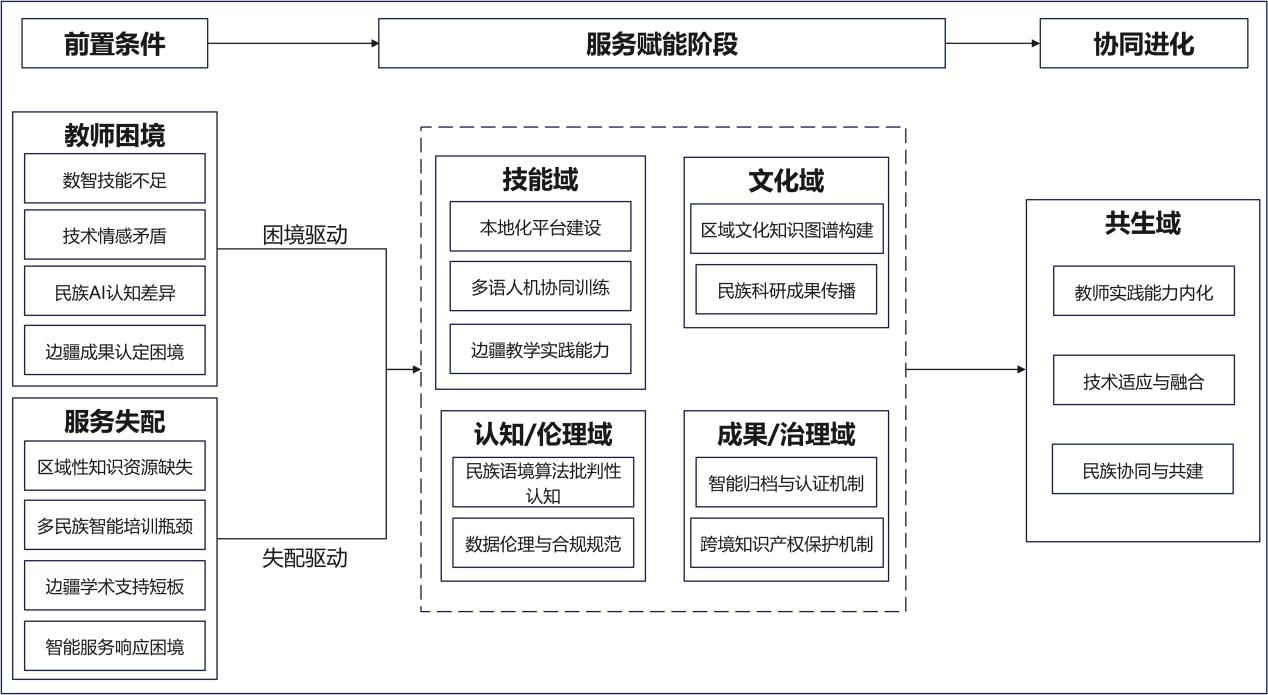
【目的/意义】探究边疆民族地区高校语境下,图书馆智慧知识服务赋能教师AI素养发展的内在机制,为破解教师数智化转型困境与拓展图书馆服务职能提供区域化视角与实践参考。【方法/过程】运用扎根理论,对30位广西边疆高校教师进行深度访谈,通过三级编码构建图书馆智慧知识服务共生机制模型。【结果/结论】研究构建一个前置条件、多维赋能与协同进化的赋能模型。教师的素养困境与图书馆的服务失配构成前置条件;图书馆继而通过技能、认知与伦理、文化与本地化、成果与治理4个相互耦合的赋能路径进行多维干预;最终驱动教师与图书馆关系实现协同进化,外显为焦虑→信任→融合→共建的行为路径,内在实现从单向支持到双向建构的根本转变。研究可以丰富智慧图书馆与教师发展的区域化理论,并为高校图书馆的在地化与协同化实践提供具体启示。

Abstract

[Purpose/Significance] This study investigates the underlying mechanism through which library smart knowledge services empower the development of AI literacy among faculty in borderland universities. It aims to provide a regional perspective and practical insights for addressing challenges in teachers' digital-intelligent transformation and for expanding the functional role of academic libraries. [Method/Process] Utilizing a grounded theory approach, in-depth interviews were conducted with 30 faculty members from universities in the Guangxi border region. Data analysis involved a three-level coding process to construct a "Symbiotic Mechanism Model of Library Smart Knowledge Services". [Result/Conclusion] The research reveals an empowerment model characterized by "Preconditions — Multi-dimensional Empowerment — Collaborative Evolution". Faculty's AI literacy challenges and mismatches in library services constitute the preconditions. Libraries then engage in multi-dimensional intervention through four interconnected empowerment pathways: skills, cognition & ethics, culture & localization, and outcomes & governance. This ultimately drives the librarian-faculty relationship towards collaborative evolution, externally manifested in the behavioral progression of "anxiety → trust → integration → co-creation", and internally representing a fundamental shift from one-way support to two-way collaboration. This study enriches the regional theoretical perspective on smart libraries and faculty development, offering concrete implications for the localized and collaborative practices of academic libraries.
关键词

图书馆智慧知识服务 / 教师AI素养 / 边疆高校 / 作用机制 / 扎根理论

Key words

knowledge services in libraries / faculty teachers' AI literacy / border-region universities / mechanism of action

引用本文

导出引用
蒋继平 , 吴睿瑶 , 韦佳秀. 图书馆智慧知识服务赋能边疆高校教师AI素养发展的作用机制[J]. 知识管理论坛. 2025, 10(6): 579-593 https://doi.org/10.13266/j.issn.2095-5472.2025.039
Jiang Jiping , Wu Ruiyao , Wei Jiaxiu. The Mechanism of Intelligent Knowledge Services in Libraries Empowering AI Literacy Development of Faculty in Border-region Universities[J]. Knowledge Management Forum. 2025, 10(6): 579-593 https://doi.org/10.13266/j.issn.2095-5472.2025.039
中图分类号: G252   

参考文献

[1]
国家教育数字化战略行动2025年部署会举行深入推动人工智能赋能教育变革[J]. 中国教育技术装备, 2025(7): 159.
National Education Digital Strategy Action 2025 deployment meeting held to promote AI-empowered education reform[J]. China educational technology & equipment, 2025(7): 159.
[2]
NING Y M, ZHANG W J, YAO D M, et al. Development and validation of the artificial intelligence literacy scale for teachers(AILST)[J].Education and information technologies, 2025, 30(12): 17769-17803.
[3]
江凤娟, 海路, 苏德. 从政策文本到学校行动:双语教育政策执行偏差研究——以广西壮族自治区为个案[J]. 民族教育研究, 2018(5): 31-41.
JIANG F J, HAI L, SU D. From policy texts to school actions: a study of the execution deviation of bilingual education policy: a case study of Guangxi Zhuang Autonomous Region[J]. Journal of research on education for ethnic minorities, 2018(5): 31-41.
[4]
孙鲁毅, 何佳晨. 广西边境地区少数民族文化传承发展中的多重逻辑调适研究——基于靖西市壮族织绣文化的调查[J]. 广西民族大学学报(哲学社会科学版), 2023(1): 127-131.
SUN L Y, HE J C. A study on logical plurality in adaptation in cultural inheritance and development among minorities in the Borderland of Guangxi: based on the investigation into embroidery culture of Zhuang People in Jingxi City[J]. Journal of Guangxi Minzu University (philosophy and social science edition), 2023(1): 127-131.
[5]
李文启, 涂涛. “AIGC+”教师数字素养提升模型构建及价值意蕴[J]. 西南大学学报(社会科学版), 2025, 51(5): 202-211, 239.
LI W Q, TU T. Construction and value implication of the "AIGC+" teacher digital literacy enhancement model[J]. Journal of Southwest University(social sciences edition), 2025, 51(5): 202-211, 239.
[6]
MAKHMETOVA Z, KARABASSOVA L, ZHAKIM A, et al. Exploring the effects of professional learning experiences on in-service teachers' growth: a systematic review of literature[J]. Education sciences, 2025, 15: 146.
[7]
柯平, 邹金汇. 后知识服务时代的图书馆转型[J]. 中国图书馆学报, 2019, 45(1): 4-17.
KE P, ZOU J H. Library transformation in the post-knowledge service era[J]. Journal of library science in China, 2019, 45(1): 4-17.
[8]
袁一帆, 卢加文, 陈雅. 数智驱动的图书馆智慧数据服务框架与路径[J]. 图书馆工作与研究, 2024(11): 16-22.
YUAN Y F, LU J W, CHEN Y. Frameworks and paths of library smart data service driven by digital intelligence[J]. Library work and study, 2024(11): 16-22.
[9]
罗美娜, 尹莉, 赵呈刚. 教师AI素养的国际研究现状、热点与趋势:基于Web of Science数据库的文献计量分析[J]. 教育科学研究, 2024(9): 73-81.
LUO M N, YIN L, ZHAO C G. International research status, hotspots, and trends in teachers' AI literacy: a bibliometric analysis based on the Web of Science database[J]. Educational science research, 2024(9): 73-81.
[10]
王丹. 人工智能视域下教师智能教育素养研究:内涵、挑战与培养策略[J]. 中国教育学刊, 2022, 347(3): 91-96.
WANG D. Research on teachers' AI literacy from the perspective of artificial intelligence: connotation, challenges, and cultivation strategies[J]. Journal of the Chinese society of education, 2022, 347(3): 91-96.
[11]
李卫姣, 虞晨琳, 蔡迎春. 高校图书馆AI素养教育的多维实践路径探析——以上海外国语大学图书馆为例[J]. 图书馆杂志, 2025(8): 20-29.
LI W J, YU C L, CAI Y C. Exploring multi-dimensional practical paths for AI literacy education in university libraries: a case study of the Shanghai International Studies University Library[J]. Library journal, 2025(8): 20-29.
[12]
杨峰, 朱梨, 胡琳. 构建人工智能素养教育的融合模式:国外高校图书馆的响应启示[J]. 图书馆论坛, 2025(4): 139-148.
YANG F, ZHU L, HU L. Constructing an integrated model for AI literacy education: insights from the responses of foreign university libraries[J]. Library tribune, 2025(4): 139-148.
[13]
张淼. 我国高校图书馆AI素养教育实践调研[J]. 图书情报工作, 2025, 69 (18): 98-108.
ZHANG M. A survey of AI literacy education practices in Chinese university libraries[J]. Library and information service, 2025, 69(18): 98-108.
[14]
ZHANG J, ZHANG Z. AI in teacher education: unlocking new dimensions in teaching support, inclusive learning, and digital literacy[J]. Journal of computer assisted learning, 2024, 40(4): 1871-1885.
[15]
吴化雨, 黄毅. 深耕本土, 美美与共:民族元素创意课程的教学实践探索[J]. 装饰, 2023(3): 120-123.
WU H Y, HUANG Y. Root in local and share beauty: exploration of teaching practice in the course of ethnic elemeuts and creativity[J]. Decoration, 2023(3): 120-123.
[16]
徐梦夏, 李洪修. TPACK下教师数字素养培育的现实困境与实现策略[J]. 教学与管理, 2025(18): 53-57.
XU M X, LI H X. Realistic dilemmas and realization strategies for teacher digital literacy cultivation under TPACK[J]. Teaching & administration, 2025(18): 53-57.
[17]
HENRIKSEN D, CREELY E, GRUBER N, et al. Social-emotional learning and generative AI: a critical literature review and framework for teacher education[J]. Journal of teacher education, 2025, 76(3): 312-328.
[18]
孙博昕, 唐晓彤. 新加坡教育数字化转型的逻辑思路与实践策略[J]. 教学与管理, 2025(19): 70-76.
SUN B X, TANG X T. Logical thoughts and practical strategies of education digital transformation in Singapore[J]. Teaching & administration, 2025(19): 70-76.
[19]
黄如艳, 桑国元, 李晓华. 民族地区教师人工智能助教应用意愿及影响因素研究——基于扎根理论的探索性分析[J]. 青海民族大学学报(社会科学版), 2022(4): 117-126.
HUANG R Y, SANG G Y, LI X H. Research on application intention and influencing factors of artificial intelligence teaching assistants of teachers in minority areas: exploratory analysis based on grounded theory[J]. Journal of Qinghai Minzu University (social sciences edition), 2022(4): 117-126.
[20]
朱学芳, 李川, 刘子溪. 5G网络环境下我国智慧知识服务体系建设策略探讨[J]. 情报科学, 2024, 42(1): 2-9, 50.
ZHU X F, LI C, LIU Z X. The construction strategies of China's smart knowledge service system under 5G network environment[J]. Information science, 2024, 42(1): 2-9, 50.
[21]
钱力, 刘细文, 张智雄, 等. AI+智慧知识服务生态体系研究设计与应用实践——以中国科学院文献情报中心智慧服务平台建设为例[J].图书情报工作, 2021, 65(15): 78-90.
QIAN L, LIU X W, ZHANG Z X, et al. Research design and application practice of AI+ smart knowledge service ecosystem: a case study of the smart service platform construction of the National Science Library, Chinese Academy of Sciences[J]. Library and information service, 2021, 65(15): 78-90.
[22]
张晓林, 梁娜. 知识的智慧化、智慧的场景化、智能的泛在化——探索智慧知识服务的逻辑框架[J]. 中国图书馆学报, 2023(3): 4-18.
ZHANG X L, LIANG N. The intellectualization of knowledge, the scenarization of intelligence, and the ubiquitization of AI: exploring the logical framework of smart knowledge services[J]. Journal of library science in China, 2023(3): 4-18.
[23]
陈一, 向妮, 鲍秀爽. 智慧图书馆知识服务:关键要素、典型场景与未来展望[J]. 图书馆论坛, 2025(10): 40-50.
CHEN Y, XIANG N, BAO X S, et al. Smart library knowledge services: key elements, typical scenarios and development prospects[J]. Library tribune, 2025(10): 40-50.
[24]
于杨, 张豪永. 具身智能驱动图书馆知识服务:基于用户视角[J]. 图书与情报, 2025(3): 114-123.
YU Y, ZHANG H Y. Embodied intelligence driving library knowledge services: from the user perspective[J]. Library and information, 2025(3): 114-123.
[25]
YU K J, GONG R Y, SUN L J, et al. The application of artificial intelligence in smart library[C]//Proceedings of the 2019 international conference on organizational innovation(ICOI2019). Amsterdam: Atlantis Press, 2019: 708-713.
[26]
钱丹丹, 刘洋, 胡姗姗, 等. 智慧图书馆知识服务构成要素及服务架构研究[J]. 情报科学, 2019(12): 52-56.
QIAN D D, LIU Y, HU S S, et al. Research on the components and service architecture of smart library knowledge services[J]. Information science, 2019(12): 52-56.
[27]
王玉梅, 朱学芳. 5G环境下智慧知识服务管理能力评价研究[J]. 情报理论与实践, 2023, 46(12): 28-35.
WANG Y M, ZHU X F. Research on the evaluation of smart knowledge service management capability in the 5G environment[J]. Information studies: theory & application, 2023, 46(12): 28-35.
[28]
周琼, 李卫姣, 王健, 等. 教育4.0环境下高校智慧图书馆实现途径研究[J]. 图书馆杂志, 2023(9): 68-76.
ZHOU Q, LI W J, WANG J, et al. Research on ways to realize intelligent libraries in universities in the environment of education 4.0[J]. Library journal, 2023(9): 68-76.
[29]
张谙宁, 叶兰, 周文琦, 等. AI生成元数据赋能图书馆资源建设的实践与启示——基于国内外案例的调查[J]. 大学图书馆学报, 2025(4): 90-104.
ZHANG A N, YE L, ZHOU W Q, et al. AI-generated metadata enabling library collection development: a case study[J]. Journal of academic libraries, 2025(4): 90-104.
[30]
张庆来, 苏云, 张军. 基于通用人工智能的图书馆知识服务研究[J]. 图书与情报, 2023(6): 70-74.
ZHANG Q L, SU Y, ZHANG J. Research on library knowledge service based on general artificial intelligence[J]. Library & information, 2023(6): 70-74.
[31]
李默, 杨彬. 从生成式人工智能到通用人工智能:赋能图书馆知识服务模式创新[J]. 农业图书情报学报, 2024(6): 50-61.
LI M, YANG B. From generative artificial intelligence to artificial general intelligence: enabling innovation models in library knowledge services[J]. Journal of agricultural library and information science, 2024(6): 50-61.
[32]
陈向明. 扎根理论的思路和方法[J]. 教育研究与实验, 1999(4): 58-63, 73.
CHEN X M. The ideas and methods of grounded theory[J]. Educational research and experiment, 1999(4): 58-63, 73.
[33]
刘凤军, 孟陆, 陈斯允, 等. 网红直播对消费者购买意愿的影响及其机制研究[J]. 管理学报, 2020(1): 94-104.
LIU F J, MENG L, CHEN S Y, et al. The impact of network celebrities' information source characteristics on purchase intention[J]. Chinese journal of management, 2020(1): 94-104.
[34]
姚宏, 邓程鹏. “一带一路”推动中外旅游国际合作的路径——基于扎根理论的质性研究[J]. 西安财经大学学报, 2021, 34(4): 84-93.
YAO H, DENG C P. The path of international tourism cooperation promoted by "the Belt and Road": the qualitative research based on grounded theory[J]. Journal of Xi'an University of Finance and Economics, 2021, 34(4): 84-93.
[35]
CORBIN J M, STRAUSS A. Grounded theory research: procedures, canons, and evaluative criteria[J]. Qualitative sociology, 1990, 13(1): 3-21.
[36]
黄璐宁, 肖海清, 王燕平, 等. 未来学习中心赋能高校图书馆高质量发展:要素、路径及策略[J]. 图书馆, 2025(8): 108-116.
HUANG L N, XIAO H Q, WANG Y P, et al. Future learning center empowers the high-quality development of university libraries: elements, paths and strategies[J]. Library, 2025(8): 108-116.
[37]
黄巨臣, 王一栋. 从“AI排斥”到“AI创能”:人工智能在大学教学中的应用深化[J]. 中国高教研究, 2025(4): 34-41.
HUANG J C, WANG Y D. From "AI Exclusion" to "AI Empowerment": deepening the application of artificial intelligence in university teaching and learning[J]. China higher education research, 2025(4): 34-41.
[38]
耿泽, 王婧, 苏德. 新质生产力赋能民族地区教育工作创新力的逻辑与进路[J]. 广西民族大学学报(哲学社会科学版), 2025(1): 9-18.
GENG Z, WANG J, SU D. Logic and approaches of empowering innovative capacity of education in ethnic areas through new quality productive force[J]. Journal of Guangxi Minzu University (philosophy and social science edition), 2025(1): 9-18.
[39]
宋婧馨, 王萍, 李依凝, 等. 基于Kano模型的少数民族档案资源呈现服务研究[J]. 情报科学, 2023(7): 163-169.
SONG J X, WANG P, LI Y N, et al. Research on the presentation service of ethnic archives resources based on the Kano model[J]. Information science, 2023(7): 163-169.
[40]
杨静, 贺聪, 魏继勋. 一流大学建设背景下的图书馆知识服务体系构建——以北京理工大学图书馆为例[J]. 图书情报工作, 2023, 67(23): 38-48.
YANG J, HE C, WEI J X. Construction of a library knowledge service system in the context of building world-class universities: a case study of the Beijing Institute of Technology Library[J]. Library and information service, 2023, 67(23): 38-48.

作者贡献声明/Author contributions:

蒋继平:选题设计,数据编码,论文撰写与修改;

吴睿瑶:数据编码,论文修改,模型图绘制;

韦佳秀:数据编码。

基金

广西高等教育发展研究中心资助项目“智慧知识服务提升广西高校教师数字素养的作用机制与实践路径”(GXGJB202508)
广西哲学社会科学基金项目“智慧图书馆知识服务体系构建及应用研究”(23BTQ001)

PDF(2775 KB)

Accesses

Citation

Detail

段落导航
相关文章

/