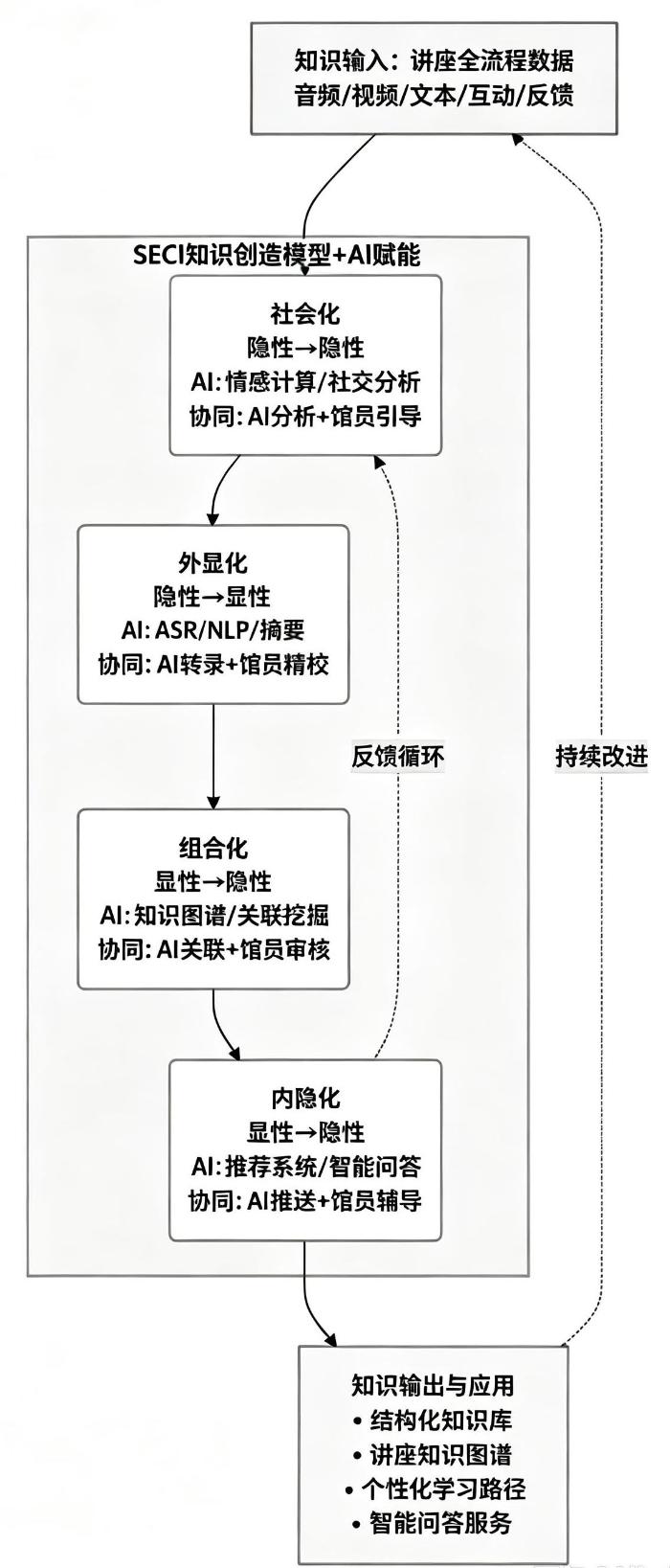
从流失到转化:SECI驱动与AI赋能的高校图书馆讲座知识管理路径探索
作者贡献声明/Author contributions:
廖 佳:研究思路设计,论文撰写与修改;
贺彦平:研究思路和方法指导,论文修改;
何 毅:文献调研,论文修改;
胡胜男:论文修改。
|
廖佳,馆员,本科,E-mail:289154142@qq.com |
|
贺彦平,馆长,副研究馆员,硕士 |
|
何毅,馆员,硕士 |
|
胡胜男,副研究馆员,硕士。 |
收稿日期: 2026-05-07
网络出版日期: 2026-09-30
基金资助
2023年湖南省哲学社会科学基金项目“智慧图书馆知识服务体系研究”(23YBA041)
From Loss to Transformation: Exploring Knowledge Management Pathways for University Library Lectures Driven by SECI and Empowered by AI
|
Liao Jia, Librarian, Bachelor's Degree, E-mail: 289154142@qq.com |
|
He Yanping, Library Director, Associate Research Librarian, Master's Degree |
|
He Yi, Librarian, Master's Degree |
|
Hu Shengnan, Associate Research Librarian, Master's Degree. |
Received date: 2026-05-07
Online published: 2026-09-30
Supported by
2023 Hunan Provincial Philosophy and Social Science Foundation Project titled "Research on Smart Library Knowledge Service System"(23YBA041)
[目的/意义] 高校图书馆讲座现场产生的口头论述、互动问答、读者反馈等知识资源,蕴含着丰富的隐性知识,却因缺乏有效的捕获与转化手段导致讲座知识随活动结束而流失,沦为“一次性事件”。为解决这一业务痛点,本文旨在探索一条以SECI知识创造螺旋为理论驱动、以AI技术为赋能工具的讲座知识全生命周期管理路径,提升高校图书馆的学术支持与知识服务能力。 [方法/过程] 首先,梳理零次信息、SECI知识创造模型及AI赋能技术的研究现状,识别现有研究在讲座知识管理整合框架方面的缺口与理论整合契机。其次,以SECI知识创造螺旋为核心理论框架,以AI技术为赋能手段,构建覆盖讲座知识从产生、捕获、转化、整合到应用全生命周期的管理路径。最后,以某高校图书馆“信息与人类文明”主题讲座为模拟场景,逐阶段推演AI技术在SECI各环节中的具体应用,验证该路径在隐性知识激发、知识显性化、跨文档知识融合及个性化知识内化等关键环节的可行性。 [结果/结论] 研究表明,SECI驱动与AI赋能的知识管理路径能够有效将传统管理模式下易流失、难关联、不闭环的讲座知识,转化为可持续积累、动态关联的知识资产。
廖佳 , 贺彦平 , 何毅 , 胡胜男 . 从流失到转化:SECI驱动与AI赋能的高校图书馆讲座知识管理路径探索[J]. 知识管理论坛, 2026 , 11(5) . DOI: 10.13266/j.issn.2095-5472.2026.040
[Purpose/Significance] University library lectures generate rich knowledge resources, including oral presentations, interactive Q&A sessions, and reader feedback, which contain substantial tacit knowledge. However, due to the lack of effective capture and transformation mechanisms, this knowledge tends to dissipate upon the conclusion of each lecture, rendering these events as "one-off" occurrences rather than sustainable assets. To address this practical challenge, this paper aims to explore a knowledge management pathway for university library lectures driven by the SECI knowledge creation spiral and empowered by AI technologies, with the goal of enhancing the academic support and knowledge service capabilities of university libraries. [Method/Process] This study first reviews the current research on zero-information capture, the SECI knowledge creation model, and AI-empowered technologies, identifying research gaps and opportunities for theoretical integration in developing a comprehensive framework for lecture knowledge management. Drawing upon the SECI spiral as the core theoretical framework and AI technologies as enabling tools, the study constructs a full-lifecycle management pathway covering lecture knowledge from generation, capture, transformation, integration, to application. A simulated case study is then conducted based on a university library lecture themed "Information and Human Civilization," in which AI applications are examined stage by stage across the SECI phases to demonstrate their feasibility in facilitating tacit knowledge elicitation, knowledge externalization, cross-document knowledge fusion, and personalized knowledge internalization. [Result/Conclusion] The findings indicate that the SECI-driven and AI-empowered knowledge management pathway effectively converts lecture knowledge—which is prone to loss, difficult to associate, and lacks closed-loop management under traditional approaches—into sustainable, dynamically interconnected knowledge assets.
表1 AI技术赋能的SECI社会化阶段Table 1 AI-empowered socialization stage of the SECI model |
| 赋能对象 | 实现目标 | |
|---|---|---|
| 连接与共鸣 | 营造社群交流场 | 协同过滤、兴趣图谱、用户画像 |
| 隐性知识激发 | 引导读者表达隐性知识 | 生成式AI(引导性问题/思维导图)、NLP主题建模(LDA/BERT) |
表2 AI技术赋能的SECI外显化阶段Table 2 AI-empowered externalization stage of the SECI model |
| 赋能对象 | 实现目标 | |
|---|---|---|
| 语音转录 | 讲座内容实时转文字 | Whisper、科大讯飞、豆包 |
| 知识提取 | 提取核心观点、关键词、逻辑框 | TextRank、BART |
| 知识图谱构建 | 构建结构化知识网络,支持可视化浏览与导航 | Neo4j、GraphRAG |
| 知识实体链接 | 自动链接至OPAC、学术数据库、机构知识库 | GPT、DeepSeek、Agentic RAG |
表3 AI技术赋能的SECI组合化阶段Table 3 AI-empowered combination stage of the SECI model |
| 赋能对象 | | |
|---|---|---|
| 知识融合 | 跨文档多源知识整合 | 向量检索、RAG |
| 体系化组织 | 自动分类、去重、建立层级目录 | 自动聚类算法、LLM分类器 |
| 个性化分发 | 基于用户画像精准推送 | 协同过滤、序列推荐 |
表4 AI技术赋能的SECI内隐化阶段Table 4 AI-empowered internalization stage of the SECI model |
| | | |
|---|---|---|
| 智能辅导 | 自适应提示与错误诊断,促进知识内化 | 自适应提示系统、错误诊断模型 |
| 虚拟情境体验 | 构建动态场景支持安全试错,内化为行动直觉 | 生成式AI情境引擎、AI虚拟角色 |
| 智能测评 | 量化知识使用率、复用深度及衍生价值 | 知识追踪模型、行为分析 |
表5 “信息与人类文明”讲座的全流程推演与验证Table 5 Full-process deduction and verification of the "information and human civilization" lecture |
| | | | |
|---|---|---|---|
| | | | |
| | | | |
| | | | |
| | | | |
| [1] |
张欣毅.回眸一个科学本体论的进化史——基于公共信息资源及其认知机制的本体论观照[J].图书馆,2005(1):31-35.
|
| [2] |
野中郁次郎,竹内弘高.创造知识的企业:日美企业持续创新的动力[M].李萌,高飞,译.北京:知识产权出版社,2006.
|
| [3] |
|
| [4] |
王庆雯.基于SECI知识创新模型的图书馆信息服务[J].技术与创新管理,2008(6):613-615.
|
| [5] |
张会平,周宁.基于可视化技术的知识转化模型[J].情报理论与实践,2009(5):5-8.
|
| [6] |
朱洪瑞.基于SECI模型的图书馆知识共享研究[J].农业网络信息,2011(3):40-42.
|
| [7] |
刘青,李瑾.基于SECI知识创造螺旋的高校图书馆学科服务能力建设研究[J].图书馆,2017(4):58-64.
|
| [8] |
何慧敏.基于SECI模型的公共图书馆读者活动中知识创造螺旋研究[J].新世纪图书馆,2021(7):5-11.
|
| [9] |
|
| [10] |
周忠义.近年来我国零次情报研究的进展[J].情报学报,1989(8):317-320.
|
| [11] |
张晓林.走向知识服务:寻找新世纪图书情报工作的生长点[J].中国图书馆学报,2000(5):32-37.
|
| [12] |
洪丽.零次信息价值理论[C]//中国图书馆学会.首届全国图书馆馆藏建设报告会论文集.北京:中国图书馆学会,2005:67-82.
|
| [13] |
洪丽.零次信息价值及其价值理论探索[J].中国图书馆学报,2006(1):94-96.
|
| [14] |
黄荣东,李臻.图书馆讲座的零次信息属性与开发利用[J].现代情报,2009(29):191-194.
|
| [15] |
|
| [16] |
杨峰,张雪蕾,王懿松,等.人工智能驱动下的图书馆知识服务创新探索与实践[J].图书馆杂志,2025,44(6):63-73.
|
| [17] |
|
| [18] |
|
| [19] |
柯平. 信息管理概论[M].2版.北京:科学出版社,2011:204-205.
|
| [20] |
|
| [21] |
刘彬,米东,杜晓明,等.仿真系统概念模型验证方法的分析与选择[J].计算机仿真,2012,29(5):111-113.
|
| [22] |
饶权.全国智慧图书馆体系:开启图书馆智慧化转型新篇章[J].中国图书馆学报,2021,47(1)4-14.
|
/
| 〈 |
|
〉 |