从“人—人”到“人—AI—人”:AI介导知识转移的过程机制与双元角色重构研究
作者贡献声明/Author contributions:
李旭光:提出研究问题,指导研究工作实施;
秦绪辰:整理论文思路,撰写与修改论文;
刘欣平:整理论文思路,修改论文;
杨 蕊:整理论文思路,修改论文。
|
李旭光,教授,博士,硕士生导师; |
|
秦绪辰,硕士研究生; |
|
刘欣平,硕士研究生。 |
收稿日期: 2026-06-27
网络出版日期: 2026-09-24
基金资助
国家社会科学基金一般项目“‘高校—企业’双向知识转移机理及其整体效果提升路径研究”(24BTQ034)
From “Human-Human” to “Human-AI-Human”: A Study on the Process Mechanisms and Reconstruction of Dual Roles in AI-Mediated Knowledge Transfer
|
Li Xuguang, Professor, PhD, Master’s Supervisor; |
|
Qin Xuchen, Master’s Candidate; |
|
Liu Xinping, Master’s Candidate. |
Received date: 2026-06-27
Online published: 2026-09-24
Supported by
General Program of the National Social Science Fund of China titled “Research on the Mechanism of Two-Way Knowledge Transfer Between Universities and Enterprises and Its Promotion Path of Overall Effect”(24BTQ034)
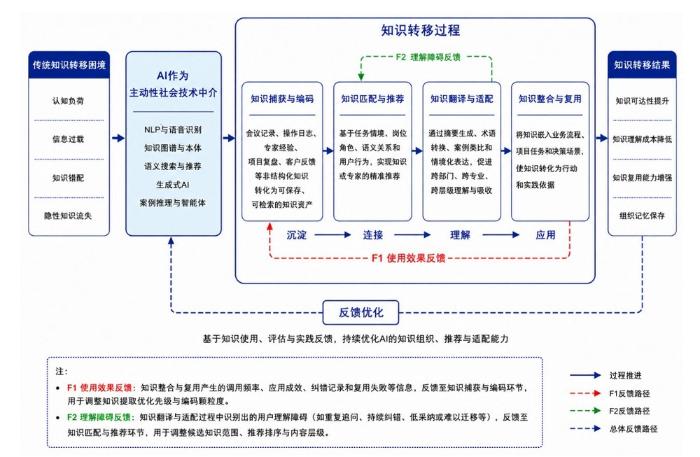
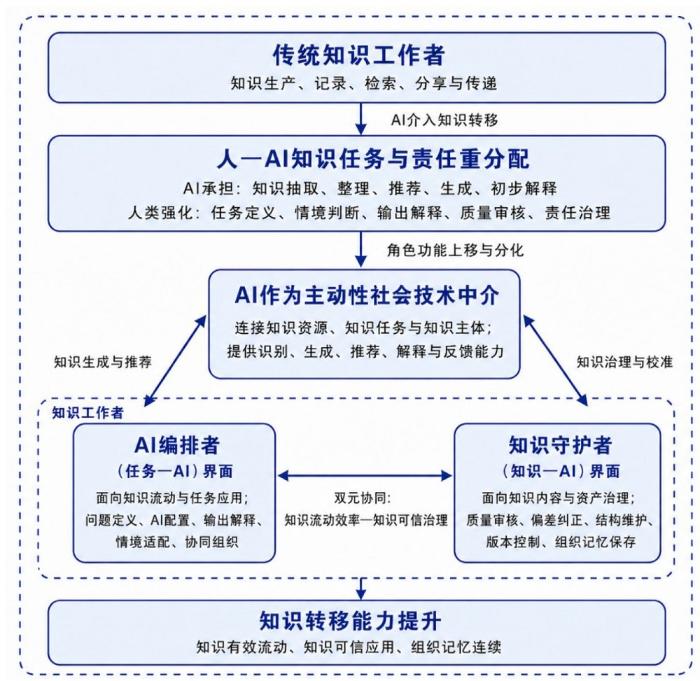
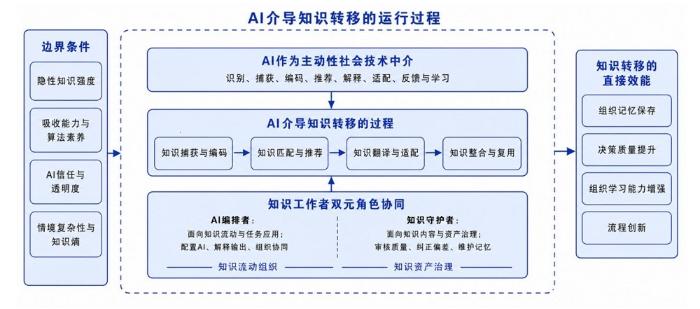
[目的/意义] 随着人工智能持续嵌入组织工作流程,知识转移正由传统“人—人”互动转向“人—AI—人”的混合协同过程。传统以人为中心的知识转移模式常受认知负荷、信息过载、共享动机不足和隐性知识流失等因素制约,难以充分支撑组织知识资产保存、组织记忆延续和流程创新。因此,本文从知识管理视角构建AI介导知识转移的理论框架,解释AI作为主动性社会技术中介对组织知识捕获、共享、理解与复用过程的重构作用。 [方法/过程] 采用文献综述与理论整合方法,基于社会技术系统理论、SECI知识创造模型和能力—动机—机会框架,梳理AI介入知识转移的过程路径、角色重构与运行边界。 [结果/结论] 研究指出,AI主要通过知识捕获与编码、匹配与推荐、翻译与适配、整合与复用4个环节,提升知识可达性、可理解性和可复用性,并推动知识工作者承担AI编排与知识守护两类互补性功能角色。由此,进一步提出双元角色重构模型,并从知识管理视角揭示AI介入知识转移的社会技术重构逻辑,为组织构建人机协同知识管理体系、保存组织记忆并推动持续流程创新提供理论参考。
李旭光 , 秦绪辰 , 刘欣平 , 杨蕊 . 从“人—人”到“人—AI—人”:AI介导知识转移的过程机制与双元角色重构研究[J]. 知识管理论坛, 2026 , 11(5) . DOI: 10.13266/j.issn.2095-5472.2026.036
[Purpose/Significance] As artificial intelligence (AI) becomes increasingly embedded in organizational workflows, knowledge transfer is shifting from traditional human-to-human interaction toward a hybrid collaborative process of "human-AI-human." Conventional human-centric knowledge transfer models are often constrained by factors such as cognitive load, information overload, insufficient sharing motivation, and tacit knowledge loss, making it difficult to adequately support the preservation of organizational knowledge assets, the continuity of organizational memory, and process innovation. Therefore, this study constructs a theoretical framework for AI-mediated knowledge transfer from the perspective of knowledge management, explaining how AI, as a proactive sociotechnical intermediary, restructures the organizational processes of knowledge capture, sharing, comprehension, and reuse. [Method/Process] Employing a literature review and theoretical integration approach, and grounded in sociotechnical systems theory, the SECI model of knowledge creation, and the ability-motivation-opportunity (AMO) framework, this study systematically examined the process pathways, role reconfiguration, and operational boundaries of AI intervention in knowledge transfer. [Results/Conclusion] The findings indicate that AI primarily enhances knowledge accessibility, comprehensibility, and reusability through four key processes: knowledge capture and codification, matching and recommendation, translation and adaptation, and integration and reuse. Concurrently, it drives knowledge workers to assume two complementary functional roles: AI orchestration and knowledge stewardship. Building upon this, the study further proposes a dual-role reconfiguration model and, from a knowledge management perspective, reveals the sociotechnical restructuring logic underlying AI intervention in knowledge transfer, thereby offering theoretical guidance for organizations to construct human-AI collaborative knowledge management systems, preserve organizational memory, and foster continuous process innovation.
表1 传统以人为中心知识转移与AI介导知识转移的比较Table 1 Comparison of traditional human-centered knowledge transfer and AI-Mediated knowledge transfer |
| 比较维度 | 以人为中心知识转移 | AI介导知识转移 |
|---|---|---|
| 转移结构 | 人—人 | 人—AI—人 |
| 知识流动逻辑 | 以人际互动为主,反馈依赖人工 | 数据与使用反馈驱动的持续调整 |
| 技术角色 | 被动性辅助工具 | 主动性社会技术中介 |
| 知识处理方式 | 人工捕获、整理与共享 | AI参与捕获、编码、匹配与复用 |
| 知识连接方式 | 人际网络与组织关系 | 算法推荐与人机协同 |
| 隐性知识处理 | 师徒制、实践共同体 | 自然语言处理(natural language processing,NLP)、知识图谱、案例推理辅助外化 |
| 主要约束 | 认知负荷、信息过载、知识流失 | 算法素养、用户信任、知识熵 |
表2 AI介导知识转移的运行边界及其作用方式Table 2 The operational boundaries of AI-Mediated knowledge transfer and how it works |
| 边界问题 | 主要条件 | 主要作用环节 | 增强AI介导效果的条件 | 削弱AI介导效果的条件 |
|---|---|---|---|---|
| 知识能否进入AI处理范围 | 隐性知识强度 | 知识捕获与编码、知识翻译与适配 | 知识可言说、可记录,经验线索较清晰,情境依赖程度较低或适中 | 知识高度身体化、经验化,依赖现场实践、直觉判断和人际互动 |
| AI输出能否转化为接收者认知 | 吸收能力与算法素养 | 知识匹配与推荐、知识翻译与适配、知识整合与复用 | 接收者具有相关专业基础,能够识别AI局限并对输出进行修正和迁移 | 缺乏专业判断与算法认知,出现理解偏差、机械采纳或拒绝使用 |
| AI输出能否被合理采纳和校验 | AI信任与透明度 | 推荐采纳、反馈纠错、知识整合与复用 | 来源可追溯,处理依据相对透明,用户信任与系统实际能力相匹配 | 系统黑箱程度较高,用户信任不足或过度信任 |
| 知识能否适配并迁移至新的任务 | 情境复杂性与知识熵 | 知识匹配与推荐、知识翻译与适配、知识整合与复用 | 任务目标和约束较为明确,知识结构有序,版本关系相对稳定 | 任务高度不确定、目标冲突,知识碎片化、相互矛盾或版本失序 |
| [1] |
|
| [2] |
|
| [3] |
|
| [4] |
|
| [5] |
|
| [6] |
|
| [7] |
|
| [8] |
|
| [9] |
|
| [10] |
|
| [11] |
|
| [12] |
|
| [13] |
马庆国,徐青,廖振鹏,等. 知识转移的影响因素分析[J]. 北京理工大学学报(社会科学版),2006,8(1):40-43.
|
| [14] |
曹兴,郭然. 知识转移影响因素研究及其展望[J]. 中南大学学报(社会科学版),2008,14(2):230-236.
|
| [15] |
汪长玉,左美云. 年长员工代际知识转移意愿研究:人生意义与人生发展阶段的影响[J]. 商业经济与管理,2017(9):24-33.
|
| [16] |
王世泽,林春培,黄丹凤. 社会技术系统视角下人工智能应用赋能企业突破性创新的组态研究——基于机器学习方法的探索[J]. 科技进步与对策,2026,43(8):13-25.
|
| [17] |
张宇,王玉梁. 大模型在知识管理中的应用与挑战[J]. 知识管理论坛,2024,9(3):227-236.
|
| [18] |
欧阳智,魏琴,肖旭. 人工智能环境下的知识管理:变革发展与系统框架[J]. 图书与情报,2017,37(6):104-111.
|
| [19] |
|
| [20] |
|
| [21] |
张亚莉,李辽辽,丁振斌. 组织管理中的人工智能决策:述评与展望[J]. 外国经济与管理,2024,46(10):18-38.
|
| [22] |
刘广,桑雪淼,方刚. 知识耦合与智能协同联动影响人机协同决策的组态研究[J]. 科技进步与对策,2025,42(20):32-42.
|
| [23] |
徐增林,盛泳潘,贺丽荣,等. 知识图谱技术综述[J]. 电子科技大学学报,2016,45(4):589-606.
|
| [24] |
|
| [25] |
|
| [26] |
张栋豪,刘振宇,郏维强,等. 知识图谱在智能制造领域的研究现状及其应用前景综述[J]. 机械工程学报,2021,57(5):90-113.
|
| [27] |
|
| [28] |
|
| [29] |
|
| [30] |
|
| [31] |
|
| [32] |
|
| [33] |
|
| [34] |
|
| [35] |
刘细文,孙蒙鸽,王茜,等. DIKIW逻辑链下GPT大模型对文献情报工作的潜在影响分析[J]. 图书情报工作,2023,67(21):3-12.
|
| [36] |
丁遒劲,苏静. 面向生成式人工智能(AIGC)的图书馆信息资源建设优化策略研究[J]. 图书情报工作,2024,68(18):23-31.
|
| [37] |
储节旺,杜秀秀,李佳轩. 人工智能生成内容对智慧图书馆服务的冲击及应用展望[J]. 情报理论与实践,2023,46(5):6-13.
|
| [38] |
马丽娜,冯梦婷. 人机协同视角下知识管理模式创新的组态研究——基于行动者网络理论的多层次分析[J]. 科技进步与对策,2026,43(8):138-149.
|
/
| 〈 |
|
〉 |