价值共创导向的哲学社会科学科研人员有组织科研合作动机研究

谭春辉, 唐天

知识管理论坛 ›› 2025, Vol. 10 ›› Issue (6) : 479-493.

PDF(2154 KB)
PDF(2154 KB)
知识管理论坛 ›› 2025, Vol. 10 ›› Issue (6) : 479-493. DOI: 10.13266/j.issn.2095-5472.2025.032  CSTR: 32306.14.CN11-6036.2025.032
研究论文

价值共创导向的哲学社会科学科研人员有组织科研合作动机研究

作者信息 +

Research on the Motivation of Organized Scientific Research Cooperation of Philosophy and Social Science Researchers Oriented towards Value Co-creation

Author information +
文章历史 +

摘要

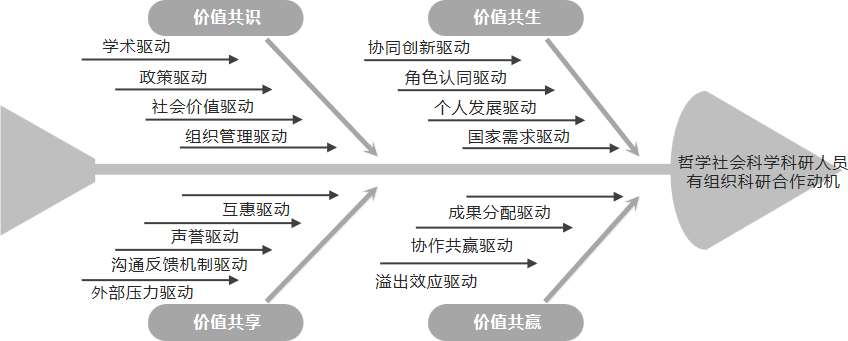
【目的/意义】 探究哲学社会科学科研人员有组织科研合作动机,以切实推进科研人员有组织科研合作。【方法/过程】 基于价值共创理论,将有组织科研合作的价值共创行为划分为价值共识、价值共享、价值共生、价值共赢等4个阶段,采用共识性质性研究,选取哲学社会科学领域的20名科研人员开展深度访谈,确认每个阶段的动机。【结果/结论】 研究发现:①在价值共识阶段,科研人员的动机主要是学术驱动、政策驱动、社会价值驱动及组织管理驱动;②在价值共享阶段,科研人员的动机主要是互惠驱动、声誉驱动、沟通反馈机制驱动及外部压力驱动;③在价值共生阶段,科研人员的动机聚焦协同创新驱动、角色认同驱动、个人发展驱动与国家需求驱动;④在价值共赢阶段,科研人员的动机强调成果分配驱动、协作共赢驱动及溢出效应驱动。同时,各阶段存在显著的跨阶段共性动机。基于研究结果,为促进哲学社会科学科研人员积极参与有组织科研合作提出相应建议。

Abstract

[Purpose/Significance] This study aims to explore the motivation of organized scientific research cooperation among philosophy and social science researchers to effectively promote such cooperation. [Method/Process] Based on the theory of value co-creation, the value co-creation behaviors in organized scientific research cooperation were divided into four stages: value consensus, value sharing, value symbiosis, and value win-win. A consensus-based qualitative research method was adopted, and in-depth interviews were conducted with 20 researchers in the field of philosophy and social sciences to identify the motivation at each stage. [Result/Conclusion] The research finds that in the value consensus stage, the motivation of researchers mainly includes academic drive, policy drive, social value drive, and organizational management drive; in the value sharing stage, the motivation mainly includes reciprocal drive, reputation drive, communication and feedback mechanism drive, and external pressure drive; in the value symbiosis stage, the motivation focuses on collaborative innovation drive, role identity drive, personal development drive, and national demand drive; in the value win-win stage, the motivation emphasizes outcome distribution drive, collaborative win-win drive, and spillover effect drive. Meanwhile, there are significant cross-stage common motivations in each stage. Based on these findings, corresponding suggestions are proposed to promote the active participation of philosophy and social science researchers in organized scientific research cooperation.
关键词

价值共创 / 合作动机 / 有组织科研 / 共识性质性研究

Key words

value co-creation / cooperation motivation / organized scientific research / consensus-based qualitative research

引用本文

导出引用
谭春辉 , 唐天. 价值共创导向的哲学社会科学科研人员有组织科研合作动机研究[J]. 知识管理论坛. 2025, 10(6): 479-493 https://doi.org/10.13266/j.issn.2095-5472.2025.032
Tan Chunhui , Tang Tian. Research on the Motivation of Organized Scientific Research Cooperation of Philosophy and Social Science Researchers Oriented towards Value Co-creation[J]. Knowledge Management Forum. 2025, 10(6): 479-493 https://doi.org/10.13266/j.issn.2095-5472.2025.032
中图分类号: G311   

参考文献

[1]
潘玉腾. 高校实施有组织科研的问题解构与路径建构[J]. 中国高等教育, 2022(S3): 12-14.
PAN Y T. Deconstruction of problems and construction of pathways in the implementation of organized research in universities[J]. China higher education, 2022(S3): 12-14.
[2]
HICKS D J. Productivity and interdisciplinary impacts of organized research units[J]. Quantitative science studies, 2021, 2(3): 990-1022.
[3]
张娟, 荀振芳. 高校有组织科研的内涵、特征及实施路径[J]. 高等工程教育研究, 2023(6): 99-104.
ZHANG J, XUN Z F. The connotation, characteristics and implementation path of “organized scientific research” in universities[J]. Research in higher education of engineering, 2023(6): 99-104.
[4]
姚林, 代胜蓝. 国外有组织科研政策动向与趋势——对主要发达国家与国际组织的考察[J]. 世界教育信息, 2024, 37(3): 27-37.
YAO L, DAI S L. Development and trend of organized research policy abroad: based on the investigation of major developed countries and international organizations[J]. World education information, 2024, 37(3): 27-37.
[5]
王杰, 朱军文. 高校哲学社会科学有组织科研的理据、模式与挑战[J]. 中国教育政策评论, 2023(1): 1-14.
WANG J, ZHU J W. Organized research in philosophy and social sciences at universities: rationale, models, and challenges[J]. Education policy review in China, 2023(1): 1-14.
[6]
高光良. 高校开展“有组织科研”的探索——以哲学社会科学领域为例[J]. 西部素质教育, 2024, 10(6): 159-164.
GAO G L, Explorations in implementing "organized research" in universities: a case study of philosophy and social sciences[J]. Western China quality education, 2024, 10(6): 159-164.
[7]
谭春辉, 周一夫, 涂瑞德, 等. 聚焦国家重大战略需求,加强“有组织科研”:内涵定位、困境阻碍与运行策略[J]. 现代情报, 2025, 45(7): 134-144, 153.
TAN C H, ZHOU Y F, TU R D, et al. Focusing on major national strategic needs and strengthening "organized scientific research": connotation-positioning, dilemmas-obstacles, and operational strategies[J]. Journal of modern information, 2025, 45(7): 134-144, 153.
[8]
RYAN R M, DECI E L. Self-determination theory and the facilitation of intrinsic motivation, social development, and well-being[J]. American psychologist, 2000, 55(1): 68-78.
[9]
BEAVER D B, ROSEN R. The professional origins of scientific co-authorship, Part III[J]. Scientometrics, 1979, 1(3): 231-245.
[10]
IORIO R, LABORY S, RENTOCCHINI F. The importance of pro-social behaviour for the breadth and depth of knowledge transfer activities: an analysis of Italian academic scientists[J]. Research policy, 2017, 46(2): 497-509.
[11]
胡泽文, 崔静静, 任萍. 国内科研合作研究进展综述[J]. 现代情报, 2022, 42(6): 148-159.
HU Z W, CUI J J, REN P. Review on domestic scientific research cooperation[J]. Journal of modern information, 2022, 42(6): 148-159.
[12]
谭春辉, 梁远亮, 魏温静. 虚拟学术社区中科研人员合作影响因素组态分析[J]. 情报理论与实践, 2022, 45(4): 128-136, 127.
TAN C H, LIANG Y L, WEI W J. Configuration analysis of influencing factors of scientific researcher’s cooperation in virtual academic community[J]. Information studies: theory & application, 2022, 45(4): 128-136, 127.
[13]
李峰, 缪亚军. 个体科研合作行为研究述评[J]. 科技进步与对策, 2015, 32(23): 156-160.
LI F, MIAO Y J. A review of research on the individual behavior in research collaboration[J]. Science & technology progress and policy, 2015, 32(23): 156-160.
[14]
王战平, 何文瑾, 谭春辉. 基于质性分析的虚拟学术社区中科研人员合作动机演化研究[J]. 情报科学, 2020, 38(3): 17-22.
WANG Z P, HE W J, TAN C H. Evolution of scientific personnel's cooperative motivation in virtual academic community based on qualitative analysis[J]. Information science, 2020, 38(3): 17-22.
[15]
RAMÍREZ R. Value co-production: intellectual origins and implications for practice and research[J]. The strategic management journal, 1999, 20(1): 49-65.
[16]
PRAHALAD C, RAMASWAMY V. The new frontier of experience innovation[J]. Sloan management review, 2003, 44(4): 12-18.
[17]
MCCOLL-KENNEDY J R, VARGO S L, DANAHER T S, et al. Health care customer value co-creation practice styles[J]. Journal of business research, 2012, 15(4): 370-389.
[18]
罗飞宁. 学术期刊集群的价值共创体系构建及运行机制研究[J]. 泰山学院学报, 2023, 45(2): 136-142.
LUO F N. Research on the construction and operating mechanism of the value co creation system of academic journal cluster[J]. Journal of Taishan University, 2023, 45(2): 136-142.
[19]
周文辉. 知识服务、价值共创与创新绩效——基于扎根理论的多案例研究[J]. 科学学研究, 2015, 33(4): 567-573, 626.
ZHOU W H. Knowledge service, value - creation and innovation performance: a multi case study on the grounded theory[J]. Studies in science of science, 2015, 33(4): 567-573, 626.
[20]
PALMA F C, TRIMI S, HONG S G. Motivation triggers for customer participation in value co-creation[J]. Service business, 2019, 13(3): 557-580.
[21]
SOHAIL S M. Customer engagement in collaborative innovation: investigating consumer motivation for participating in value co-creation[J]. Middle East journal of management, 2020, 7(3):123-140.
[22]
AMIN M, KHAN I, SHAMIM A, et al. Employee motivations in shaping customer value co-creation attitude and behavior: job position as a moderator[J]. Journal of retailing and consumer services, 2024, 79(3/4):103-119.
[23]
邓良柳. 网络用户参与品牌价值共创的动机及类型[J]. 新闻前哨, 2023(9): 70-72.
DENG L L. Motivation and types of internet users' participation in brand value co-creation[J]. Press outpost, 2023(9): 70-72.
[24]
王学军, 李航宇. 公众参与合作生产的动机图谱及其影响——价值共创视角下的混合研究[J]. 公共行政评论, 2023, 16(2): 4-24, 196.
WANG X J, LI H Y. Citizens' motivations for co-production and the influences on behaviors: mixed research in the perspective of value[J]. Journal of public administration, 2023, 16(2): 4-24, 196.
[25]
袁静, 李森涛. 用户参与政府开放数据价值共创动因研究[J]. 数字图书馆论坛, 2023, 19(2): 1-9.
YUAN J, LI S T. On motivations of users’ participation in value co-creation of open government data[J]. Digital library forum, 2023, 19(2): 1-9.
[26]
李岱素. 高校有组织科研的实践逻辑:基于价值共创视角[J]. 学术研究, 2024(2): 69-73.
LI D S. The practical logic of organized research in universities: from the perspective of value co-creation[J]. Academic research, 2024(2): 69-73.
[27]
马椿荣. 自我决定理论研究综述[J]. 现代商业, 2014(27): 280-282.
MA C R. A review of research on self-determination theory[J]. Modern business, 2014(27): 280-282.
[28]
程雅馨, 程延园, 何勤, 等. 平台企业赋能与价值共创的动态过程——基于社会交换视角的多案例分析[J]. 管理案例研究与评论, 2022, 15(5): 468-484.
CHENG Y X, CHENG Y Y, HE Q, et al. Research on the dynamic process of platform enterprises’ empowerment and value co-creation: a multi-case study based on the social exchange perspective[J]. Journal of management case studies, 2022, 15(5): 468-484.
[29]
赵学琳. 中国特色哲学社会科学的价值结构研究[J]. 学术探索, 2019(2): 21-27.
ZHAO X L. Research on the value structure of philosophy and social sciences with Chinese characteristics[J]. Academic exploration, 2019(2): 21-27.
[30]
GALVAGNO M, DALLI D. Theory of value co-creation: a systematic literature review[J]. Managing service quality, 2014, 24(6): 643-683.
[31]
SONNENWALD D H, PIERCE L G. Information behavior in dynamic group work contexts: interwoven situational awareness, dense social networks and contested collaboration in command and control[J]. Information processing & management, 2000,36(3):461-479.
[32]
珠玛, 侯志瑾, 邵瑾, 等. 共识性质性研究方法(CQR)及其在心理咨询研究中的应用[J]. 中国临床心理学杂志, 2011, 19(3): 413-418.
ZHU M, HOU Z J, SHAO J, et al. Consensual qualitative research and its application to counseling research[J]. Chinese journal of clinical psychology, 2011, 19(3): 413-418.
[33]
孙鑫章, 孙瑞, 梁欣, 等. 共识性质性研究的方法学及在护理领域的应用进展[J]. 护理学杂志, 2024, 39(7): 118-121.
SUN X Z, SUN R, LIANG X, et al. Research progress of methodology of consensual qualitative research and its application in nursing[J]. Journal of nursing science, 2024, 39(7): 118-121.
[34]
邵瑾, 樊富珉, 吴洁琼, 等. 团体咨询中的共情表达:基于共识性质性研究[J]. 中国健康心理学杂志, 2023, 31(6): 820-826.
SHAO J, FAN F M, WU J Q, et al. Empathic expression in group counseling: a consensual qualitative research[J]. China journal of health psychology, 2023, 31(6): 820-826.
[35]
HILL C E, KNOX S, THOMPSON B J, et al. Consensual qualitative research: an update[J]. Journal of counseling psychology, 2005, 52(2): 196-205.
[36]
彭贤杰, 张希胜, 罗瑾琏, 等. 基于共识性质性研究的女博士生职业决策相关因素辨析[J]. 高教探索, 2014(5): 115-120.
PENG X J, ZHANG X S, LUO J L, et al. Analysis of factors related to female doctoral students' career decision-making based on consensual qualitative research[J]. Higher education exploration, 2014(5): 115-120.
[37]
国家自然科学基金委员会人才处. 首次试点青年学生基础研究项目,在青年人才培养中出新招求实效[EB/OL]. [2025-11-14]. https://www.nsfc.gov.cn/p1/3371/3373/76321.html.
National Natural Science Foundation of China(NSFC), Division Talent. NSFC launches first pilot program for young students' basic research projects: innovating and delivering results in cultivating young talents[EB/OL]. [2025-11-14]. https://www.nsfc.gov.cn/p1/3371/3373/76321.html.
[38]
瞿橙. 有组织科研背景下高校加强基础研究的思考[J]. 现代职业教育, 2023(33): 145-148.
QU C. Reflections on strengthening basic research in universities under the background of organized research[J]. Modern vocational education, 2023(33): 145-148.

作者贡献声明/Author contributions:

谭春辉:提出研究思路,设计论文框架,修改论文与定稿;

唐 天:采集与分析数据,撰写与修改论文。

基金

国家社会科学基金重点项目“有组织科研范式下哲学社会科学科研人员合作机制研究”(23ATQ007)

PDF(2154 KB)

Accesses

Citation

Detail

段落导航
相关文章

/