PDF(1715 KB)
 PDF(1715 KB)
 PDF(1715 KB)
网络思政背景下美术类本科生网络应用行为模型构建——基于扎根理论的探索
Constructing a Model of Online Application Behavior for Fine Arts Undergraduates in the Context of Online Ideological and Political Education: An Exploration Based on Grounded Theory
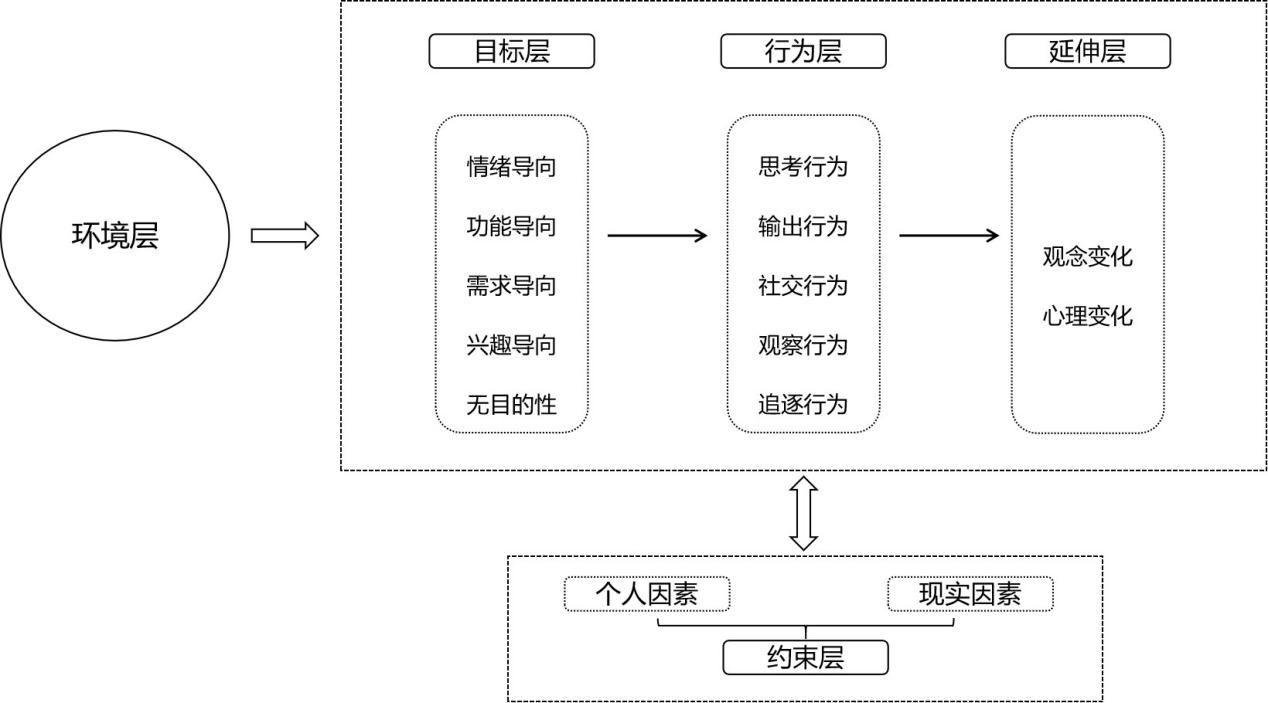
【目的/意义】 通过构建美术类本科生网络应用行为的模型,为艺术类高校了解和把握学生的网络应用行为提供依据,从而掌握学生网络动向,探索高校网络思政教育模式。 【方法/过程】 基于扎根理论,借助质性数据分析工具Nvivo12,对访谈文本进行开放式编码、主轴编码、选择性编码、理论饱和度检验等,构建出美术类本科生的网络应用行为模型。 【结果/结论】 该模型显示,在不同的网络和现实背景下,受到个人特质和现实因素的约束及影响,美术类本科生的网络应用行为呈现出相似的群体特征及差异化的行为目的和行为模式,模型共归纳提炼出表征层、环境层、目标层、行为层、延伸层和约束层等6个核心范畴和18个主范畴。结合所得的核心范畴,本研究进一步提出艺术类高校应从环境治理、目标引领、行为修正三个方面加强网络思政引领效能,为高校正确引导学生网络应用行为提供依据。
[Purpose/Significance] By constructing a model of online application behavior among fine arts undergraduates, this study aims to provide a basis for art universities to understand and grasp students' online behaviors, thereby monitoring their digital activities and exploring innovative online ideological and political education models in higher education. [Method/Process] Based on grounded theory and using the qualitative data analysis tool NVivo 12, interview texts were subjected to open coding, axial coding, selective coding, and theoretical saturation testing to develop a model of online application behavior for fine arts undergraduates. [Result/Conclusion] The model reveals that under different online and real-world contexts, influenced by personal traits and realistic constraints, fine arts undergraduates' online behaviors exhibit similar group characteristics while differing in behavioral purposes and patterns. The model summarizes six core categories (representation layer, environment layer, goal layer, behavior layer, extension layer, and constraint layer), as well as 18 main categories. Based on these core categories, the study further proposes that art universities should enhance the effectiveness of online ideological and political education by focusing on three aspects: environmental governance, goal guidance, and behavior correction, thereby providing a foundation for properly guiding students' online behaviors.
fine arts undergraduates / online application behavior / grounded theory / qualitative research
| [1] |
沈建红, 陈松源.网络话语体系构建与高校思想政治教育实效性[J]. 当代青年研究, 2009(6): 39-42.
|
| [2] |
李一.网络行为: 一个网络社会学概念的简要分析[J]. 兰州大学学报, 2006, (05): 48-53.
|
| [3] |
于珊.大学生网络行为分析及引导[M]. 北京: 中国商业出版社, 2020.
|
| [4] |
黄少华. 网络空间的社会行为: 青少年网络行为研究[M]. 北京: 人民出版社, 2008.
|
| [5] |
中国互联网络信息中心. 2014年中国青少年上网行为研究报告[EB/OL]. [2025-06-04].
China Internet Network Information Center. 2014 research report on internet usage behavior among Chinese youth [EB/OL]. [2025-06-04].
|
| [6] |
姚书志, 彭天祥.大学生网络行为对思想政治教育效果的影响——基于西安市27所高校的实证分析[J]. 中学政治教学参考, 2023(12): 32-36.
|
| [7] |
吕小亮.新冠疫情下“00后”大学生网络行为动因与引导策略[J]. 当代青年研究, 2020(4): 5-10.
|
| [8] |
宋元林.网络时代大学生思想政治教育导论[M]. 长沙: 湖南人民出版社, 2002: 60-69.
|
| [9] |
邓艳葵, 旷晓霞.全媒体环境下大学生网络行为失范分析与干预——以广西高校为例[J]. 思想理论教育导刊, 2016(9): 151-155.
|
| [10] |
严瀚钦, 陈思宇, 陈坚.大学生总体家庭功能与网络利他行为的交叉滞后分析[J]. 中国学校卫生, 2025, 46(4): 528-532.
|
| [11] |
金童林, 乌云特娜, 张璐, 等.网络社会排斥对大学生网络攻击行为的影响: 道德推脱的纵向调节作用[J]. 心理科学, 2024, 47(6): 1373-1380.
|
| [12] |
邝宏达, 李间, 谷正杰, 等.广西大学生网络心理求助行为现状及影响因素[J]. 中国学校卫生, 2023, 44(9): 1365-1369.
|
| [13] |
景鹏成.网络直播对大学生消费行为影响探析——评中国财政经济出版社《直播经济对大学生消费的影响研究》[J]. 价格理论与实践, 2023(5): 216.
|
| [14] |
梁斌, 李海, 秦宗静.异性拒绝与大学生网络色情偏差行为: 有调节的中介模型[J]. 四川师范大学学报(社会科学版), 2023, 50(2): 116-123.
|
| [15] |
李松岩, 梁胜.大学生网络依赖行为的综合影响机制[J]. 中国健康心理学杂志, 2023, 31(3): 405-413.
|
| [16] |
孙雨, 孟维杰.社会文化理论视域下大学生网络欺凌的难题与破解[J]. 苏州大学学报(教育科学版), 2022, 10(3): 89-95.
|
| [17] |
栗蕊蕊, 王淼.Z世代大学生网络社交: 行为特征与引导策略[J]. 思想理论教育, 2024(7): 107-111.
|
| [18] |
朱丹, 刘正之.网络时代辅导员思政工作方法及路径探索[J]. 思想战线, 2015, 41(S1): 66-67.
|
| [19] |
|
| [20] |
热孜亚·艾海提, 郑小川, 李珊珊, 等.社交媒体环境下用户截屏行为模型构建——基于扎根理论的探索[J]. 图书情报知识, 2025, 42(1): 101-112.
Reziya · Aihaiti,
|
| [21] |
杨华, 赵景阳.大学生网络社交圈层化的成因、隐忧与破解[J]. 学校党建与思想教育, 2024(18): 79-81.
|
| [22] |
梁钦.“00后”大学生网络行为失范现象及治理策略探析[J]. 思想理论教育导刊, 2023(1): 132-137.
|
/
| 〈 |
|
〉 |